Check patentability & draft patents in minutes with Patsnap Eureka AI!

Method and system for predictive modeling

A predictive model and predictive analysis technology, applied in character and pattern recognition, instruments, complex mathematical operations, etc., can solve problems such as not allowing user experiments, long response time, etc.

Inactive Publication Date: 2013-08-21
INT BUSINESS MASCH CORP
View PDF5 Cites 12 Cited by
  • Summary
  • Abstract
  • Description
  • Claims
  • Application Information

AI Technical Summary

Problems solved by technology

However, this scheme requires heavy computational effort and, in most cases, involves considerable response time, which renders the task non-interactive and does not allow the user to interactively experiment with information about the "true" distribution P( X ) with different assumptions
Also, this presents a security risk organizationally, since everyone who takes the model and adapts it to new applications will need to gain access to the actual source data

Method used

the structure of the environmentally friendly knitted fabric provided by the present invention; figure 2 Flow chart of the yarn wrapping machine for environmentally friendly knitted fabrics and storage devices; image 3 Is the parameter map of the yarn covering machine
View more

Image

Smart Image Click on the blue labels to locate them in the text.
Viewing Examples
Smart Image
  • Method and system for predictive modeling
  • Method and system for predictive modeling
  • Method and system for predictive modeling

Examples

Experimental program
Comparison scheme
Effect test

Embodiment Construction

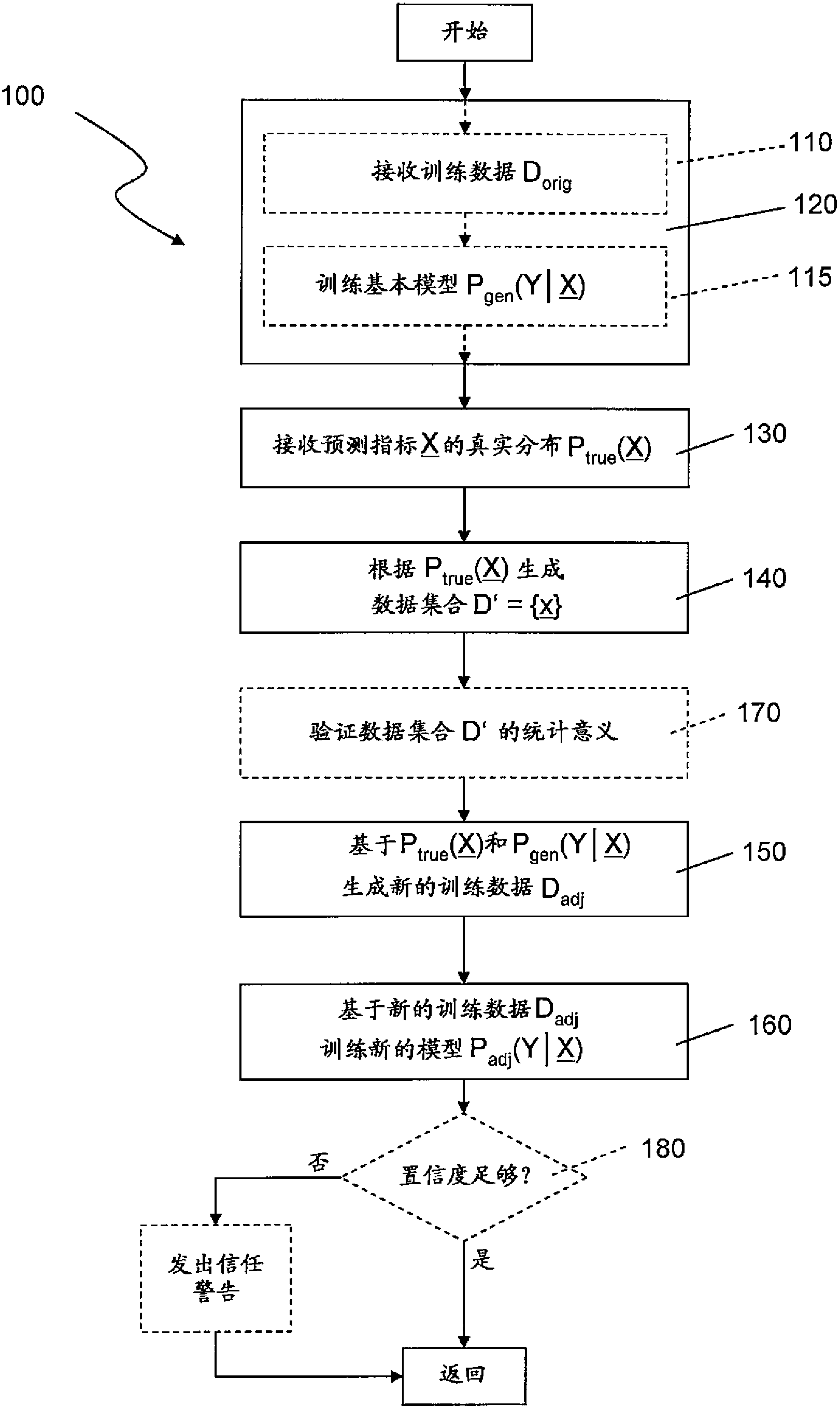
[0024] Figure 1a Depicts the probability distribution P(Y| X A schematic flow diagram of a method 100 for predicting a given feature X The probability of a specific outcome Y for a predefined set. here, X refers to a vector of variables (indicators) describing the influencer and a single variable Y (value) describing the prediction. Note that in the following, variables will be referred to by the term "feature" X , "predictor" and "indicator" are interchangeable; and the variable Y will be referred to by the terms "value", "label" or "prediction". All variables can be numeric or categorical. If the value variable Y is categorical, the method solves a classification problem, and if the value variable Y is numerical, the method solves a regression problem. Both cases can be handled in a similar manner.

[0025] The modeling process is based on the original set of training data D orig ;D orig Contains have the form ( x , a tuple of y), where x ∈ X (which is, x is an ...

the structure of the environmentally friendly knitted fabric provided by the present invention; figure 2 Flow chart of the yarn wrapping machine for environmentally friendly knitted fabrics and storage devices; image 3 Is the parameter map of the yarn covering machine
Login to View More

PUM

No PUM Login to View More

Abstract

A method (100) for carrying out a predictive analysis is provided which generates a predictive model (Padj (Y|X)) based on two separate pieces of information, namely - a set of original training data (Dorig), and - a "true" distribution of indicators (Ptrue(X)). The method (100) begins by generating a base model distribution (Pgen(Y|X)) from the original training data set (Dorig) containing tuples (x, y) of indicators (x) and corresponding labels (y) (step 120). Using the "true" distribution (Ptrue(X)) of indicators, a random data set (D') of indicator records (x) is generated reflecting this "true" distribution (Ptrue(X)) (step 140).; Subsequently, the base model (Pgen(Y|X)) is applied to said random data set (D'), thus assigning a label (y) or a distribution of labels to each indicator record (x) in said random data set (D') and generating an adjusted training set (Dadj) (step 150). Finally, an adjusted predictive model (Padj (Y|X)) is trained based on said adjusted training set (Dadj) (step 160).

Description

technical field [0001] The present invention generally relates to predictive modeling. In particular, the invention relates to adapting existing predictive models generated from a training data set to additional information such as a given probability distribution of features. Background technique [0002] Predictive modeling is the process by which a model is created or selected in an attempt to best predict the probability of an outcome. Typically, the model is chosen on a detection theory basis to try to guess the probability of an outcome given a set amount of input data (eg: given an email to determine how likely it is to be spam). Thus, it is assumed that the features (indicators) X A predefined set of , the goal of predictive modeling is to predict the probability P(Y| X ). This task can be thought of as for the "true" probability distribution P(Y| X ), however, this is not directly observable. Instead, one has to try to generate the best distribution, which sho...

Claims

the structure of the environmentally friendly knitted fabric provided by the present invention; figure 2 Flow chart of the yarn wrapping machine for environmentally friendly knitted fabrics and storage devices; image 3 Is the parameter map of the yarn covering machine
Login to View More

Application Information

Patent Timeline
no application Login to View More
Patent Type & Authority Applications(China)
IPC IPC(8): G06F17/18G06K9/62
CPCG06F17/18G06N7/01G06F18/2415G06F18/214
Inventor C·林根菲尔德M·武斯特P·彭佩
Owner INT BUSINESS MASCH CORP
Features
  • R&D
  • Intellectual Property
  • Life Sciences
  • Materials
  • Tech Scout
Why Patsnap Eureka
  • Unparalleled Data Quality
  • Higher Quality Content
  • 60% Fewer Hallucinations
Social media
Patsnap Eureka Blog
Learn More