
The application of the 3' untranslated region of brca2 in the preparation of tumor diagnostic, therapeutic and prognostic reagents
A technology of terminal untranslated regions and reagents, which is applied in the field of preparation of reagents for tumor diagnosis, treatment and prognosis, and can solve problems such as unclear related mechanisms and poor prognosis of cancer
- Summary
- Abstract
- Description
- Claims
- Application Information
AI Technical Summary
Problems solved by technology
Method used
Image


Examples
Embodiment 1
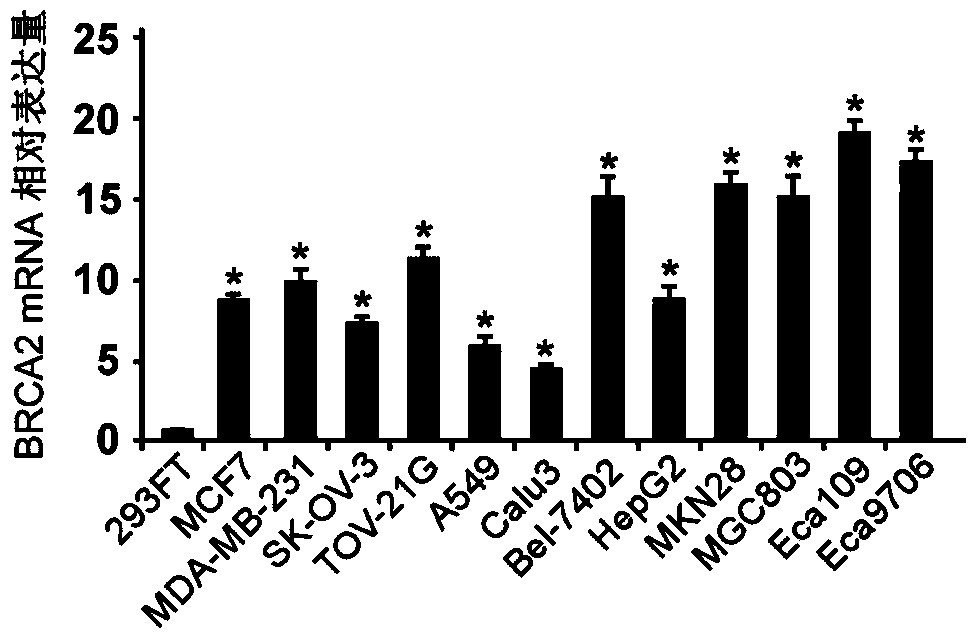
[0041] Example 1: BRCA2 is up-regulated in tumors
[0042] (1) TCGA database analysis
[0043] Methods: In order to investigate the expression of BRCA2 in tumors, biological analysis methods were applied to analyze the RNA expression data of 16 tumors in The CancerGenome Atlas (TCGA) public database, including female reproductive system cancers: Breast invasive carcinoma, BRCA), Endometrial Carcinoma (UCEC), Cervical squamous cell carcinoma and endocervical adenocarcinoma (CESC); Male reproductive system cancer: Prostateadenocarcinoma (PRAD); Respiratory system Cancer: Lung adenocarcinoma (LUAD), Lung squamous cell carcinoma (LUSC); Digestive system cancer: Esophagealcarcinoma (ESCA), Stomach adenocarcinoma (STAD), Hepatocellular carcinoma (Liverhepatocellular) carcinoma, LIHC), pancreatic cancer (Pancreatic adenocarcinoma, PAAD), colon adenocarcinoma (COAD); endocrine system cancer: Thyroid carcinoma (THCA); urinary tract system cancer: kidney renal clear cell carcinoma (Kidney r...
Embodiment 3
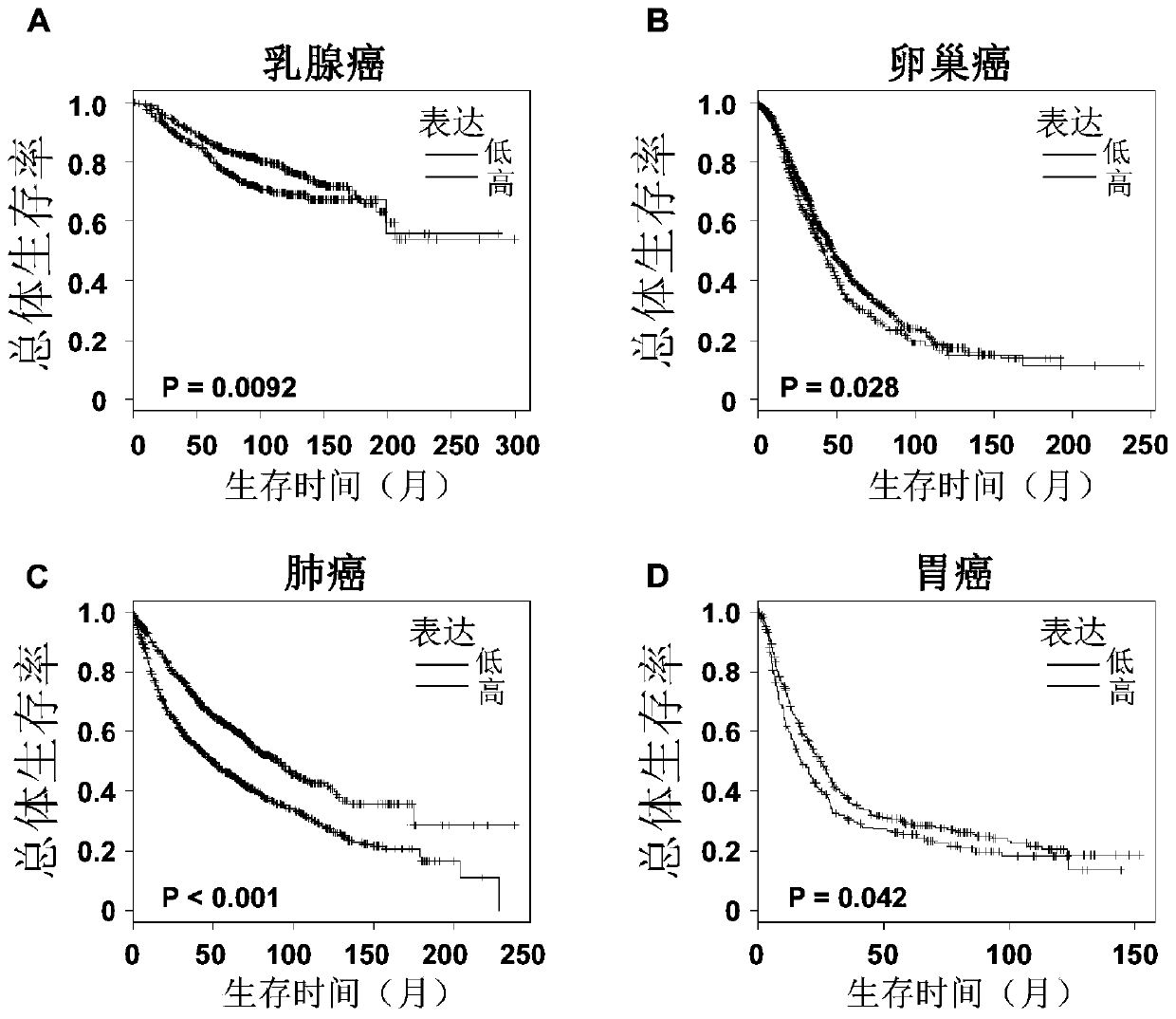
[0056] Example 3: BRCA2 RNA expression level is correlated with the overall survival prognosis of various cancer patients
[0057] BRCA2 is highly expressed at RNA levels in a variety of tumors, which may be related to the occurrence and development of cancer. Therefore, the present invention further explores the relationship between the level of BRCA2 expression and the overall survival of multiple cancer patients.
[0058] Methods: Kaplan-Meier plotter, an online tool for survival and prognosis, was used to analyze the relationship between BRCA2 mRNA expression in various cancer tissues (breast cancer, ovarian cancer, lung cancer and gastric cancer) and the overall survival prognosis of patients. Log-rank test is used to compare whether the results of different experimental groups are significantly different.
[0059] A total of 1115 cases of breast cancer patients were involved in the above. Kaplan-Meier plotter automatically selected the best points of the BRCA2 high and low expr...
Embodiment 4
[0065] Example 4: BRCA2-3’UTR interacts with microRNA
[0066] Methods: Use the online tool TargetScan to predict whether the 3'untranslated region of BRCA2 (hereinafter referred to as BRCA2-3' UTR) has a target site that binds to microRNA. Then it was verified by RNA binding protein immunoprecipitation (RIP) experiment. Construct the BRCA2-3'UTR overexpression plasmid pMSCV-BRCA2-3'UTR and transfect the breast cancer cell line MDA-MB-231 to obtain the cell line MDA-MB-231-BRCA2-3 stably overexpressing BRCA2-3'UTR 'UTR, the empty vector plasmid pMSCV-Vector was transfected into the cell line MDA-MB-231 to obtain MDA-MB-231-Vector cells as a control group. Collect about 5×10 separately 6 Two MDA-MB-231-BRCA2-3'UTR cells and MDA-MB-231-Vector cells were used in RIP experiments to detect the presence of microRNA in the Argonaute complex bound to BRCA2-3'UTR, and then use real-time fluorescent quantitative PCR To identify the captured microRNA, U6 is used as an internal reference f...
PUM
 Login to View More
 Abstract
Description
Claims
Application Information
 Login to View More