Application of schisandrin B and schisandrin C in the preparation of anti-hepatic fibrosis drugs
What is AI technical title?
AI technical title is built by Patsnap AI team. It summarizes the technical point description of the patent document.
A Schisandra C, anti-hepatic fibrosis technology, applied in the field of medicine, can solve the problem of no anti-hepatic fibrosis effect
Active Publication Date: 2017-09-12
SECOND MILITARY MEDICAL UNIV OF THE PEOPLES LIBERATION ARMY
View PDF2 Cites 0 Cited by
Summary
Abstract
Description
Claims
Application Information
AI Technical Summary
This helps you quickly interpret patents by identifying the three key elements:
Problems solved by technology
Method used
Benefits of technology
Problems solved by technology
Schisandra chinensis mainly contains polysaccharides, volatile oils and lignans of Schisandra chinensis, among which lignin components have hepatoprotective effect, but there is no relevant literature report on which chemical components play an anti-hepatic fibrosis effect
Method used
the structure of the environmentally friendly knitted fabric provided by the present invention; figure 2 Flow chart of the yarn wrapping machine for environmentally friendly knitted fabrics and storage devices; image 3 Is the parameter map of the yarn covering machine
View more
Image
Smart Image Click on the blue labels to locate them in the text.
Viewing Examples
Smart Image
Click on the blue label to locate the original text in one second.
Reading with bidirectional positioning of images and text.
Smart Image
Examples
Experimental program
Comparison scheme
Effect test
Embodiment 1
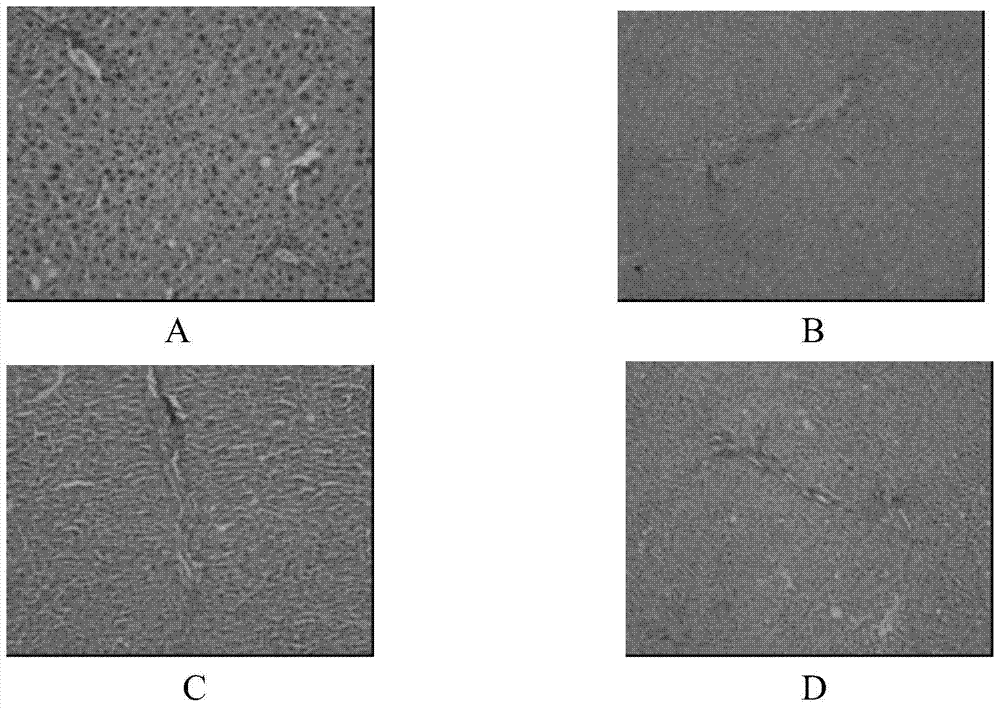
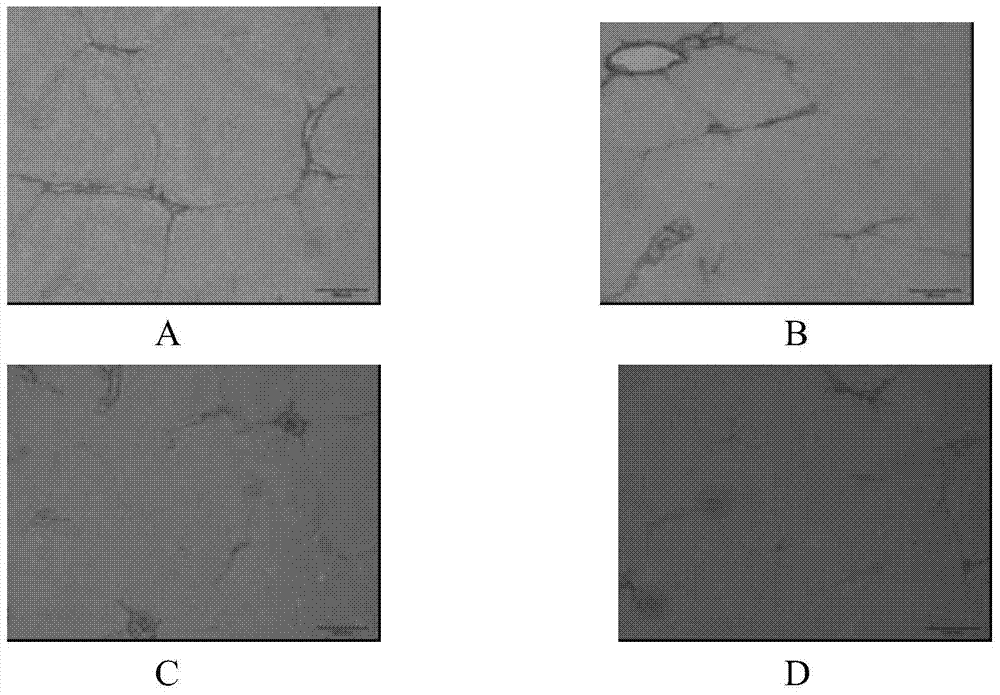
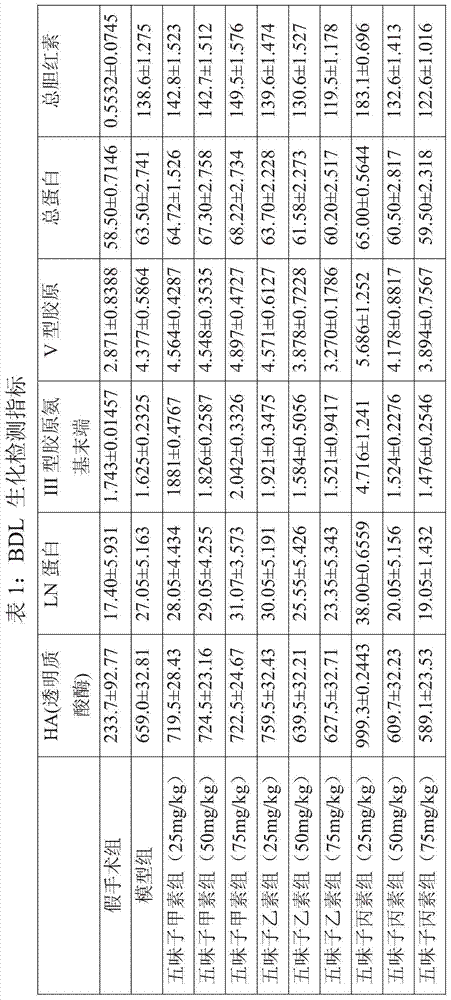
[0014] Example 1: Therapeutic effect of schisandrin A, schisandrin B and schisandrin C on liver fibrosis model rats with common bile duct ligation
[0015] Liver fibrosis experiment with common bile duct ligation (Xu Shuyun, Bian Rulian, Chen Xiu. Pharmacological Experimental Methodology, 3rd Edition [M]. Beijing: People's Medical Publishing House, 2002: 807). The specific method is as follows:
[0016] SD rats, male and female, 6-8 weeks old, weighing 200±10 g, were provided by the Experimental Animal Center of the Second Military Medical University of the Chinese People's Liberation Army.
[0018] Randomly grouped, 10 rats in each group: blank control group, model group, schisandrin A group (25mg / kg·d), schisandrin A group (50mg / kg·d), schisandrin A group (75mg / kg·d). d), Schisandra B group (25mg / kg·d), Schisandra B group (50mg / kg·d), Schisandra B group (75mg / kg·d), Schisa...
Embodiment 2
[0024] Embodiment 2: Schizandrin A, Schisandrin B, Schisandrin C on CCL 4 Rat Therapeutic Effects of an Induced Liver Fibrosis Model
[0025] CCL 4 Induced liver fibrosis model experiments (Xu Shuyun, Bian Rulian, Chen Xiu. Pharmacological Experimental Methodology, 3rd Edition [M]. Beijing: People's Medical Publishing House, 2002: 807). The specific method is as follows:
[0026] SD rats, male and female, 6-8 weeks old, weighing 200±10 g, were provided by the Experimental Animal Center of the Second Military Medical University of the Chinese People's Liberation Army.
[0028] Randomly grouped, 10 rats in each group: blank control group, model group, schisandrin A group (25mg / kg·d), schisandrin A group (50mg / kg·d), schisandrin A group (75mg / kg·d). d), Schisandra B group (25mg / kg·d), Schisandra B group (50mg / kg·d), Schisandra B group (75mg / kg·d), Schisandra C group (25mg / kg·...
the structure of the environmentally friendly knitted fabric provided by the present invention; figure 2 Flow chart of the yarn wrapping machine for environmentally friendly knitted fabrics and storage devices; image 3 Is the parameter map of the yarn covering machine
Login to View More
PUM
Login to View More
Abstract
The invention relates to the technical field of medicine. The main characteristic components of Schisandra chinensis are lignans, which include schisandrin A, schisandrin B, schisandrin C, etc. Modern pharmacological experiments show that lignans have liver protection and anti-oxidation properties. Various pharmacological activities. The invention provides new medical applications of schisandrin B and schisandrin C components, specifically the application in the preparation of anti-hepatic fibrosis drugs. The pharmacodynamic studies of the present invention show that Schizandrin B and Schisandra C can significantly reduce the concentrations of ALT and AST in the serum of liver fibrosis model rats induced by common bile duct ligation and CCL4, improve the symptoms of liver fibrosis, and have good anti-inflammatory effects. Liver fibrosis activity, so it can be used to prepare anti-hepatic fibrosis medicine or health food.
Description
Technical field: [0001] The invention relates to the technical field of medicine, in particular to the application of schisandrin B and schisandra C in the preparation of anti-hepatic fibrosis medicine or health food. Background technique: [0002] Liver cirrhosis is one of the common diseases that seriously endanger human health, and the incidence rate in my country is still at a relatively high level. The pathological basis of liver cirrhosis is liver fibrosis, which is caused by various liver damage factors (such as viral hepatitis, alcoholic liver disease, certain metabolic diseases, drug and chemical poison damage, and liver parasitic diseases, etc.). Damage and inflammation, leading to the necessary pathological process of chronic liver disease developing into liver cirrhosis. Liver fibrosis is a common pathological feature of most chronic liver diseases, and it is also an important intermediate link in the further development and deterioration of chronic hepatitis an...
Claims
the structure of the environmentally friendly knitted fabric provided by the present invention; figure 2 Flow chart of the yarn wrapping machine for environmentally friendly knitted fabrics and storage devices; image 3 Is the parameter map of the yarn covering machine
Login to View More
Application Information
Patent Timeline
Application Date:The date an application was filed.
Publication Date:The date a patent or application was officially published.
First Publication Date:The earliest publication date of a patent with the same application number.
Issue Date:Publication date of the patent grant document.
PCT Entry Date:The Entry date of PCT National Phase.
Estimated Expiry Date:The statutory expiry date of a patent right according to the Patent Law, and it is the longest term of protection that the patent right can achieve without the termination of the patent right due to other reasons(Term extension factor has been taken into account ).
Invalid Date:Actual expiry date is based on effective date or publication date of legal transaction data of invalid patent.
Login to View More
Patent Type & AuthorityPatents(China)
IPC IPC(8): A61K31/36A61K31/09A61P1/16
Inventor张海张国庆柴逸峰
OwnerSECOND MILITARY MEDICAL UNIV OF THE PEOPLES LIBERATION ARMY


 Login to View More
  Login to View More