
Method for preparing epiandrosterone
An epiandrosterone and ketal technology, applied in the directions of steroids, organic chemistry, etc., can solve the problems of high cost of epiandrosterone raw materials, great potential safety hazard, great environmental damage, etc., and achieves low price, few by-products, and high cost. low cost effect
- Summary
- Abstract
- Description
- Claims
- Application Information
AI Technical Summary
Problems solved by technology
Method used
Image

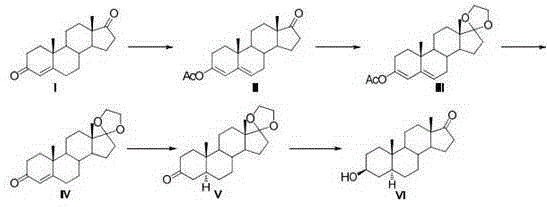
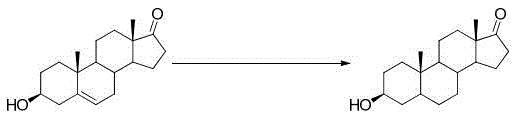
Examples
Embodiment 1
[0051] In the first step, add 4-androstenedione (I) (10g, 0.035mol) and catalyst p-toluenesulfonic acid (2g, 0.01mol) into a 100ml three-necked flask, then add 50ml of acetic anhydride, 2 Under protection, stir the reaction at 25°C for 1h, stop the reaction when there is no raw material detected by thin layer chromatography (TLC), pour into 300ml of ice water to precipitate, stir for 1h, filter with suction, dry at 40°C to obtain the crude esterified product (II) (11.40 g, 0.035 mol). The weight yield is 114%, and the HPLC (High Performance Liquid Chromatography, high performance liquid chromatography) content is 98%;
[0052] In the second step, dissolve the esterified crude product (II) (11.40g, 0.035mol) in a 250ml three-necked flask with 35ml of dichloromethane, then add 23ml of ethylene glycol and 23ml of triethyl orthoformate, and 2 Under protection, 0.3 ml of boron trifluoride diethyl ether was added, and the reaction was carried out at 25° C. for 4 h. Stop the reacti...
Embodiment 2
[0058] In the first step, add 4-androstenedione (I) (10g, 0.035mol) and catalyst pyridine hydrochloride (2g, 0.02mol) into a 100ml three-necked flask, then add 50ml of acetic anhydride, 2 Under protection, stir the reaction at 25°C for 1h, stop the reaction when there is no raw material detected by TLC, pour into 300ml of ice water to precipitate, stir for 1h, filter with suction, and dry at 40°C to obtain the crude esterified product (II) (11.0g, 0.034mol), weight yield 110%, HPLC content 96%;
[0059] Subsequent steps are the same as in Example 1.
Embodiment 3
[0061] In the first step, add 4-androstenedione (I) (10g, 0.035mol), catalyst boron trifluoride ethyl ether (1ml) into a 100ml three-necked flask, and then add 50ml of acetic anhydride. 2 Under protection, stirred and reacted at 25°C for 1h, stopped the reaction when no raw materials were detected by TLC, poured into 300ml of ice water to precipitate, stirred for 1h, filtered with suction, and dried at 40°C to obtain the crude esterified product (II) (11.2g, 0.034mol), weight yield 112%, HPLC content 97%;
[0062] Subsequent steps are the same as in Example 1.
PUM
 Login to View More
 Abstract
Description
Claims
Application Information
 Login to View More