A kind of copper network with superamphiphobic property and its preparation method and application

A super-amphiphobic, copper mesh technology, applied in separation methods, chemical instruments and methods, immiscible liquid separation, etc., can solve the problems of hindering the upper layer water from passing through the filter screen, unable to filter heavy oil, etc., to achieve easy promotion, oil-water separation Good effect, flexible and convenient preparation method

CN108159735BActive Publication Date: 2020-01-21浙江净昕新材料科技有限公司
5 Cites 0 Cited by

Patent Information

Authority / Receiving Office
CN · China
Patent Type
Patents(China)
Current Assignee / Owner
Publication Date
2020-01-21

Smart Images

  • Figure 1
    Figure 1
  • Figure 2
    Figure 2
  • Figure 3
    Figure 3
Patent Text Reader

Abstract

The invention discloses a copper net with a super double-hydrophobic property, and a preparation method and a use thereof. A microporous array is processed on the surface of a copper sheet through a laser direct writing technique, a copper net is prepared from the copper sheet, then the copper net is subjected to surface micro processing by laser, a micro-nano double structure is processed, and the super double-hydrophobic copper net is obtained; the copper net has the under-oil super hydrophobic property and under-water super hydrophobic property, and can be used for filtering light oil and heavy oil at the same time. The copper net can be used for oil and water separation, has the advantages of wide sources of raw materials, low price, simple and reliable preparation process, high oil and water separation rate, simultaneous separation of light oil and heavy oil, good stability and the like.
Need to check novelty before this filing date? Find Prior Art

Description

technical field

[0001] The invention belongs to the field of functional materials, and in particular relates to a superamphiphobic copper mesh, a preparation method and application thereof. Background technique

[0002] Oil-water separation has attracted widespread attention, not only for scientific research, but also for environmental, social, and economic issues. On the one hand, frequent oil spills can cause serious environmental pollution and huge energy losses. On the other hand, the oily wastewater caused by petrochemical, textile, metallurgy, food, leather and other industries is increasing and has become the most common pollutant in the world. In response to these enormous challenges, researchers are committed to developing efficient and inexpensive oil-water separation methods. Various methods have been widely used, such as centrifugal separation, gravity separation, skimming, air flotation and biological treatment. Although these methods can separate most of the...

Examples

Embodiment

[0036] 1) Select a copper sheet with a purity of 99.99%, a diameter of 26 mm, and a thickness of 1 mm, and ultrasonically clean the copper sheet in absolute ethanol for 10 minutes;

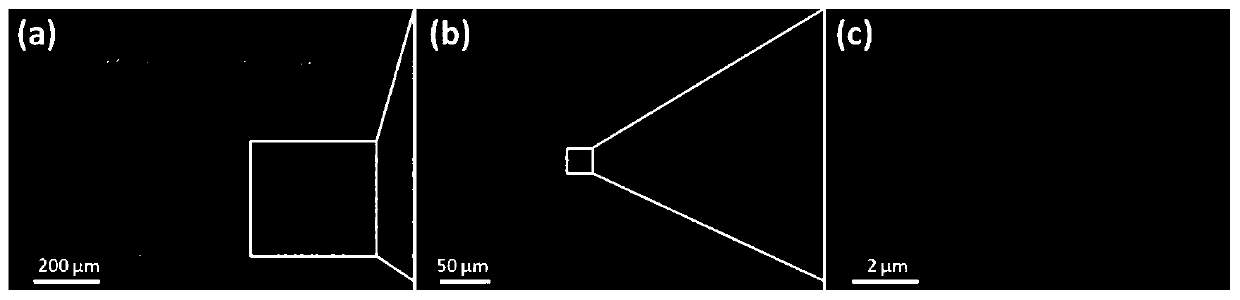
[0037] 2) Process a microhole array on the surface of the copper sheet with a laser to prepare a copper mesh; the laser is a fiber optic pulse laser with a wavelength of 1064nm and a pulse duration of 100ns, the focal length is set to 329mm, and the spot diameter irradiated on the surface of the copper sheet is 50 μm ; Copper sheets need to be fixed with scotch tape during laser processing to prevent displacement during laser processing; figure 2 As shown, the smaller square holes on the copper grid are the processed micropores, and the side length of the micropores can be 60-120 μm, with an average of about 100 μm;

[0038] 3) After the microhole array is processed, it is best to micro-process the surface of the copper mesh obtained by laser scanning immediately. The number of scans is 5 to 15 t...