

Crowd evacuation macroscopic model-based T junction evacuation simulation method
A macro-model, T-junction technology, applied in design optimization/simulation, electrical digital data processing, data processing applications, etc., can solve problems such as no two-way pedestrian flow dynamics superposition mechanism, no known T-junction crowd convergence modeling method, etc. , to achieve the effect of improving simulation effectiveness, reasonable pedestrian density distribution, and comprehensive consideration of factors.
- Summary
- Abstract
- Description
- Claims
- Application Information
AI Technical Summary
Problems solved by technology
Method used
Image

Examples
Embodiment Construction
[0047] The present invention will be described in detail below in conjunction with the accompanying drawings and specific embodiments. This embodiment is carried out on the premise of the technical solution of the present invention, and detailed implementation and specific operation process are given, but the protection scope of the present invention is not limited to the following embodiments.
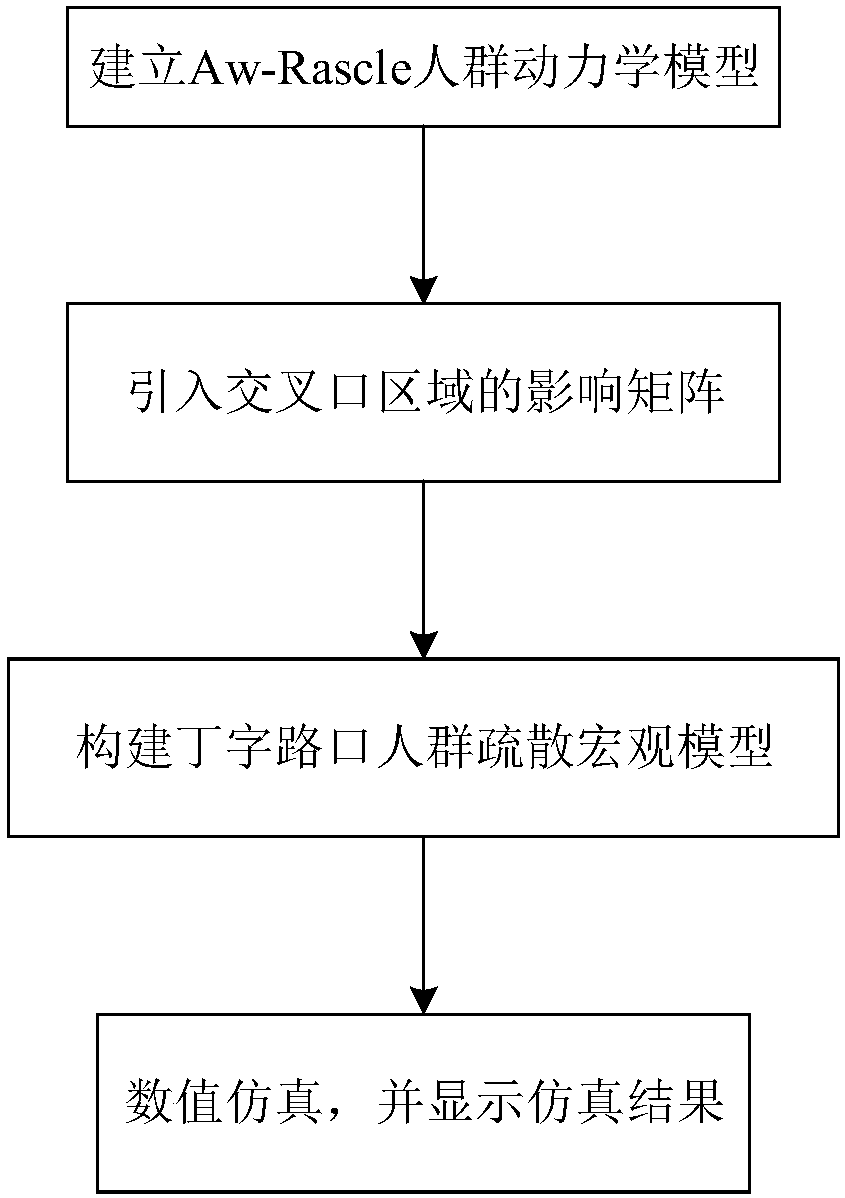
[0048] Such as figure 1 As shown, the present invention provides a kind of T-junction evacuation simulation method based on crowd evacuation macro model, comprising: establishing Aw-Rascle crowd dynamics model; On the basis of described Aw-Rascle crowd dynamics model, introducing the influence of intersection area matrix to construct a macroscopic model of crowd evacuation at a T-shaped intersection; perform numerical simulation based on the macroscopic model of crowd evacuation at a T-shaped intersection, and display the simulation results.
[0049] 1. Establishment of Aw-Rascle cro...
PUM
 Login to View More
 Abstract
Description
Claims
Application Information
 Login to View More