
Node similarity relation detection method based on combined meta-path in heterogeneous information network
A similar relationship and detection method technology, applied in the field of social networks, can solve problems such as difficulty in applying complex network analysis, limited time overhead, etc., and achieve the effect of avoiding bad interference and complete semantics
Patent Information
- Authority / Receiving Office
- CN · China
- Patent Type
- Applications(China)
- Current Assignee / Owner
- Publication Date
- 2018-07-20
Smart Images
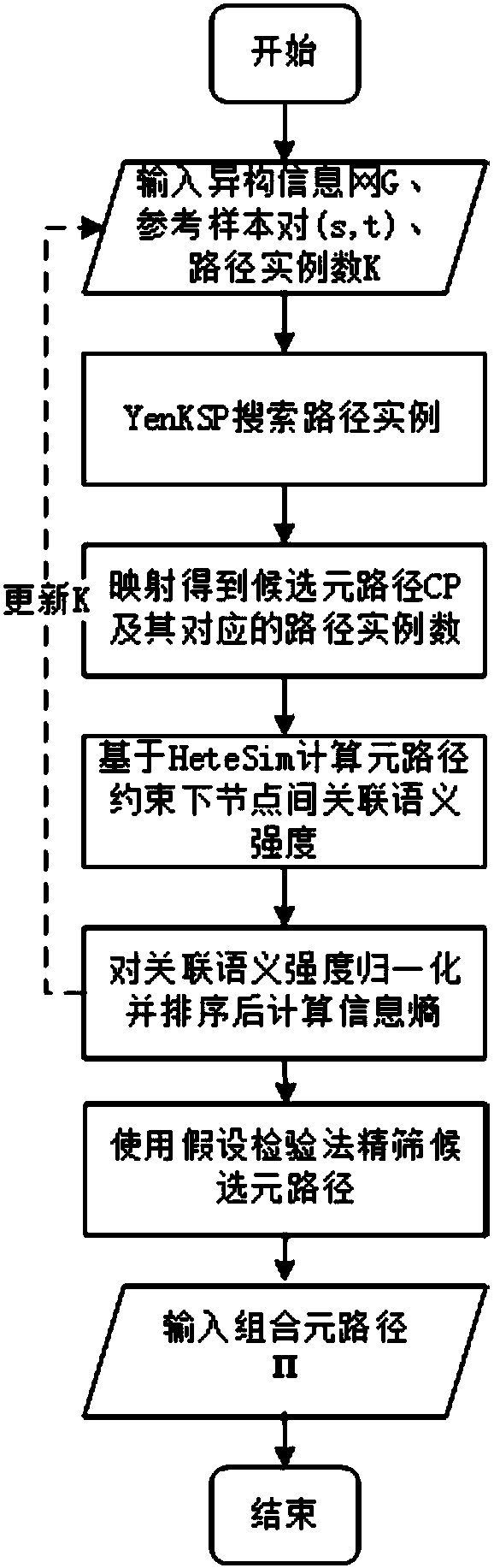
Figure 1 
Figure 2 
Figure 3
Abstract
Description
technical field
[0001] The present invention relates to the technical field of social networks, in particular to a method for detecting node similarity relationships based on combined meta-paths in heterogeneous information networks, which can be used to discover node pairs carrying similar association relationships in social networks. Background technique
[0002] The analysis of the relationship between entities in social networks plays an important role. Different entities in a social network are connected to each other with specific associations to form a complex heterogeneous network. Analyzing its association characteristics will help us find entities with specific associations. At the same time, this technology can also be used in recommendation systems based on heterogeneous information networks. . In order to make the social network a more reliable information dissemination platform, when an emergency occurs, we can quickly discover the cause of the emergency and o...
Examples
Embodiment
[0056] In order to more clearly illustrate the technical scheme in the present invention, enumerate the following specific examples to further illustrate:
[0057] The node similarity detection method based on the combined meta-path in the heterogeneous information network provided by the present invention comprises the following steps:
[0058] Step S1: Input the heterogeneous information network G, the reference sample pair (s, t) and the number of path instances K used in path rough screening;
[0059] Step S2: use the classic YenKSP algorithm to search for K shortest path instances of connections (s, t); use the classic YenKSP algorithm to search for K shortest path instances;
[0060] The step S2 is specifically:
[0061] Step S21: use the classic top-K shortest path algorithm YenKSP to search for path instances connecting the source-target nodes within the reference sample pair (s, t);
[0062] Step S22: Select the first K path instances P 1 .
[0063] Step S3: Map t...