Unlock instant, AI-driven research and patent intelligence for your innovation.
RCS-controllable corner reflector and design method
What is Al technical title?
Al technical title is built by PatSnap Al team. It summarizes the technical point description of the patent document.
A corner reflector and square technology, applied in the field of radar, can solve the problems of large RCS and fixed RCS
Inactive Publication Date: 2019-03-08
BEIJING INST OF ENVIRONMENTAL FEATURES
View PDF5 Cites 1 Cited by
Summary
Abstract
Description
Claims
Application Information
AI Technical Summary
This helps you quickly interpret patents by identifying the three key elements:
Problems solved by technology
Method used
Benefits of technology
Problems solved by technology
[0006] The technical problem to be solved by the present invention is to solve the problem that the traditional corner reflector has a relatively large RCS and a fixed RCS
Method used
the structure of the environmentally friendly knitted fabric provided by the present invention; figure 2 Flow chart of the yarn wrapping machine for environmentally friendly knitted fabrics and storage devices; image 3 Is the parameter map of the yarn covering machine
View more
Image
Smart Image Click on the blue labels to locate them in the text.
Viewing Examples
Smart Image
Click on the blue label to locate the original text in one second.
Reading with bidirectional positioning of images and text.
Smart Image
Examples
Experimental program
Comparison scheme
Effect test
Embodiment 1
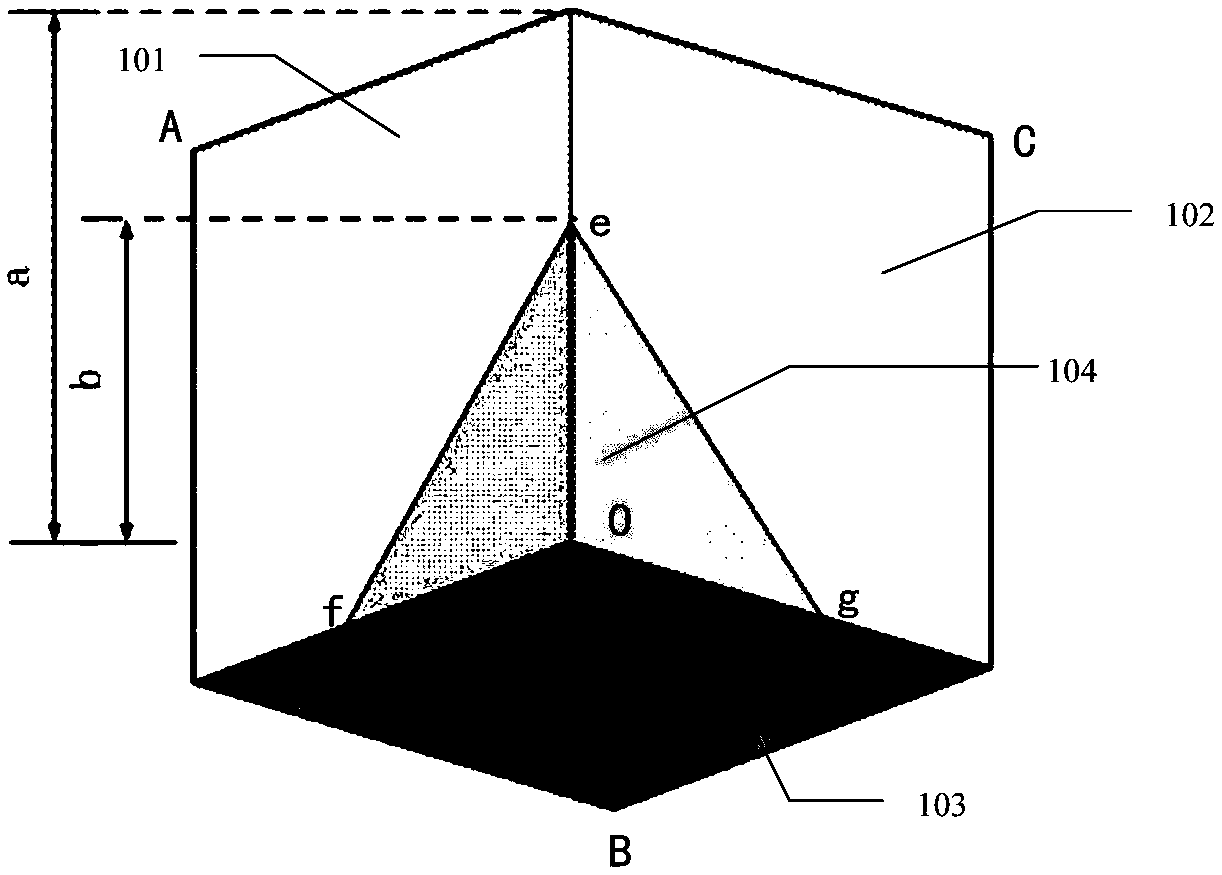
[0031] Such as figure 1 As shown, the corner reflector provided by the embodiment of the present invention includes: three square metal plates 101 , 102 , 103 and one baffle 104 . Wherein, the three square metal plates 101, 102, 103 are vertically connected in pairs, and there is a shared vertex in the three square metal plates 101, 102, 103 (such as figure 1 Vertex O) in and three shared connecting edges.
[0032] A baffle 104 is attached to each of the three square metal plates 101 , 102 , 103 . In specific implementation, the baffle may be a metal baffle.
[0033] In an optional embodiment, the baffle 104 may be a triangular baffle, and the three vertices of the triangular baffle (such as figure 1 The illustrated vertices e, f, g) each lie on the three common connecting edges.
[0034] Further, the triangular baffle may be an equilateral triangular baffle, and the distance b from the apex of the equilateral triangular baffle to the common vertex satisfies 0
Embodiment 2
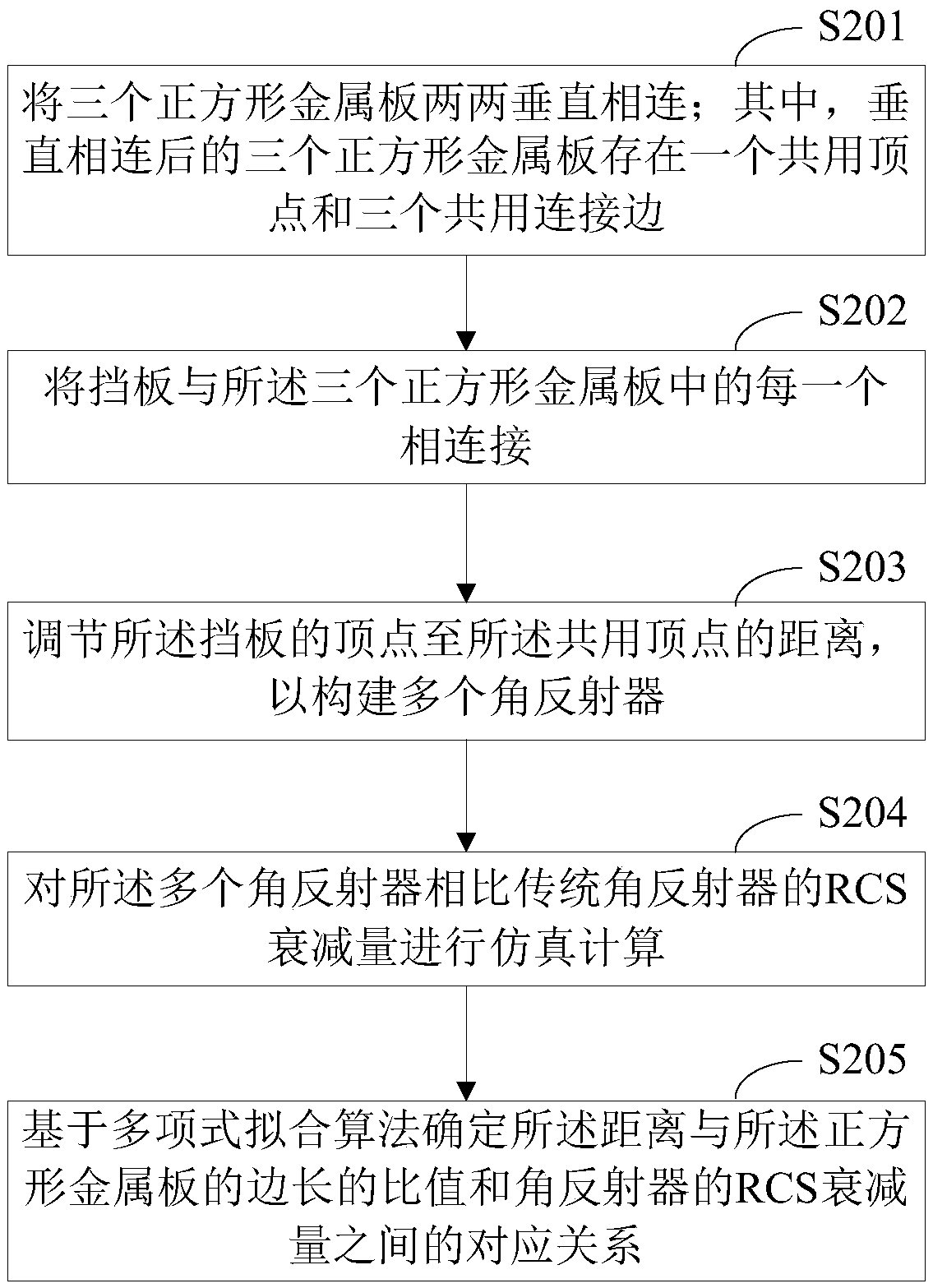
[0038] Such as figure 2 As shown, the corner reflector design method of the embodiment of the present invention includes the following steps:
[0039] Step S201 , vertically connect three square metal plates two by two; wherein, the three vertically connected square metal plates have a common vertex and three common connection edges.
[0040] Step S202, connecting the baffle with each of the three square metal plates.
[0041] In an optional implementation manner, the baffle is a triangular baffle, and three vertices of the triangular baffle are respectively located on the three common connecting sides. Further, the triangular baffle may be an equilateral triangular baffle, and the distance b from the apex of the equilateral triangular baffle to the common vertex satisfies 0
[0042] Step S203 , adjusting the distance b from the apex of the baffle to the common apex, so as to construct multiple corner reflect...
the structure of the environmentally friendly knitted fabric provided by the present invention; figure 2 Flow chart of the yarn wrapping machine for environmentally friendly knitted fabrics and storage devices; image 3 Is the parameter map of the yarn covering machine
Login to View More
PUM
Login to View More
Abstract
The invention discloses an RCS-controllable corner reflector and a design method, and relates to the technical field of radar. The corner reflector comprises three square metal plates and a baffle. The three square metal plates are perpendicularly connected in pairs, and the three square metal plates have a common vertex and three common connecting edges. The baffle is connected with each of the three square metal plates. According to the corner reflector, the baffle is additionally mounted on the basis of a square three-side corner reflector, so that compared with a traditional corner reflector of the same size, the RCS of the novel corner reflector is weakened, the order of the RCS can be reduced, and the need of generating low-order RCSs in practical engineering is met. By changing thesize of the baffle, the aim of being capable of controlling the RCS can be met, and therefore the need of generating different RCS order indexes in practical engineering can be met.
Description
technical field [0001] The invention relates to the technical field of radar, in particular to an RCS controllable corner reflector and a design method. Background technique [0002] The square trihedral reflector is a common analog unit in target design. Due to the stable structure of the square trihedral corner reflector, it can cause strong echo scattering in a wide range of angles, so it can be used as a radar echo enhancement device. [0003] In the process of realizing the present invention, the inventors of the present invention have found that: first, the RCS (radar cross-section) produced by the traditional square trihedral corner reflector is relatively large, which cannot meet the needs of generating lower-order RCS in actual engineering ; Second, the magnitude of RCS generated by the traditional square trihedral reflector is fixed, which cannot meet the needs of different RCS magnitude indicators in actual engineering. [0004] Therefore, to address the above d...
Claims
the structure of the environmentally friendly knitted fabric provided by the present invention; figure 2 Flow chart of the yarn wrapping machine for environmentally friendly knitted fabrics and storage devices; image 3 Is the parameter map of the yarn covering machine
Login to View More
Application Information
Patent Timeline
Application Date:The date an application was filed.
Publication Date:The date a patent or application was officially published.
First Publication Date:The earliest publication date of a patent with the same application number.
Issue Date:Publication date of the patent grant document.
PCT Entry Date:The Entry date of PCT National Phase.
Estimated Expiry Date:The statutory expiry date of a patent right according to the Patent Law, and it is the longest term of protection that the patent right can achieve without the termination of the patent right due to other reasons(Term extension factor has been taken into account ).
Invalid Date:Actual expiry date is based on effective date or publication date of legal transaction data of invalid patent.

 Login to View More
  Login to View More


