
Adaptive tracking of correlated filtered video based on artificially combined depth features
An adaptive tracking and deep feature technology, applied in the field of computer vision, can solve the problems of increasing the computational burden and poor real-time performance, and achieve the effect of enhancing the representation ability, improving the stability, and increasing the background information.
Patent Information
- Authority / Receiving Office
- CN · China
- Current Assignee / Owner
- Publication Date
- 2019-03-12
- Estimated Expiration
- Not applicable · inactive patent
Smart Images
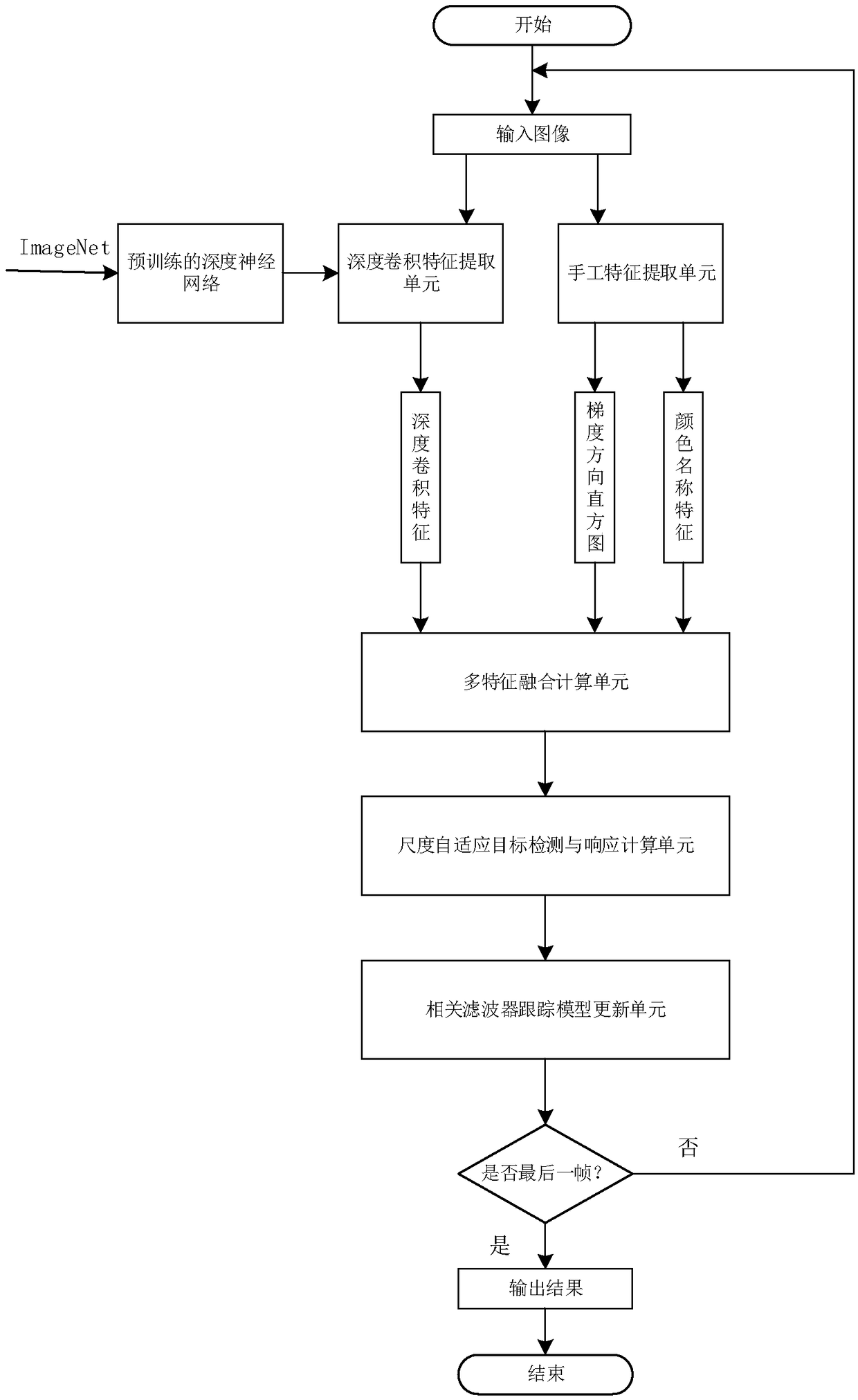
Figure 1 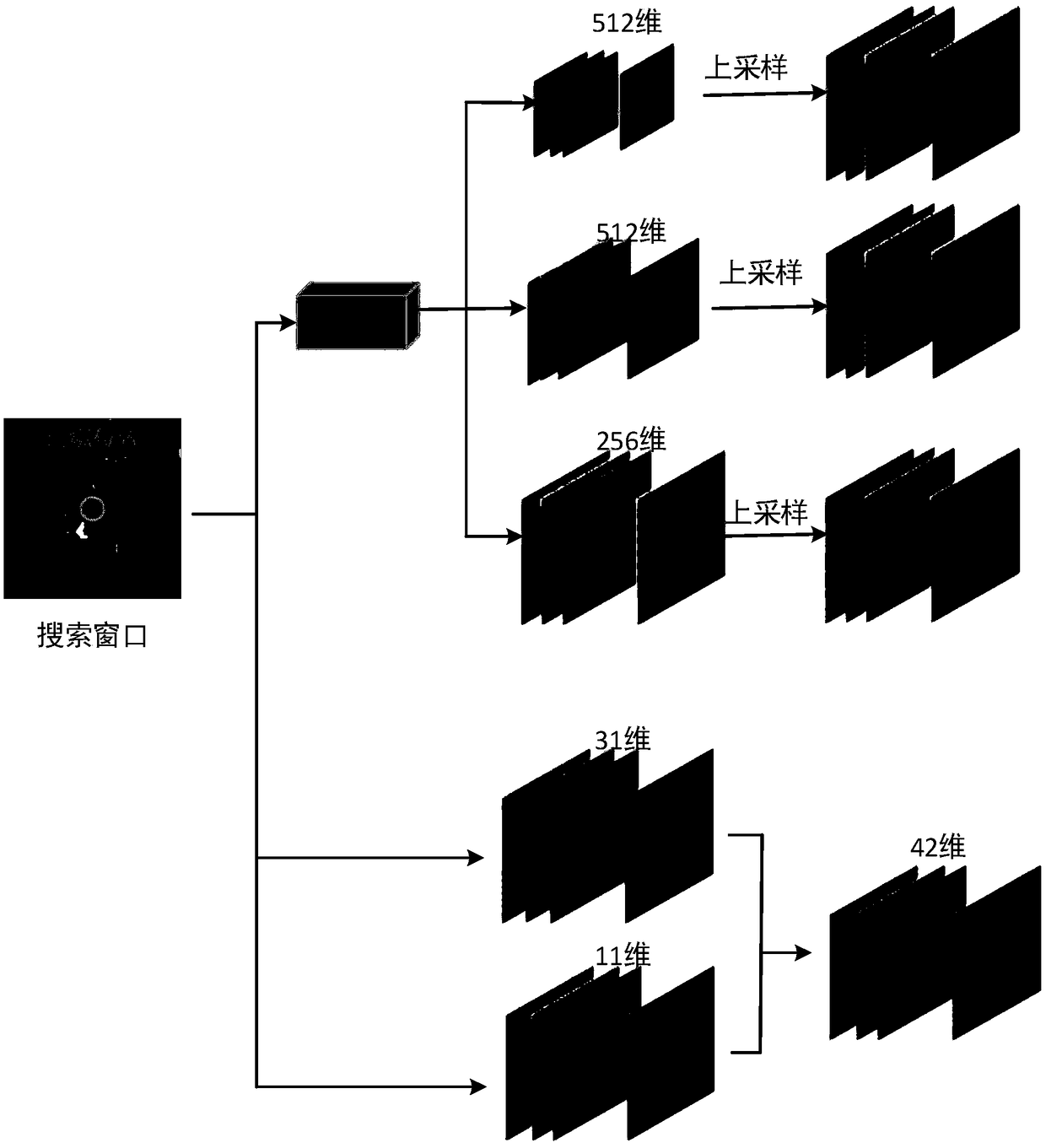
Figure 2 
Figure 3
Abstract
Description
technical field
[0001] The invention relates to the field of computer vision, in particular to a correlation filtering video adaptive tracking method combining artificial and depth features. Background technique
[0002] Target tracking is an important research content in the field of computer vision. Target tracking is mainly based on the position of the target in the first frame or the first few frames in the video to estimate the position trajectory of the target in the subsequent sequence. At present, the methods in the field of target tracking technology are mainly divided into two categories:
[0003] (1) Generative method: This method mainly uses the generative model to describe the appearance characteristics of the target, and finds the region most similar to the target appearance in the subsequent sequence, that is, minimizes the reconstruction error by searching for candidate targets. More representative algorithms include sparse coding, Kalman filter, particle fi...
Examples
Embodiment
[0068] Such as figure 1 As shown, a correlation filtering video adaptive tracking method combining artificial and depth features, including the following steps:
[0069] Step 1: Deep Neural Network Pre-training
[0070] Pre-training of deep neural networks on ImageNet, a large-scale dataset with class labels.
[0071] Step 2: Deep Convolutional Feature Extraction
[0072] (1) At the t-th frame of the image, according to the target position and scale, take the position as the center of the candidate area, and the scale as the size of the candidate area, crop the image to obtain the target candidate block z t ;
[0073] (2) The candidate block z t Input to the pre-trained deep neural network in step 1 for forward calculation, and extract the convolutional features of the Conv3 layer, Conv4 layer and Conv5 layer respectively.
[0074] Step 3: Manual Feature Extraction
[0075] (1) At the t-th frame of the image, according to the target position and scale, take the position ...