

A high-speed bit synchronization method and device for quantum key distribution system
A quantum key distribution and bit synchronization technology, applied in the field of quantum communication, can solve the problems of long bit synchronization time, reduce the effective working time of the quantum key distribution system, etc., and achieve the effect of improving processing capacity
- Summary
- Abstract
- Description
- Claims
- Application Information
AI Technical Summary
Problems solved by technology
Method used
Image

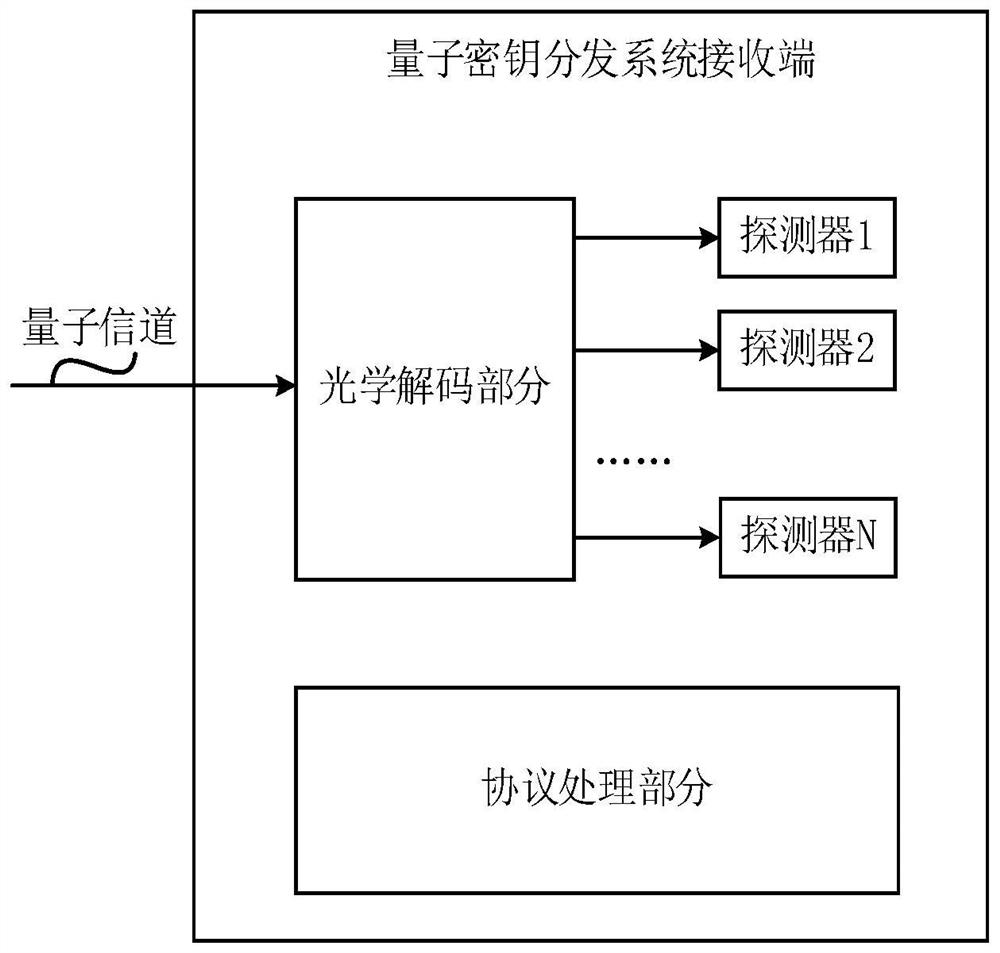


Examples
Embodiment 1
[0078] In step 101, the transmitting end of the quantum key distribution system sets the intensity of the transmitted light according to the channel attenuation value of the quantum channel. The purpose of setting is to increase the light intensity value of the sending light, thereby reducing the detection count accumulation time during the bit synchronization process of the receiving end. Setting the light intensity value of the sent light needs to meet the following two constraints:
[0079] 1) It will not damage the detector at the receiving end, that is, after adjusting the light intensity at the transmitting end, the light intensity at the entrance of the detector at the receiving end of the quantum key distribution system must not exceed the maximum input optical intensity allowed by the detector (Maximum input optical intensity);
[0080] 2) It will not cause detector count saturation, that is, after adjusting the light intensity at the transmitting end, the detection c...
Embodiment 2
[0163] Step 201 is the same as step 101
[0164] Step 202 is the same as step 102
[0165] Step 203 is the same as step 103
[0166] In step 204, the receiving end of the quantum key distribution system completes the scanning process by time intervals, and the bit synchronization processing unit obtains the optimal delay value for detection by each detector according to the scanning results.
[0167] Each detector cooperates to complete the scan within the joint delay search range. The joint delay search range is confirmed according to the delay efficiency relationship of the detectors and the period size of the pulse signal light sent by the quantum key distribution system transmitter through the quantum channel: Take two points on both sides of the peak value of the detector delay efficiency curve, and the difference between the delay values corresponding to these two points is equal to the period of the pulse signal light sent by the transmitter of the quantum key distri...
Embodiment 3
[0235] The main process is the same as [Example 1], except that there is no coarse-grained and time-segmented scanning process, but one or more rounds of fine-grained and time-separated scans are directly performed on the joint delay search range until the desired optimal delay is found value.
[0236] Step 301 is the same as step 101.
[0237] Step 302 is the same as step 102.
[0238] Step 303 is the same as step 103.
[0239] Step 304 , performing one or more rounds of fine-grained time-segmented scans on the joint delay search range until the desired optimal delay value is found. The receiving end of the quantum key distribution system regards the joint delay search range as a fine-grained delay search range, selects several delay values within this range, and the delay value between any two adjacent delay values in these delay values The difference is the selected Par in Example 1 F , that is, the fine-grained delay step is Par F . The bit synchronization proces...
PUM
 Login to View More
 Abstract
Description
Claims
Application Information
 Login to View More