
Method and device for removing motion blur of image
A motion blurring and deblurring technology, applied in image enhancement, image analysis, image data processing, etc., can solve problems such as single estimation, ringing effect, and spatially non-uniform motion blur
- Summary
- Abstract
- Description
- Claims
- Application Information
AI Technical Summary
Problems solved by technology
Method used
Image

Examples
Embodiment 1
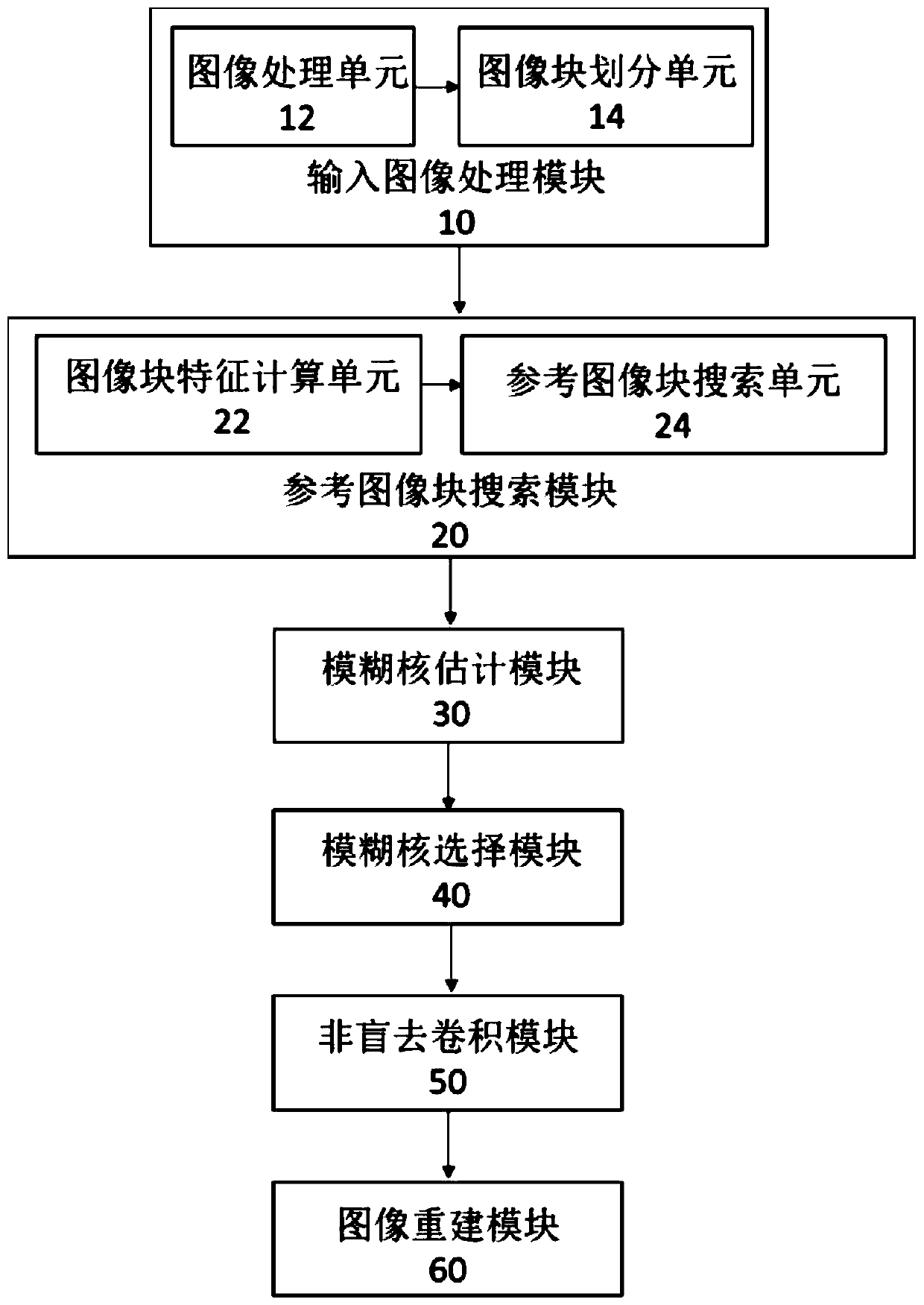
[0049] Embodiment 1, a device for removing motion blur from an image, the structural block diagram is as follows figure 2 As described above, it includes an input image processing module 10 , a reference image block search module 20 , a blur kernel estimation module 30 , a blur kernel selection module 40 , a non-blind deconvolution module 50 , and an image reconstruction module 60 .
[0050] The input image processing module 10 is used to process the original motion blurred image and obtain a series of overlapping image blocks {P i}; Specifically, the input image processing module 10 includes an image processing unit 12 and an image block division unit 14; the image processing unit 12 is used to read the image to be processed, identify the image format and decompress it, calculate the image space distance, color, The processing of texture and fuzzy features to obtain blurred images and features; and the resulting blurred images and features are input to the image block divisi...
Embodiment 2
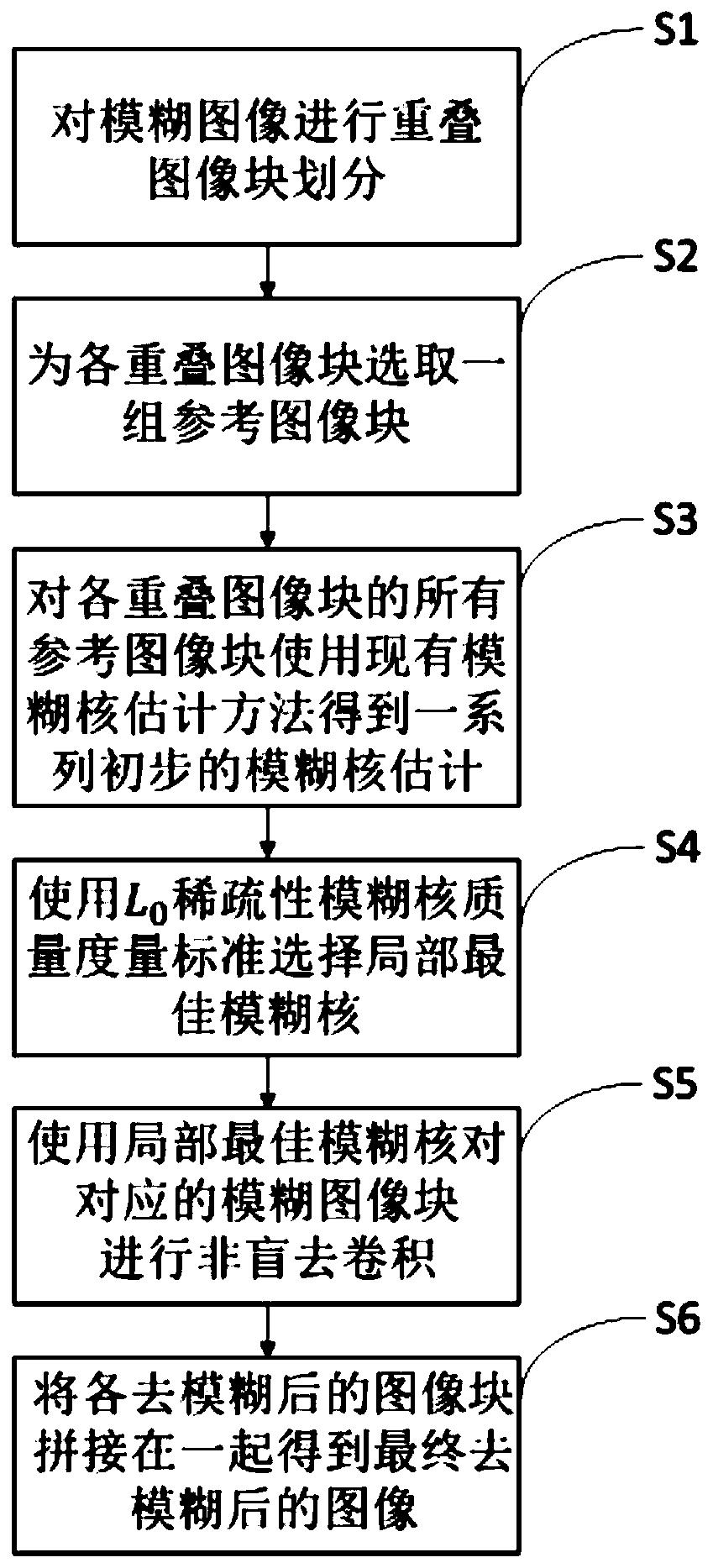
[0056] Embodiment 2, a method for image de-blurring using the device described in Embodiment 1 (based on L 0 image deblurring methods with sparsity blur kernel quality metric), such as figure 1 As shown, the image de-blurring method mainly includes the following steps (S1-S6),
[0057] Step S1, using features such as spatial distance, color, texture, and blur, divide the original blurred image into a series of overlapping image blocks {P i}={P 1 , P 2 ,...,P N}, where N is the number of image blocks. The overlapping image blocks {P i}={P 1 , P 2 ,...,P N} can be formulated according to the spatial position, color, texture, and fuzzy features of the image block; specifically, it can be: make the similarity of the spatial distance, color, texture, and fuzzy features of pixels in the same image block high, and not in the same image block The similarity of the spatial distance, color, texture, and fuzzy features of pixels in the same image block is low, wherein the measur...
example 1
[0071] Example 1, this example performs image motion blur removal according to the method described in Example 2, and the steps are as follows:
[0072] Input: blurred image y.
[0073] Output: final deblurred image
[0074] Parameter settings: overlapping image block size W×W, domain range ±N, step size S; where W=64 pixels, N=64 images
[0075] pixel, S=32 pixels.
[0076] Step S1:
[0077] Divide the blurred image y into n overlapping image blocks of size W×W {y l}.
[0078] Step S2:
[0079] For all l=1, 2, .., n, let for y l A set of reference image blocks; where, for y l All W×W, 2W×2W, 4W×4W size image block collections within the ±N neighborhood of .
[0080] Step S3:
[0081] For all l=1, 2, ..., n, and the y obtained in step S2 l A set of reference image blocks of For all reference image blocks in , use the existing blur kernel estimation method based on maximum a posteriori probability to get the preliminary estimated blur kernel
[0082] Step S...
PUM
 Login to View More
 Abstract
Description
Claims
Application Information
 Login to View More