
A method for preparing hierarchical porous carbon materials by growing mof with bacteria as a template and its application in energy storage devices
A porous carbon material, MOF technology, applied in the field of porous carbon materials, can solve the problems that a single noble metal catalyst cannot be used as a dual-function electrocatalyst at the same time, expensive and insufficient stability, restricting the wide application of noble metal catalysts, etc., to achieve the suppression of shuttle effect, The effect of good cycle performance and excellent catalytic performance
- Summary
- Abstract
- Description
- Claims
- Application Information
AI Technical Summary
Problems solved by technology
Method used
Image

Examples
Embodiment 1
[0040] Disperse 0.2g of Escherichia coli powder with 200mL of methanol to form a bacterial suspension, then add 2.4g of dimethylimidazole and 1.2g of zinc nitrate in sequence, stir evenly, and then sonicate for 30min. MOF materials). After 24 hours, centrifuge and wash with methanol several times to obtain a white precipitate, vacuum-dry it in a 60-degree oven for 12 hours, take it out, grind and weigh it, and then carbonize it at a heating rate of 5°C / min to 900°C under the protection of nitrogen or argon, and the carbonization time is 5 hours . After carbonization and cooling, it is ground to obtain a capsule-shaped multi-level porous active multifunctional carbon material.
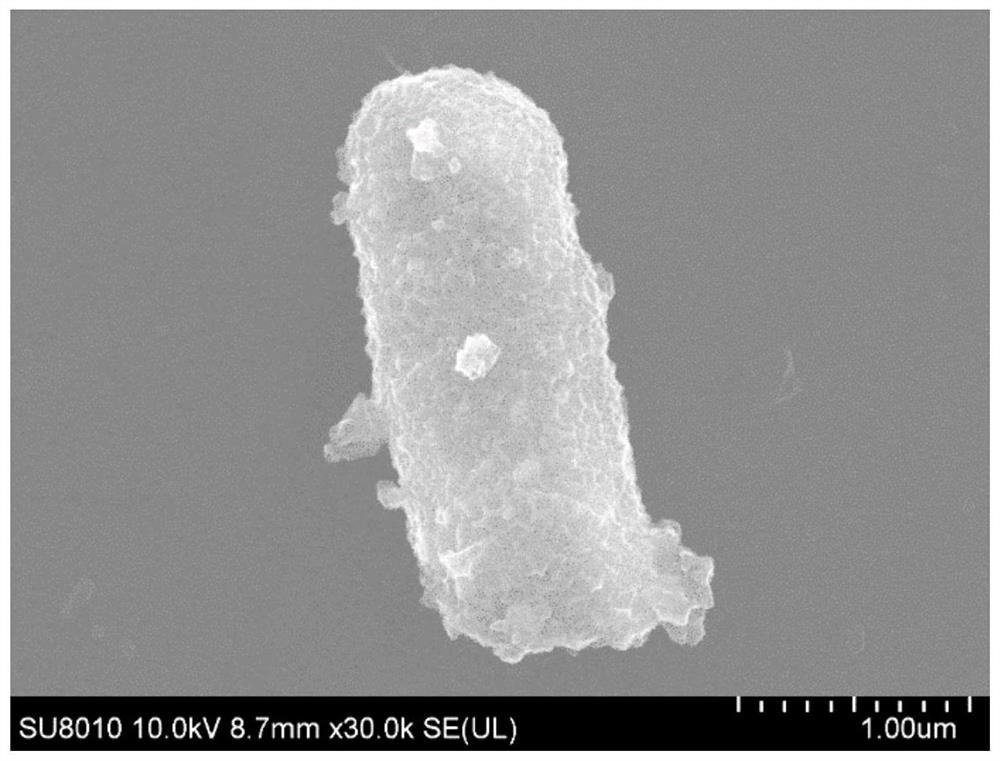
[0041] The microscopic appearance of the multifunctional carbon material that embodiment 1 obtains is as follows figure 2 shown.
Embodiment 2
[0043] Disperse 0.2g of Escherichia coli powder with 200mL of methanol to form a bacterial suspension, then add 2.4g of dimethylimidazole, 0.9g of zinc nitrate and 0.3g of cobalt nitrate in sequence, stir well, then ultrasonicate for 30min, seal and let stand at room temperature to grow ZIF . After 24 hours, centrifuge and wash with methanol several times to obtain a light blue precipitate, dry it in a 60-degree oven for 12 hours in a vacuum, take it out, grind and weigh it, and then carbonize it at a heating rate of 5°C / min to 900°C under the protection of nitrogen or argon. Time 5h. After carbonization and cooling, it is ground to obtain a capsule-shaped multi-level porous active multifunctional carbon material.
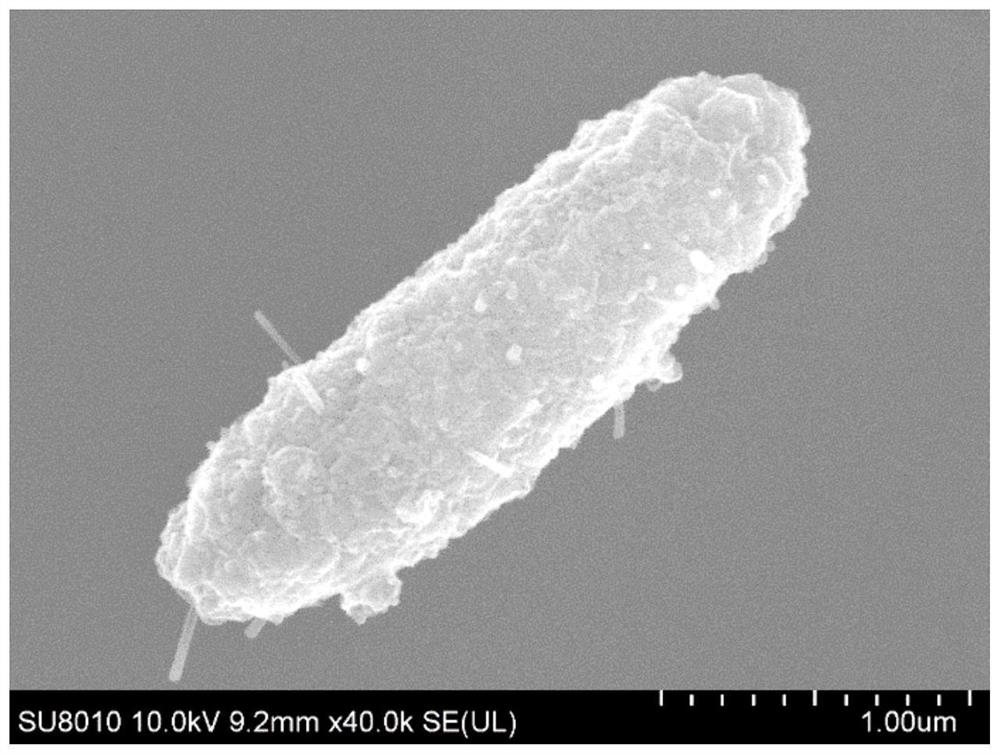
[0044] The microscopic appearance of the multifunctional carbon material that embodiment 2 obtains is as follows image 3 shown.
Embodiment 3
[0046] Disperse 0.2g of Escherichia coli powder with 200mL of methanol to form a bacterial suspension, then add 2.4g of dimethylimidazole, 0.6g of zinc nitrate and 0.6g of cobalt nitrate in sequence, stir well and then ultrasonicate for 30min, seal and let stand at room temperature to grow ZIF . After 24 hours, it was centrifuged and washed with methanol several times to obtain a blue precipitate. It was vacuum-dried in a 60-degree oven for 12 hours, taken out, ground and weighed, and then carbonized at a heating rate of 5°C / min to 900°C under the protection of nitrogen or argon. The carbonization time 5h. After carbonization and cooling, it is ground to obtain a capsule-shaped multi-level porous active multifunctional carbon material.
[0047] Due to the increase of Co content, the product contains more Co nanoparticles and the product is enriched on the surface, the SEM image is as follows Figure 4 shown.
PUM
 Login to View More
 Abstract
Description
Claims
Application Information
 Login to View More