Unlock instant, AI-driven research and patent intelligence for your innovation.

Cross-modal person re-identification method based on contrastive correlation

A pedestrian re-identification and cross-modal technology, applied in the field of computer vision, can solve the problems of cross-modal image differences and achieve the effect of improving accuracy

Active Publication Date: 2022-04-26
NORTHWESTERN POLYTECHNICAL UNIV
View PDF0 Cites 1 Cited by
  • Summary
  • Abstract
  • Description
  • Claims
  • Application Information

AI Technical Summary

Problems solved by technology

[0003] Cross-modal person re-identification tasks are more challenging than single-modal person re-identification tasks
It not only faces problems such as pedestrian posture, occlusion, camera shooting height and angle, but also faces differences between cross-modal pictures

Method used

the structure of the environmentally friendly knitted fabric provided by the present invention; figure 2 Flow chart of the yarn wrapping machine for environmentally friendly knitted fabrics and storage devices; image 3 Is the parameter map of the yarn covering machine
View more

Image

Smart Image Click on the blue labels to locate them in the text.
Viewing Examples
Smart Image
  • Cross-modal person re-identification method based on contrastive correlation
  • Cross-modal person re-identification method based on contrastive correlation
  • Cross-modal person re-identification method based on contrastive correlation

Examples

Experimental program
Comparison scheme
Effect test

Embodiment Construction

[0036] Now in conjunction with embodiment, accompanying drawing, the present invention will be further described:

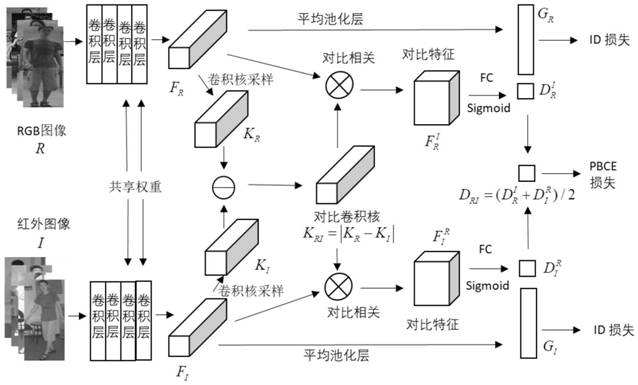
[0037] The technical solution module of the present invention mainly includes two parts: a two-way network for maintaining spatial information and a comparative correlation network. A two-way network that maintains spatial information is used to extract features that are common to both modalities that are independent of the modality and that maintain spatial information. On this basis, a contrastive correlation network is designed to focus on the semantic differences between two pedestrians, Thereby it is judged whether two pedestrians belong to the same pedestrian.

[0038] 1. A two-way network that preserves spatial information

[0039] Two-way networks that preserve spatial information are designed to extract common features across modal (RGB, infrared) images, represented by 3D feature tensors. It contains two branches: RGB branch and infrared branch, and t...

the structure of the environmentally friendly knitted fabric provided by the present invention; figure 2 Flow chart of the yarn wrapping machine for environmentally friendly knitted fabrics and storage devices; image 3 Is the parameter map of the yarn covering machine
Login to View More

PUM

No PUM Login to View More

Abstract

The invention relates to a cross-modal pedestrian re-identification method based on comparison and correlation, which mainly includes two parts: a two-way network for maintaining spatial information and a comparison and correlation network. A two-way network that maintains spatial information is used to extract features that are common to both modalities that are independent of the modality and that maintain spatial information. On this basis, a contrastive correlation network is designed to focus on the semantic differences between two pedestrians, Thereby it is judged whether two pedestrians belong to the same pedestrian. The invention improves the accuracy of the cross-modal pedestrian re-identification task.

Description

technical field [0001] The invention belongs to the field of computer vision, and in particular relates to a cross-modal (RGB-infrared) pedestrian re-identification method and system based on contrast correlation. This system designs a two-way network that retains spatial information to extract modal 3D feature tensors of different modal images. On this basis, a comparative network is designed to focus on the semantic differences between two input pedestrian images. Background technique [0002] The task of person re-identification has become a hot spot in the field of image recognition. The main purpose of the pedestrian re-identification task is to retrieve whether the pedestrian appearing in one camera has appeared in other cameras, that is, given a pedestrian picture under a camera, select the same pedestrian picture from the candidate picture library. Pedestrian re-identification technology is widely used in criminal investigation, person tracing, image retrieval, etc....

Claims

the structure of the environmentally friendly knitted fabric provided by the present invention; figure 2 Flow chart of the yarn wrapping machine for environmentally friendly knitted fabrics and storage devices; image 3 Is the parameter map of the yarn covering machine
Login to View More

Application Information

Patent Timeline
no application Login to View More
Patent Type & Authority Patents(China)
IPC IPC(8): G06V40/10G06K9/62G06V10/74
CPCG06V40/103G06F18/22
Inventor 王鹏杨毅飞张世周张艳宁
Owner NORTHWESTERN POLYTECHNICAL UNIV