

Polypeptide, and polypeptide composition and application thereof in tumor immunity
A polypeptide composition and fusion polypeptide technology, applied in the field of medical immunology, can solve the problems of induced tolerance, low quantity, low immunogenicity, etc.
- Summary
- Abstract
- Description
- Claims
- Application Information
AI Technical Summary
Problems solved by technology
Method used
Image


Examples
Embodiment 1
[0160] The separation of embodiment 1PBMC cell and dendritic cell (DC)
[0161] Isolation of PBMC cells was performed as follows:
[0162] 1. Take 200-400 μL from the blood of the donor subject and measure the concentration of white blood cells with a white blood cell analyzer.
[0163] 2. Preheat Ficoll in a 20°C water bath for more than 20 minutes.
[0164] 3. According to the measured white blood cell concentration, dilute each blood sample with PBS to a white blood cell concentration of 5-9×10 9 / L, the dilution factor is calculated according to the situation.
[0165] 4. Ficoll separation
[0166] Calculate the amount of Ficoll according to the ratio of volume to blood sample: Ficoll=4:3. Add the diluted blood sample to Ficoll slowly along the wall of the centrifuge tube at a uniform speed. After completion, gently hold the centrifuge tube and put it into the centrifuge. Adjust the speed of the centrifuge to 800g for 25 minutes, adjust the speed up to 1g / s, and the sp...
Embodiment 2D
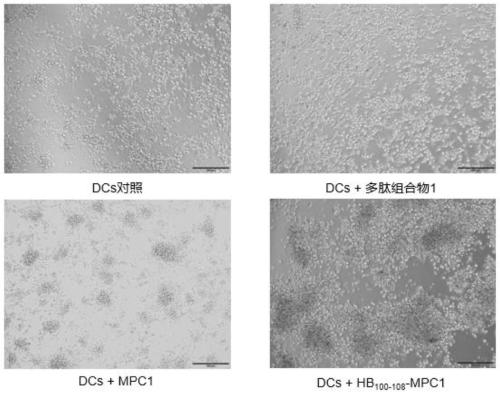
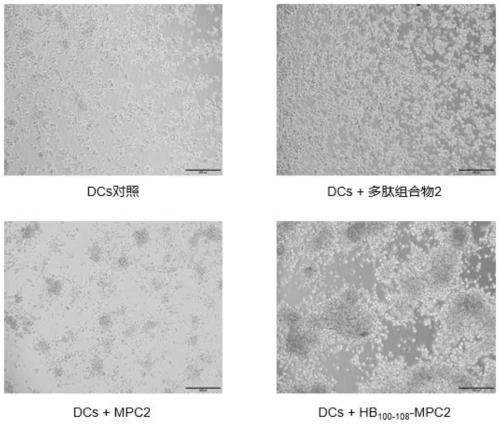
[0182] The detection of embodiment 2DC aggregation effect
[0183] 1) Spread the DCs isolated in Example 1 on a 24-well plate, and add 1 mL of cells to each well at a density of 1×10 6 / mL of DC suspension;
[0184] 2) Divide the wells covered with DC into 7 groups, namely DC control, DC+polypeptide composition 1, DC+MPC1, DC+HB 100-108 - MPC1, DC+polypeptide composition 2, DC+MPC2 and DC+HB 100-108 -MPC2, 3 parallel auxiliary wells in each group, respectively add corresponding polypeptide compositions or polypeptide constructs (MPC) to each experimental group, wherein the final concentrations of polypeptide compositions 1 and 2 are both 60 μg / mL (polypeptide composition The concentration of each polypeptide in the product is 20μg / mL), all polypeptide constructs (MPC1, HB 100-108 -MPC1, MPC2, HB 100-108 The final concentration of -MPC2) is 40 μg / mL, 37 ℃ 5% CO 2 Incubate for 6 hours;
[0185] 3) The cells were washed with PBS, and each group selected one of the three aux...
Embodiment 3
[0188] Fluorescence microscope detection of the DC absorption level of the polypeptide construct of embodiment 3
[0189] 1) Spread the DCs isolated in Example 1 on a 24-well plate, and add 1 mL of cells to each well at a density of 1×10 6 / mL of DC suspension;
[0190]2) Add 10 μg, 20 μg, 40 μg and 80 μg of FITC-labeled different polypeptide constructs (MPC1 and HB 100-108 -MPC1), 37°C 5% CO 2 Incubate for 3 hours and 6 hours respectively, and observe the absorption level of the polypeptide construct by DCs under a fluorescence microscope.
[0191] The result is as Figure 4-Figure 7 shown. Figure 4-Figure 7 DC responses to different concentrations of MPC1 and HB are shown, respectively 100-108 - MPC1 uptake levels after incubation for 3h, 6h. Figure 4 , 6 are the absorption levels of DCs for different concentrations of MPC1 after incubation for 3h and 6h, respectively. Figure 4 , 6 It was shown that the uptake of MPC1 by DCs after incubation for 6h was significan...
PUM
 Login to View More
 Abstract
Description
Claims
Application Information
 Login to View More