
Zymologic quantification method for 1,5-anhydroglucitol, and quantification reagent adopted by zymologic quantification method
An anhydroglucitol and anhydroglucose technology, applied in 1 field, can solve the problems of inaccurate determination, difficulty in obtaining the optimal reaction conditions of all tool enzymes, low content, etc., and achieve the effect of eliminating interference
Inactive Publication Date: 2020-08-25
王学忠
View PDF1 Cites 4 Cited by
- Summary
- Abstract
- Description
- Claims
- Application Information
AI Technical Summary
Problems solved by technology
[0003] The chemical structure of 1,5-anhydroglucitol is very similar to that of glucose. It is known that commercial quantitative 1,5-anhydroglucitol kits must remove the interference of glucose in the sample, because the content of glucose in biological samples is much larger In 1,5-anhydroglucitol, and the content of 1,5-anhydroglucitol is very low, so it is very difficult to accurately and quantitatively determine the content of 1,5-anhydroglucitol
[0004] Measure 1 at present, the enzymatic method of 5-anhydroglucitol mainly comprises (1) pyranose oxidase method, this method adopts glucokinase and pyruvate kinase to remove the interference of glucose in the sample, but glucokinase and 1,5- Anhydroglucitol also plays a role, making the determination inaccurate; and this method directly adopts Trinder's chromogenic method, and the determination sensitivity is low
(2) 1,5-anhydroglucitol-6-phosphate dehydrogenase method (Chinese patent authorization announcement number CN1179051C), the method uses adenosine diphosphate-dependent hexokinase, phosphoglucose isomerase and 6-fructose phosphate Kinase converts glucose in the sample into fructose-1,6-bisphosphate to remove glucose interference. This method has a complex enzyme system, and the quantitative reagent contains 6 enzymes and multiple coenzymes to eliminate the glucose product and adenosine diphosphate. It is difficult to obtain the optimal reaction conditions for all tool enzymes in the same reagent, and phosphoglucose isomerase will also undergo a reversible reaction, making the determination inaccurate
Method used
the structure of the environmentally friendly knitted fabric provided by the present invention; figure 2 Flow chart of the yarn wrapping machine for environmentally friendly knitted fabrics and storage devices; image 3 Is the parameter map of the yarn covering machine
View moreImage
Smart Image Click on the blue labels to locate them in the text.
Smart ImageViewing Examples

Examples
Experimental program
Comparison scheme
Effect test
Embodiment 2
[0068] Prepare a reagent for quantifying 1,5-anhydroglucitol with the following composition:
[0069] Reagent 1
[0070]
[0071] Reagent 2
[0072]
Embodiment 3
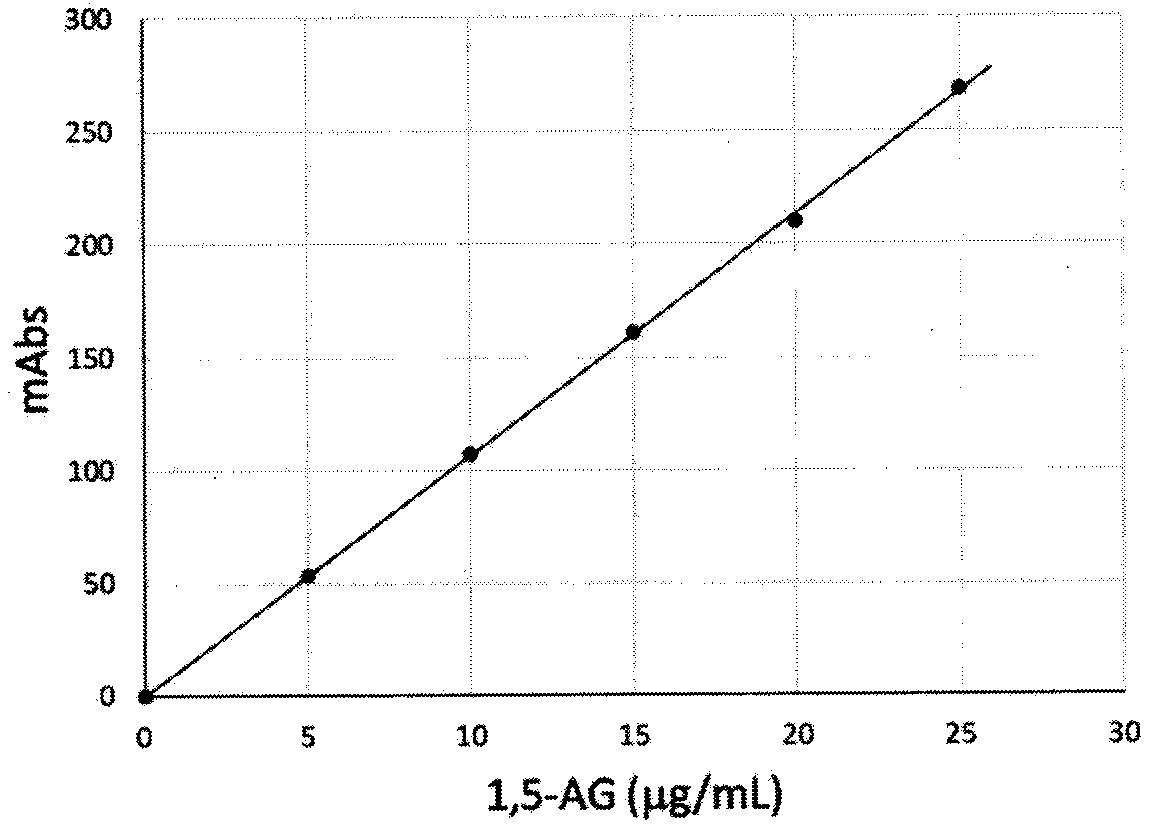
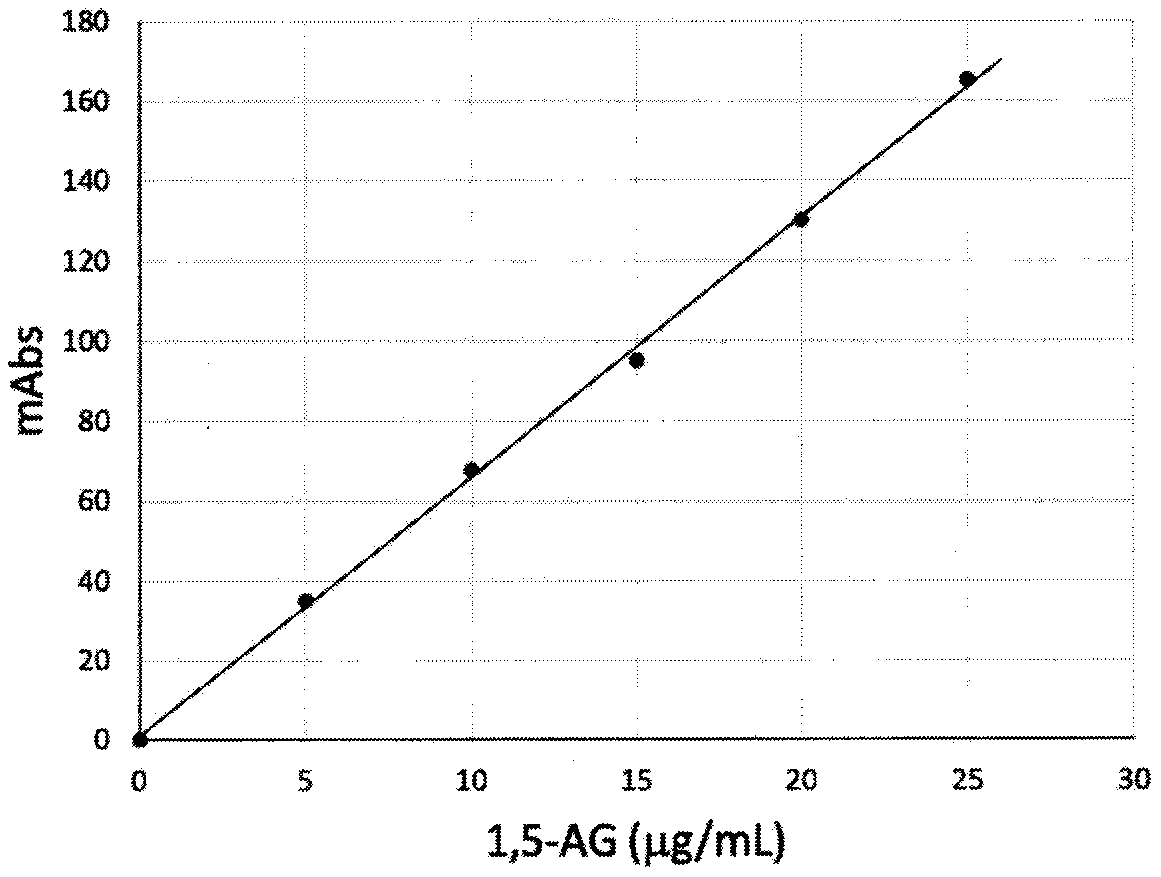
[0074] Dilute the 25 μg / mL standard solution of 1,5-anhydroglucitol into 5 solutions with different concentrations as samples, add 240 μL of reagent 1 in Example 2 to 6 μL of sample and pure water, and act on 5 at 37 °C Minutes, then add 80 μL of reagent 2 in Example 2, and make it react for 5 minutes, record the measured absorbance at 540nm, and draw a standard curve as figure 1 shown.
the structure of the environmentally friendly knitted fabric provided by the present invention; figure 2 Flow chart of the yarn wrapping machine for environmentally friendly knitted fabrics and storage devices; image 3 Is the parameter map of the yarn covering machine
Login to View More PUM
 Login to View More
 Abstract
The invention provides a quantification method for quickly measuring 1,5-anhydroglucitol in a glucose-containing sample, and a quantification reagent and a quantification-purpose kit used by the quantification method. The quantification method for the 1,5-anhydroglucitol in the glucose-containing sample is a method characterized in that a scavenger enzyme system consisting of a coenzyme I, glucosedehydrogenase and NAD (nicotinamide adenine dinucleotide)-dependent malic dehydrogenase is adopted to scavenge interference generated by glucose cross reaction in a test specimen, and then, a measurement enzyme system consisting of an oxidized coenzyme II and 1,5-anhydroglucitol-6-phosphate dehydrogenase is adopted to quantitatively measure a generated reduced coenzyme II.
Description
technical field [0001] The invention relates to an enzymatic method using different coenzymes to quantify 1,5-anhydroglucitol in a biological sample, a quantitative reagent and a quantitative kit. Background technique [0002] 1,5-anhydroglucitol (abbreviated as 1,5-AG) can make up for the lack of other blood glucose monitoring indicators, such as fasting blood glucose, glycosylated albumin, and glycosylated hemoglobin can only reflect immediate, nearly 2-3 weeks and nearly 2-3 weeks respectively. There is no indicator of blood sugar within a month that can accurately reflect the changes in blood sugar in the last 3 to 7 days, and 1,5-AG just fills this gap. The lower the 1,5-AG level, the poorer the blood sugar control. [0003] The chemical structure of 1,5-anhydroglucitol is very similar to that of glucose. It is known that commercial quantitative 1,5-anhydroglucitol kits must remove the interference of glucose in the sample, because the content of glucose in biological ...
Claims
the structure of the environmentally friendly knitted fabric provided by the present invention; figure 2 Flow chart of the yarn wrapping machine for environmentally friendly knitted fabrics and storage devices; image 3 Is the parameter map of the yarn covering machine
Login to View More Application Information
Patent Timeline
 Login to View More
 Patent Type & AuthorityApplications(China)
IPC IPC(8): C12Q1/48C12Q1/32
CPCC12Q1/32C12Q1/485
Inventor王学忠
Owner王学忠