
Objective optical system for endoscope
A technology for optical systems and endoscopes, which is applied in the field of objective lens optical systems for endoscopes, and can solve problems such as narrowing depth of field
- Summary
- Abstract
- Description
- Claims
- Application Information
AI Technical Summary
Problems solved by technology
Method used
Image

Examples
Embodiment approach
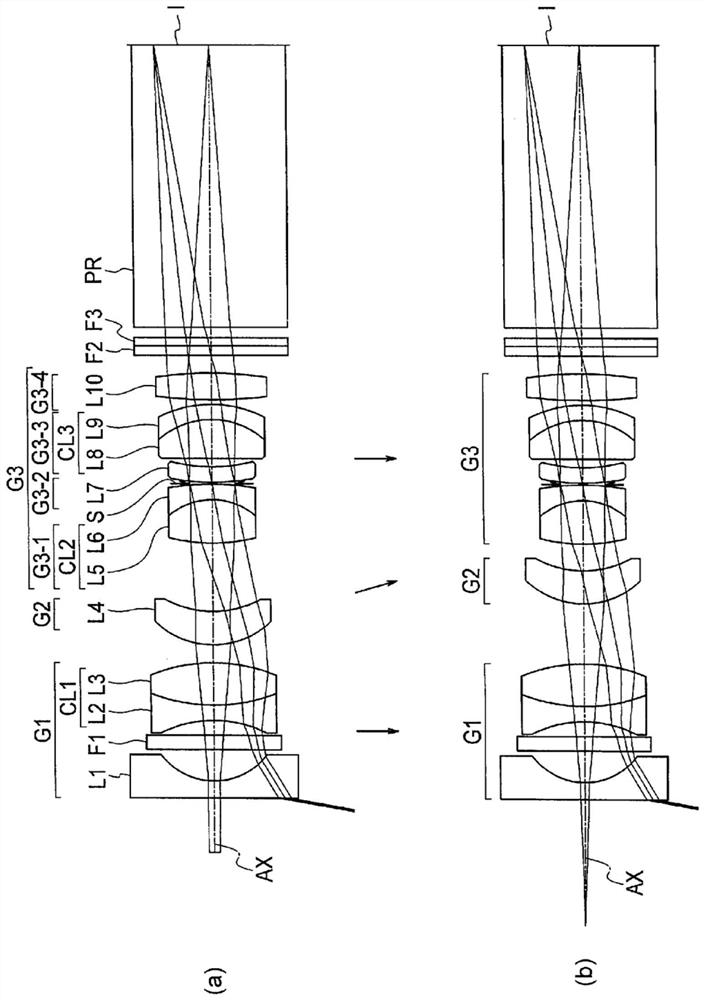
[0035] figure 1 (a) is a lens cross-sectional view in a normal observation state of the endoscope objective optical system according to the embodiment. figure 1 (b) is a lens cross-sectional view of the endoscope objective optical system according to the embodiment in a close-up observation state. From the normal observation state to the close-up observation state, the second group G2 moves toward the image side.
[0036] The objective optical system for an endoscope according to this embodiment is composed of a first group G1 of negative refractive power, a second group G2 of positive refractive power, and a third group G3 of positive refractive power arranged in this order from the object side. Group 1 G1 and Group 3 G3 are fixed, and Group 2 G2 moves. The first group G1 has at least two lenses with negative refractive power, and the third group G3 consists of the positive refractive power group 3-1 G3-1 and the negative refractive power group 3-2 G3- arranged in order f...
Embodiment 1
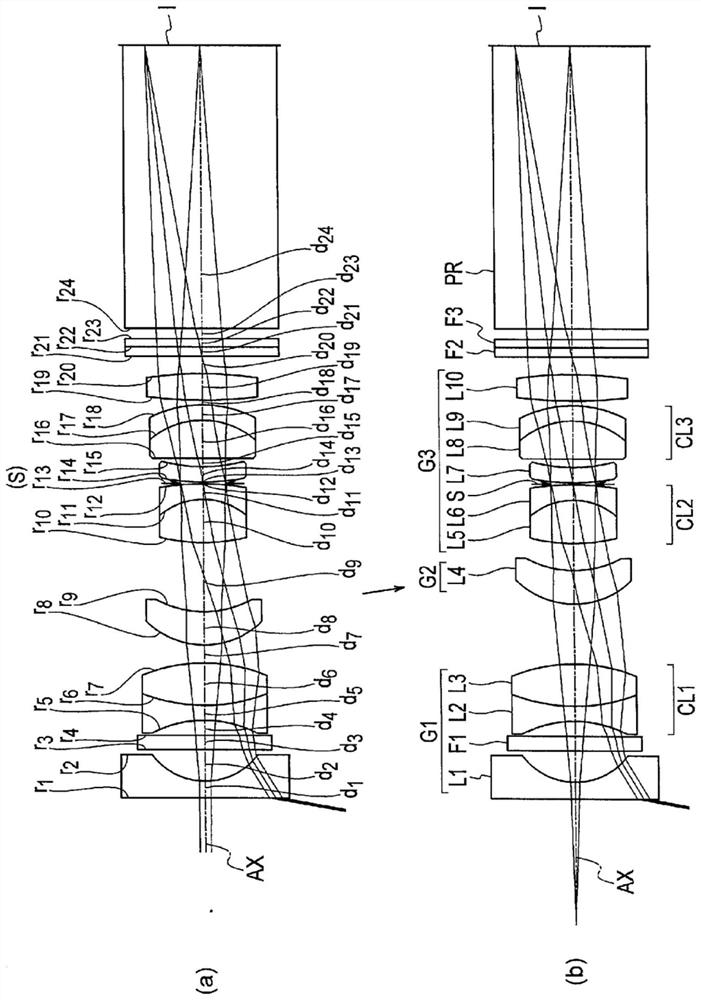
[0144] figure 2 (a) is a lens cross-sectional view of the endoscope objective optical system according to Example 1 in a normal observation state. figure 2 (b) is a lens cross-sectional view of the endoscope objective optical system according to Example 1 in a close-up observation state.
[0145] The objective optical system for an endoscope according to Example 1 is composed of a first group G1 of negative refractive power, a second group G2 of positive refractive power, and a third group G3 of positive refractive power arranged in this order from the object side. The first group G1 and the third group G3 are fixed, and the second group G3 moves. In the close observation state, the second group G2 moves toward the image side.
[0146] The first group G1 of negative refractive power has a plano-concave first negative lens L1 with the plane facing the object side, an infrared cut filter F1, a biconcave second negative lens L2, and a biconvex second negative lens L2 arranged...
Embodiment 2
[0152] Figure 4 (a) is a lens cross-sectional view of the endoscope objective optical system according to Example 2 in a normal observation state. Figure 4 (b) is a lens cross-sectional view of the endoscope objective optical system according to Example 2 in a close-up observation state.
[0153] The objective optical system for an endoscope according to Example 2 is composed of a first group G1 of negative refractive power, a second group G2 of positive refractive power, and a third group G3 of positive refractive power arranged in this order from the object side. The first group G1, the third group G3 are fixed, and the second group G2 moves. In the close observation state, the second group G2 moves toward the image side.
[0154] The first group G1 of negative refractive power has a first negative meniscus lens L1 with a convex surface facing the object side, an infrared cut filter F1, a biconcave second negative lens L2, and a biconvex third negative lens L2 arranged i...
PUM
 Login to View More
 Abstract
Description
Claims
Application Information
 Login to View More