
Calculation method of the maximum number of vehicles that can be accommodated in the urban road network
A technology of urban road network and calculation method, which is applied to traffic control systems, instruments, and traffic flow detection of road vehicles. problem, to reduce blindness, improve the prediction of urban car ownership, and achieve the effect of high practicability
- Summary
- Abstract
- Description
- Claims
- Application Information
AI Technical Summary
Problems solved by technology
Method used
Image

Examples
specific Embodiment approach 1
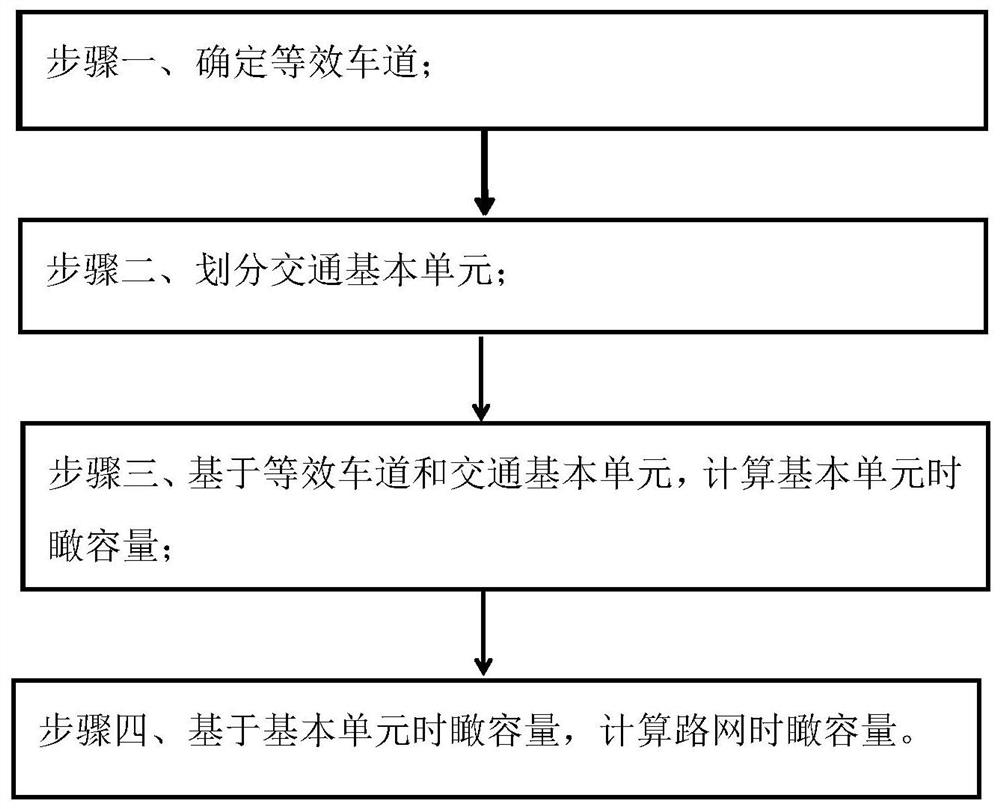
[0030] Specific implementation mode 1: The specific process of the calculation method of the maximum number of vehicles that can be accommodated in the urban road network in this implementation mode is as follows:
[0031] The technical problem to be solved by the present invention is to overcome the inaccurate calculation of the maximum number of vehicles that can be accommodated in the road network in the existing method, and the problem that the accommodation performance of the road network structure cannot be evaluated in advance, and the core influencing factors of the maximum number of vehicles that the road network can accommodate are analyzed. Lane Equivalent-Traffic Flow Abstraction" conversion process realizes the accurate calculation of the maximum number of vehicles that the road network can accommodate. The invention utilizes related technologies in the field of traffic planning and design to study the calculation problem of the maximum number of vehicles that can ...
specific Embodiment approach 2
[0051] Embodiment 2: The difference between this embodiment and Embodiment 1 is that in the step 3, based on the equivalent lane and the traffic basic unit, the time-view capacity of the basic unit is calculated; the specific process is:
[0052] Step 31, constructing the travel time model of the basic unit; the specific process is:
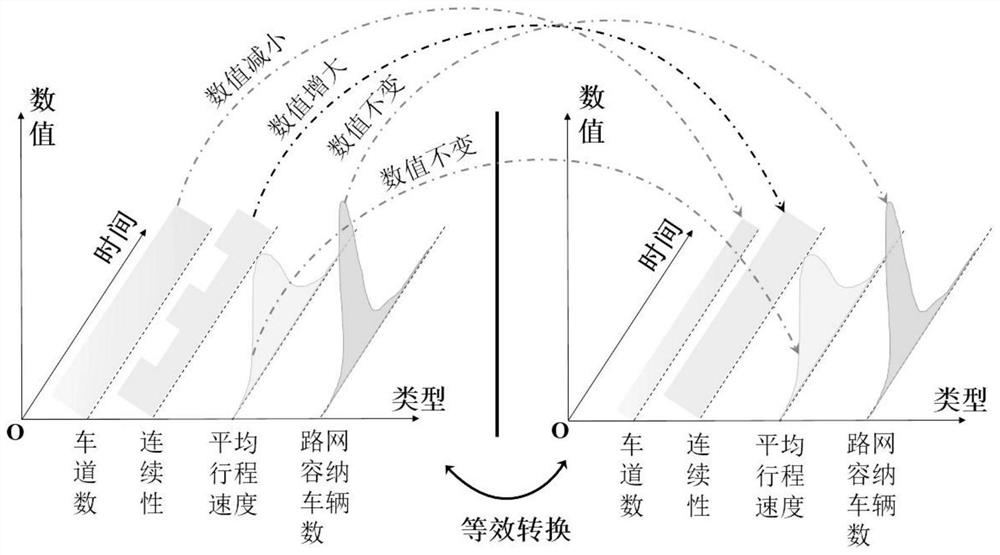
[0053] refer to figure 2 , after the equivalent conversion of traffic flow, the number of entrances at the intersection will decrease. When the traffic volume is large, the traffic flow will be blocked before the stop line. In order to count the total number of vehicles including blocked traffic flow, the idea of "traffic flow abstraction" is proposed. Regardless of the speed of the vehicles on the road section and the form of the blocked vehicles queuing through the intersection, as long as the travel time before and after the abstraction remains unchanged, the traffic flow on the basic unit can always be abstracted as a process of "free dr...
specific Embodiment approach 3
[0064] Specific implementation mode three: the difference between this implementation mode and specific implementation mode one or two is that: in the step three and two, the time-sighted capacity of the basic unit is calculated; the specific process is:
[0065] Step 321, calculating the time-of-view capacity of the equivalent lane;
[0066] Step 322, calculate the time-of-view capacity of the non-equivalent lane;
[0067] Step 323: Calculate the time-view capacity of the basic unit based on the time-view capacity of the equivalent lane and the time-view capacity of the non-equivalent lane.
[0068] Other steps and parameters are the same as those in Embodiment 1 or Embodiment 2.
PUM
 Login to View More
 Abstract
Description
Claims
Application Information
 Login to View More