Check patentability & draft patents in minutes with Patsnap Eureka AI!

Short fiber reinforced composite material mechanical property prediction method based on CT scanning

A short fiber reinforced, composite material technology, applied in the field of materials, can solve the problems of mechanical properties prediction, no establishment of reactive composite materials, etc., to achieve the effects of improving mechanical properties, computing efficiency and computing accuracy

Active Publication Date: 2021-03-26
XIDIAN UNIV
View PDF4 Cites 1 Cited by
  • Summary
  • Abstract
  • Description
  • Claims
  • Application Information

AI Technical Summary

Problems solved by technology

However, this CT technology does not establish a model of the real structure of the reactive composite material, nor does it predict its mechanical properties.

Method used

the structure of the environmentally friendly knitted fabric provided by the present invention; figure 2 Flow chart of the yarn wrapping machine for environmentally friendly knitted fabrics and storage devices; image 3 Is the parameter map of the yarn covering machine
View more

Image

Smart Image Click on the blue labels to locate them in the text.
Viewing Examples
Smart Image
  • Short fiber reinforced composite material mechanical property prediction method based on CT scanning
  • Short fiber reinforced composite material mechanical property prediction method based on CT scanning
  • Short fiber reinforced composite material mechanical property prediction method based on CT scanning

Examples

Experimental program
Comparison scheme
Effect test

Embodiment Construction

[0033] Below in conjunction with accompanying drawing, implementation process of the present invention is described in further detail:

[0034] refer to figure 1 , the implementation steps of the present invention are as follows:

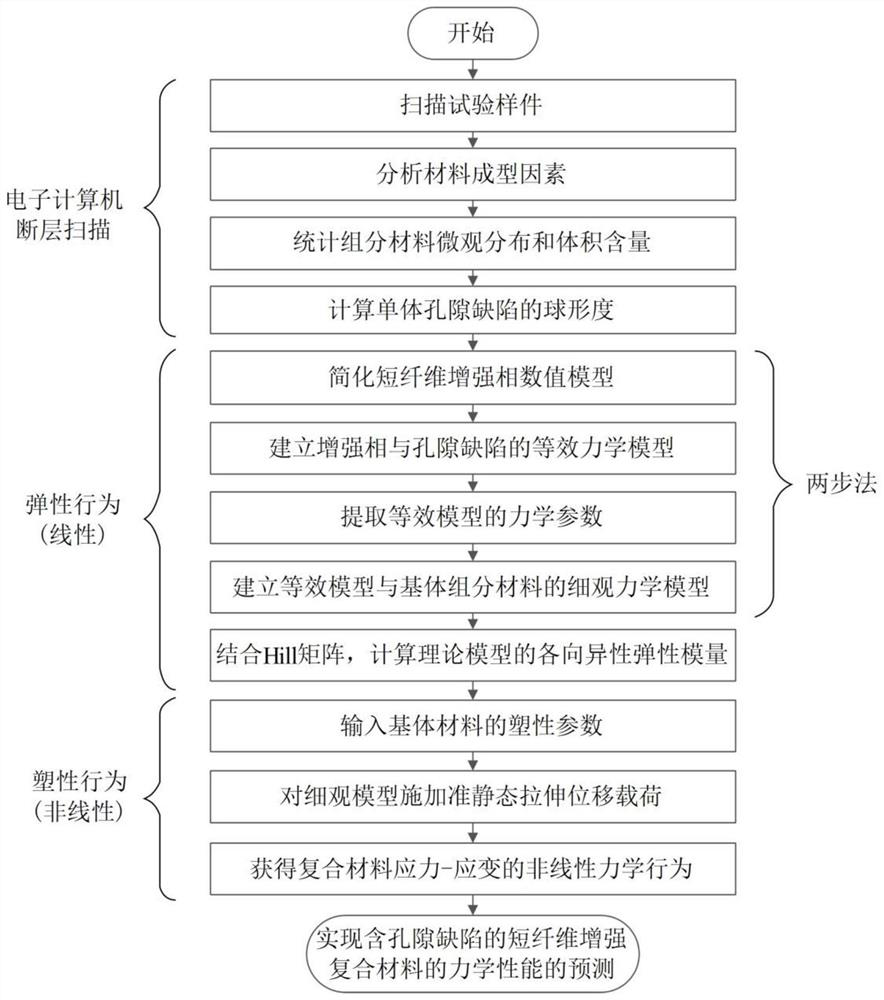
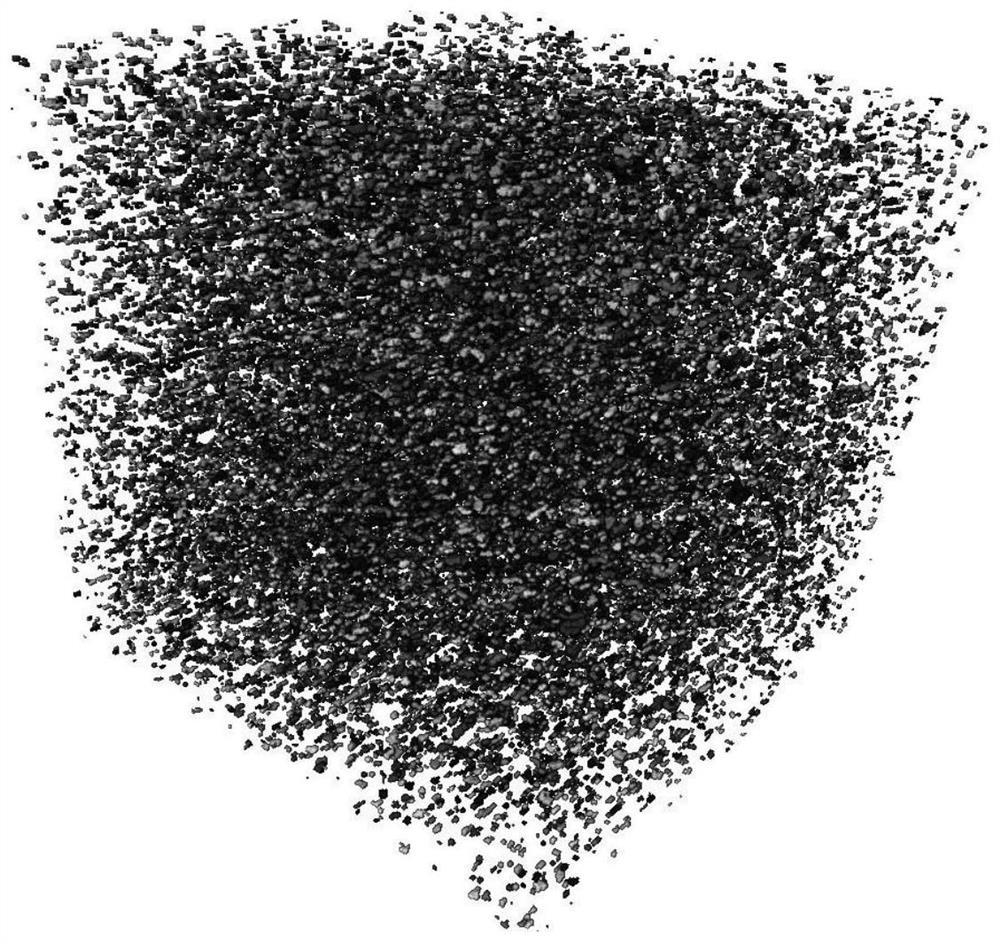
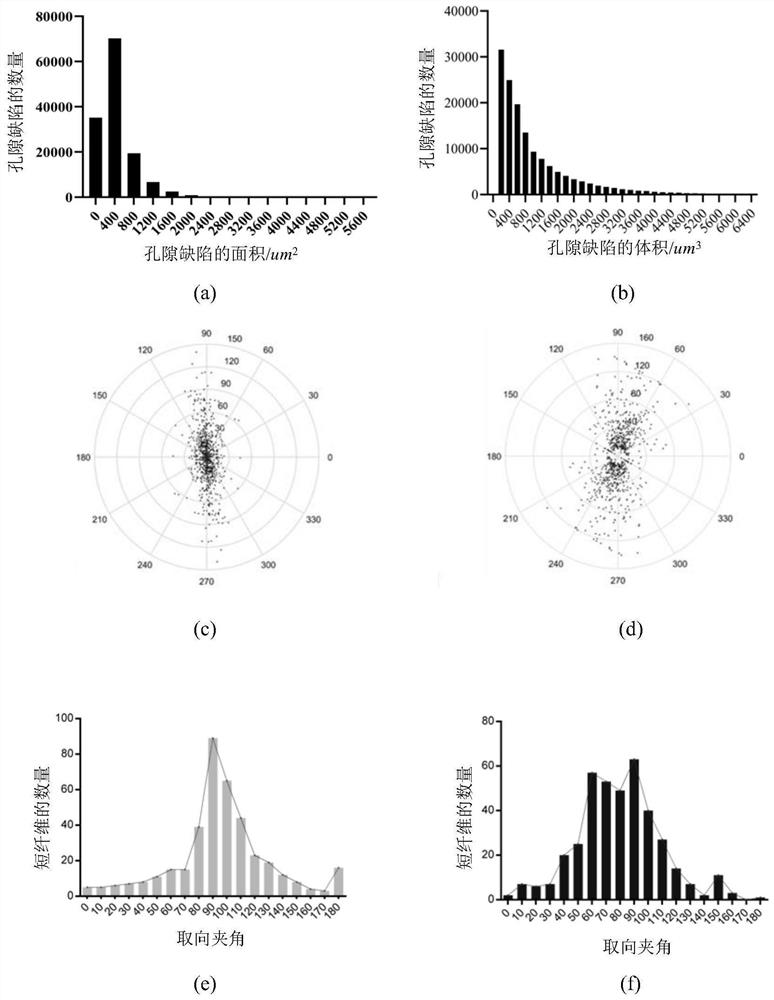
[0035] Step 1: Obtain the geometric characteristics of each component phase of the composite material through CT scanning technology, and perform segmentation and statistical processing to obtain the three-dimensional microscopic distribution and volume content of each component material.

[0036] 1.1) Based on the micron-level CT scanning technology, a 2mm*2mm*2mm CT scanning sample is cut from a 500mm*500mm*2.5mm custom board. The sample material used in this example is a short glass fiber-reinforced polyether ether ketone composite material PEEK / GL30 with a micron-sized mass content of 30%, and the material contains pore defects;

[0037] 1.2) Use Zeiss Xradia 520versa equipment to conduct CT scanning experiments on the sample materials, set th...

the structure of the environmentally friendly knitted fabric provided by the present invention; figure 2 Flow chart of the yarn wrapping machine for environmentally friendly knitted fabrics and storage devices; image 3 Is the parameter map of the yarn covering machine
Login to View More

PUM

No PUM Login to View More

Abstract

The invention relates to a method for predicting the mechanical property of a short fiber reinforced composite material containing pore defects based on CT scanning, and mainly solves the problem of low prediction precision calculation efficiency in the prior art. According to the scheme, the method includes: obtaining a short fiber reinforced phase, pore defects and microcosmic distribution of abase material through CT scanning; establishing an ellipsoidal simplified mechanical model according to the length and the spatial orientation of the short fibers; establishing a three-dimensional isoparameterized micromechanics model based on a finite volume direct average micromechanics method; equivalently homogenizing a short fiber reinforced phase and a pore defect two-component material, andcarrying out secondary equivalence on an equivalent model and a matrix component material to obtain a mesomechanics model; and obtaining anisotropic mechanical parameters of the composite material through the spatial distribution and the mechanical parameters of the component materials. According to the method, the prediction precision is improved, the calculation efficiency higher than that of the voxel inclusion theory is obtained, the time is saved, and the method can be used for testing and selecting new energy vehicles, aerospace and marine ship materials.

Description

technical field [0001] The invention belongs to the field of material technology, and in particular relates to a method for predicting the mechanical properties of composite materials, which can be used for material testing and selection of new energy vehicles, aerospace, ocean ships, and sports equipment. Background technique [0002] Short fiber reinforced composites refer to a class of composite materials in which short fibers are randomly distributed in space in the matrix phase. On the mesoscopic scale, due to the random distribution of short fibers in space, the distribution of mesoscopic stress field is often uneven. However, compared with traditional materials, this type of composite material shows excellent toughness and impact resistance. The molding process of short fiber reinforced composite materials is simple, and the output of sheet molding compound and bulk molding compound is extremely large in actual production. The use of polymer-based short-fiber composi...

Claims

the structure of the environmentally friendly knitted fabric provided by the present invention; figure 2 Flow chart of the yarn wrapping machine for environmentally friendly knitted fabrics and storage devices; image 3 Is the parameter map of the yarn covering machine
Login to View More

Application Information

Patent Timeline
no application Login to View More
Patent Type & Authority Applications(China)
IPC IPC(8): G06F30/20G06F113/26G06F119/14
CPCG06F30/20G06F2119/14G06F2113/26Y02T90/00
Inventor 叶俊杰蔡恒史金旺叶建乔徐永和师阳
Owner XIDIAN UNIV
Features
  • R&D
  • Intellectual Property
  • Life Sciences
  • Materials
  • Tech Scout
Why Patsnap Eureka
  • Unparalleled Data Quality
  • Higher Quality Content
  • 60% Fewer Hallucinations
Social media
Patsnap Eureka Blog
Learn More