
Nanometer antibody specifically binding to protein kinase p38delta, nucleic acid, expression vector, host cell and application thereof
A technology for binding proteins and nanobodies, applied in the fields of antibodies, applications, immunoglobulins, etc., can solve the problems of no p38δ inhibitors and difficulties, and achieve outstanding thermal stability, acid-base stability, and high specific binding activity Effect
- Summary
- Abstract
- Description
- Claims
- Application Information
AI Technical Summary
Problems solved by technology
Method used
Image

Examples
Embodiment 1
[0038] This Example 1 provides a screen for Nanobodies that specifically bind the protein kinase p38δ. Specific steps are as follows:
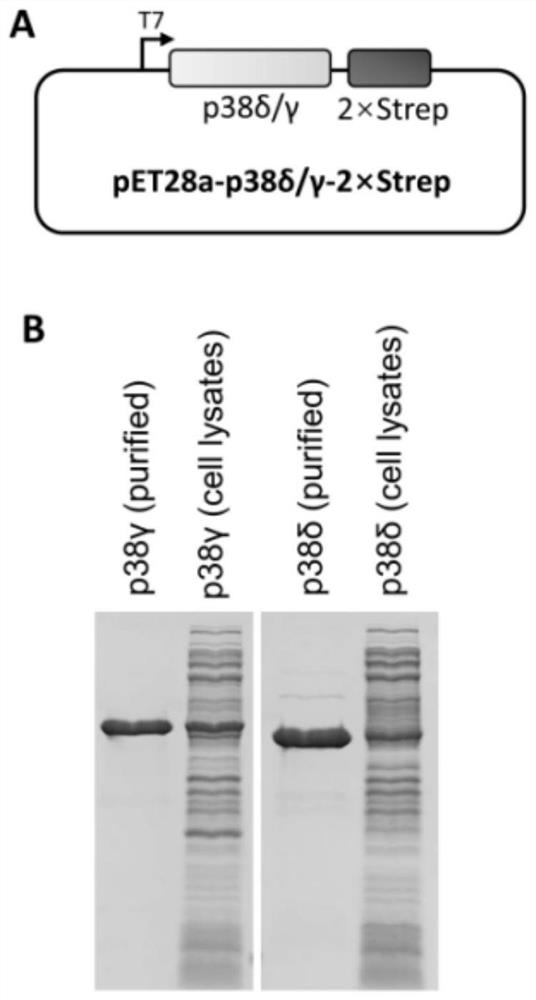
[0039] (1) According to the third generation developed by IBA company Protein purification system to construct p38δ, p38γ expression vectors, such as figure 1 a. The amino acid sequence of p38δ is shown in SEQ ID NO.9, the amino acid sequence of p38γ is shown in SEQ ID NO.10; the coding sequence of p38δDNA is shown in SEQ ID NO.11, and the coding sequence of p38γDNA is shown in SEQ ID NO.12. The amino acid sequence of the 2×Strep tag is shown in SEQ ID NO.13, and the DNA coding sequence of the 2×Strep tag is shown in SEQ ID NO.14. The constructed expression vector was transformed into Escherichia coli expression bacteria BL21(DE3), its expression was induced by IPTG, the protein was purified using MagStrep "type3" XT magnetic beads, and the expressed and purified product was detected by SDS-PAGE and Coomassie brilliant blue staining , and...
Embodiment 2
[0043] This example provides methods for the identification of Nanobodies.
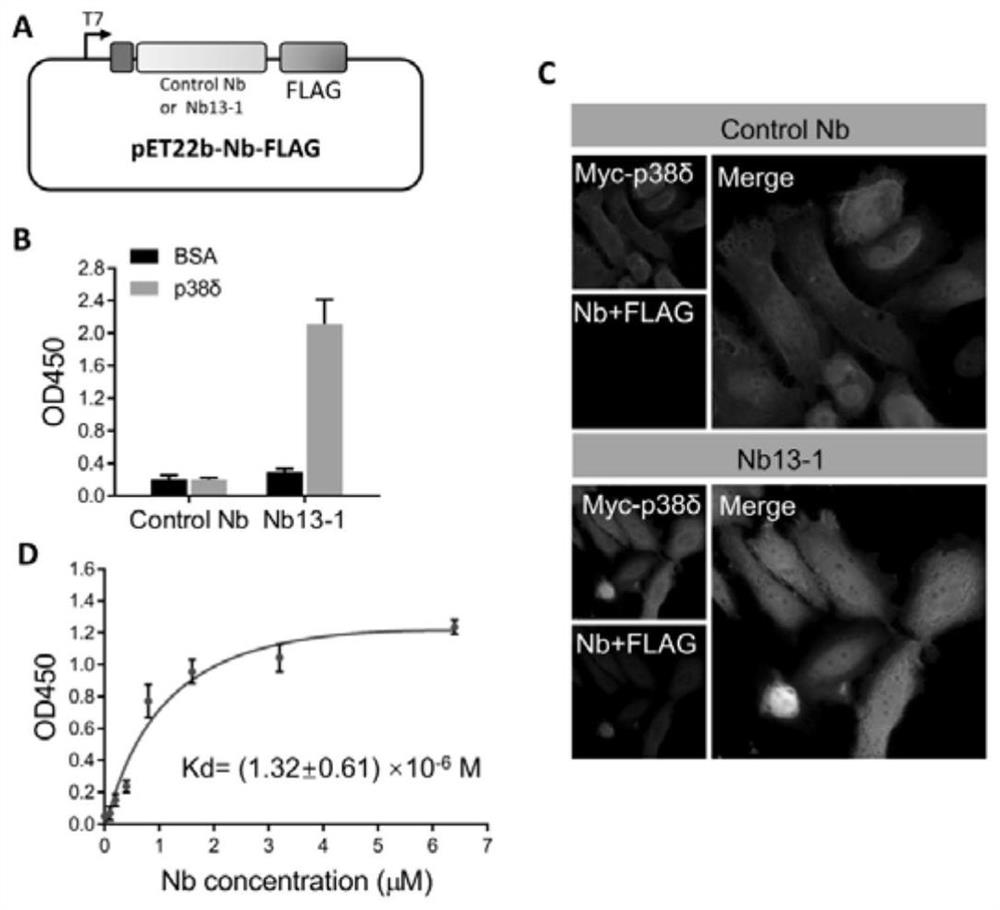
[0044] (1) Select the clone Nb13-1 obtained in Example 1, its DNA sequence is shown in SEQ ID NO.8, and its encoded amino acid sequence is shown in SEQ ID NO.7. The nucleotide sequence encoding the nanobody was subcloned into the expression vector pET22b by molecular cloning, and the FLAG tag sequence was fused at its C-terminus, such as figure 2 As shown in A, the control Nanobody expression vector was constructed in the same way.
[0045] (2) The constructed Nanobody expression vector was transformed into Escherichia coli expression strain BL21(DE3), the expression was induced by IPTG, and then the pericellular protein was extracted by low-osmotic hair.
[0046] (3) ELISA detection of the binding of bacterial cell periplasmic protein expressing Nanobody to p38δ:
[0047] Coat p38δ and BSA proteins to 96-well ELISA plates, and after blocking with blocking solution, incubate the nanobody bacterial ...
Embodiment 3
[0053] In Example 3, the cross-reactivity between Nb13-1 and other p38 MAPK family proteins was detected.
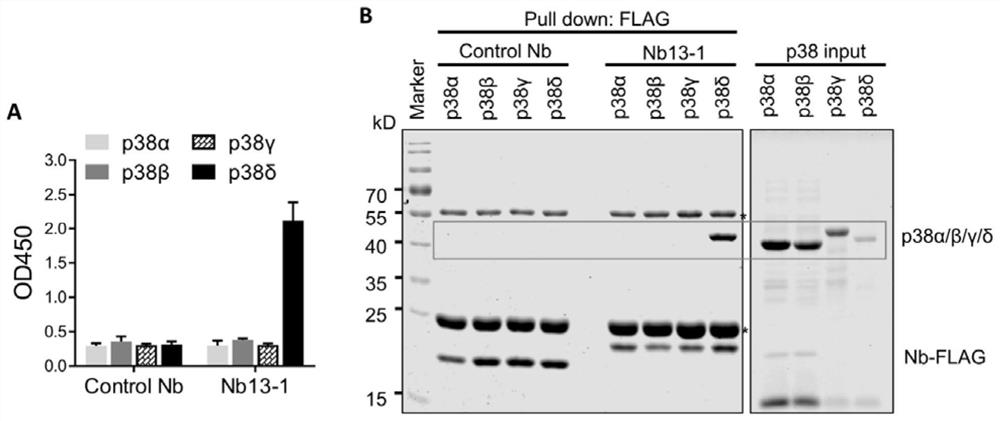
[0054] (1) ELISA detection of cross-reaction between Nb13-1 and other p38 MAPK family proteins: Coat p38α, p38β, p38γ and p38δ proteins to 96-well microtiter plates, after blocking with blocking solution, nanobody bacterial cells were surrounded by extracts at 37°C Incubate for 2 hours, then incubate with anti-FALG mouse monoclonal antibody at 37°C for 1 hour, then incubate with HRP-labeled mouse secondary antibody at 37°C for 1 hour, carry out color reaction and stop reaction according to ELISA kit (Solebo), and finally detect the reaction The 450nM absorbance value (OD450) of the solution, such as image 3 As shown in A, the result analysis shows that Nb13-1 specifically binds to p38δ, and does not cross-react with p38α, p38β, and p38γ.
[0055] (2) Co-immunoprecipitation detection of cross-reactivity between Nb13-1 and other p38 MAPK family proteins: Nanobody bacteri...
PUM
 Login to View More
 Abstract
Description
Claims
Application Information
 Login to View More