Unlock instant, AI-driven research and patent intelligence for your innovation.

Method and system for weakly supervised image semantic segmentation based on node classification

A technology of semantic segmentation and node classification, applied in the field of computer vision, can solve the problems of backward segmentation accuracy, incomplete semantic segmentation target prediction, unable to capture pixel relationship, etc., to improve the accuracy, reduce the amount of calculation and the effect of storage space.

Active Publication Date: 2022-04-15
NANJING UNIV OF SCI & TECH
View PDF4 Cites 0 Cited by
  • Summary
  • Abstract
  • Description
  • Claims
  • Application Information

AI Technical Summary

Problems solved by technology

However, classification models can only find the most discriminative part of an object, not the entire object
Therefore, the segmentation accuracy of this method lags far behind fully supervised methods
Most existing models such as FCN and U-Net suffer from the limitations of convolution operations and cannot capture a more comprehensive relationship between pixels, which leads to a series of problems such as incomplete target prediction and inaccurate positioning of semantic segmentation.

Method used

the structure of the environmentally friendly knitted fabric provided by the present invention; figure 2 Flow chart of the yarn wrapping machine for environmentally friendly knitted fabrics and storage devices; image 3 Is the parameter map of the yarn covering machine
View more

Image

Smart Image Click on the blue labels to locate them in the text.
Viewing Examples
Smart Image
  • Method and system for weakly supervised image semantic segmentation based on node classification
  • Method and system for weakly supervised image semantic segmentation based on node classification
  • Method and system for weakly supervised image semantic segmentation based on node classification

Examples

Experimental program
Comparison scheme
Effect test

Embodiment 1

[0043] In this embodiment, a weakly supervised image semantic segmentation method based on node classification is disclosed, such as figure 1 shown, including:

[0044] Using the image classification network, the class activation map is obtained;

[0045] Through the OAA accumulation strategy and the self-error correction module, the node classification label is obtained;

[0046] Through IR-Net, the feature vector and adjacency matrix are obtained;

[0047] Use the K-means clustering method to perform clustering operations on the feature vectors, perform graph convolution on each cluster, obtain node classification results, and perform CRF post-processing to obtain image segmentation labels;

[0048] Input the original image and segmentation label into the semantic segmentation network for training;

[0049] Input the test picture into the trained semantic segmentation network to obtain pixel-level segmented images.

[0050] Further, when using OAA for cumulative operatio...

Embodiment 2

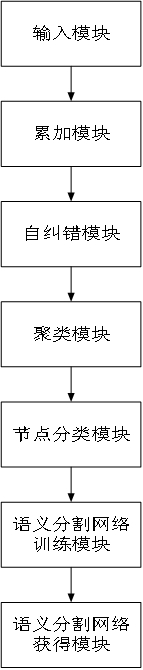
[0087] In this embodiment, a weakly supervised image semantic segmentation system based on node classification is disclosed, including:

[0088] The input module is used to input the original image into the classification network, and the network uses pre-trained parameters to obtain class activation maps of different categories according to the image-level labels.

[0089] The accumulation module is used for accumulating the class activation maps based on the class activation maps obtained in different training stages, using a pixel maximum accumulation strategy to obtain a class activation map with a larger outline.

[0090] The self-correcting module is used to let the network learn parameters by itself based on the perfected class activation map for the defects of the accumulation module itself, partially attenuate the class activation map, reduce noise, and obtain the initial pseudo-label.

[0091] The clustering module is used for the training process of the node-based c...

Embodiment 3

[0097] In this embodiment, an electronic device is disclosed, including a memory, a processor, and computer instructions stored in the memory and executed on the processor. When the computer instructions are executed by the processor, a method disclosed in Embodiment 1 is completed. The steps described in a weakly supervised image semantic segmentation method based on node classification.

the structure of the environmentally friendly knitted fabric provided by the present invention; figure 2 Flow chart of the yarn wrapping machine for environmentally friendly knitted fabrics and storage devices; image 3 Is the parameter map of the yarn covering machine
Login to View More

PUM

No PUM Login to View More

Abstract

The invention discloses a weakly supervised image semantic method and system based on node classification, aiming at transforming image semantic segmentation into a graph node classification problem. The method includes: inputting an original image into a classification network, and using image-level labels to obtain initial pseudo-labels; The initial pseudo-label is applied to node classification, and after training and CRF post-processing, the final image segmentation training label is obtained; the image is input into the segmentation network, and the optimized segmentation label is used for training to obtain the final result. The method provided by the present invention converts semantic segmentation into a node classification problem, introduces a graph model, fully considers the relationship between each pixel, and significantly improves the accuracy of a weakly supervised semantic segmentation model when only image-level annotations are used.

Description

technical field [0001] The invention relates to the field of computer vision, in particular to a method and system for semantic segmentation of weakly supervised images based on node classification. Background technique [0002] Semantic segmentation is an essential task in computer vision that aims to identify a class for each pixel in an image. Applied to various scenarios such as autonomous driving and intelligent medical care. Supervised learning based on convolutional neural networks has made significant progress in semantic segmentation. However, it is challenging to obtain fine-grained dataset labels, which are very expensive and time-consuming, and thus difficult to obtain in large batches. In contrast, weakly supervised datasets are easier to obtain. Therefore, it is of great significance to explore effective weakly supervised semantic segmentation methods. [0003] Classification models are widely used in weakly supervised semantic segmentation tasks due to the...

Claims

the structure of the environmentally friendly knitted fabric provided by the present invention; figure 2 Flow chart of the yarn wrapping machine for environmentally friendly knitted fabrics and storage devices; image 3 Is the parameter map of the yarn covering machine
Login to View More

Application Information

Patent Timeline
no application Login to View More
Patent Type & Authority Patents(China)
IPC IPC(8): G06V10/764G06V10/774G06V10/762G06K9/62G06V10/26
CPCG06F18/23213G06F18/24G06F18/214
Inventor 严慧张金凯
Owner NANJING UNIV OF SCI & TECH