Equipment fault positioning method based on natural language understanding
A natural language understanding and equipment failure technology, applied in natural language data processing, neural learning methods, semantic analysis, etc., can solve problems such as difficulty in inheriting knowledge and experience, difficulty in fault location, and high knowledge requirements for maintenance personnel, so as to improve the efficiency of equipment maintenance Effect
- Summary
- Abstract
- Description
- Claims
- Application Information
AI Technical Summary
Problems solved by technology
Method used
Image



Examples
Embodiment 1
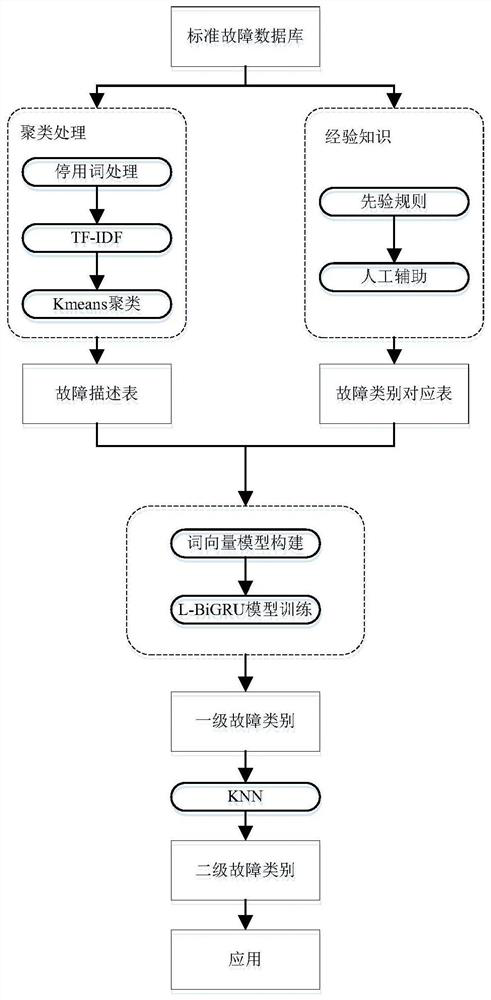
[0025] like figure 1 As shown, the technical solution of the present invention is: an apparatus fault location method based on natural language, including the following steps:
[0026] Step 1: Get historical fault data, establish a standard fault database according to the historical fault data; the fault description table and the fault category correspondence table are constructed according to the standard fault data.
[0027] The standard fault database contains product code, product number, fault description, fault location, fault time, failure cause, corrective action, and fault location.
[0028] Specifically, according to the standard fault database, construct a fault descriptor table and the fault category relationship, including: according to the priori rule, the history of the history fault data in the standard fault database performs data extraction and the storage operation, fault Category Relations correspondence table, see Table 1 - Table 3.
[0029] It should be noted...
Embodiment 2
[0057]This paper uses a fault description data to discriminate the fault category using the fault description data. The overall method is divided into two steps of the generation of the word feature vector and the construction of the fault diagnosis model. The specific content is as follows:
[0058] Step 1: The generation of the word feature vector
[0059] The depth learning model requires a standardized, structural feature as an input of the model, so in order to introduce text data to the text data, the speech feature vector is obtained to lay the foundation for the training of the subsequent depth learning model. Since the characteristics generated by the TF-I DF method do not take into account the context semantics information described in the text, the Word2VEC model is used in accordance with the Word2VEC model to all fault data (including maintenance scheme data, fault description data, reason) based on the contextual text semantics technology. Outfield phone data, etc.),...
Embodiment 3
[0086] like Figure 4 As shown, for example, the performance is not satisfied as an example, the "performance difference" is input, and the classification model is used to classify the fault category.
[0087] The maintenance personnel can follow the "Dismantably Differences", "Differential Poor", "Using Problem", "Using Problem", "Using Problem", "Using Problem", "Using Problem", "Using Problem", "Using Problem".
PUM
 Login to View More
 Abstract
Description
Claims
Application Information
 Login to View More