Check patentability & draft patents in minutes with Patsnap Eureka AI!

Time-varying hop count constraint shortest path solving method based on dynamic neural network

A technology of dynamic neural network and constrained shortest path, which is applied in neural learning methods, biological neural network models, neural architectures, etc., can solve problems that are difficult to solve the shortest path problem, and achieve significant application significance and the effect of increasing computing speed

Pending Publication Date: 2022-04-12
TIANJIN UNIVERSITY OF TECHNOLOGY
View PDF0 Cites 0 Cited by
  • Summary
  • Abstract
  • Description
  • Claims
  • Application Information

AI Technical Summary

Problems solved by technology

Although these methods have many advantages in solving the shortest path problem with hop constraints on static networks, it is difficult to solve the shortest path problem with hop constraints on non-static networks (such as time-varying networks)

Method used

the structure of the environmentally friendly knitted fabric provided by the present invention; figure 2 Flow chart of the yarn wrapping machine for environmentally friendly knitted fabrics and storage devices; image 3 Is the parameter map of the yarn covering machine
View more

Image

Smart Image Click on the blue labels to locate them in the text.
Viewing Examples
Smart Image
  • Time-varying hop count constraint shortest path solving method based on dynamic neural network
  • Time-varying hop count constraint shortest path solving method based on dynamic neural network
  • Time-varying hop count constraint shortest path solving method based on dynamic neural network

Examples

Experimental program
Comparison scheme
Effect test

Embodiment Construction

[0042] The present invention will be described in detail below with reference to the accompanying drawings and examples.

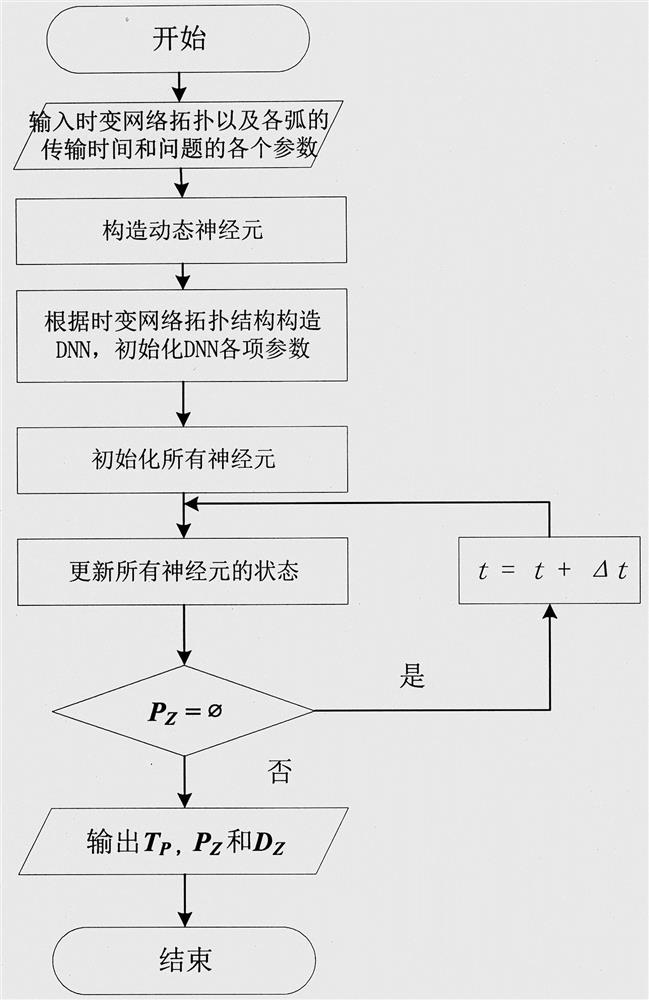
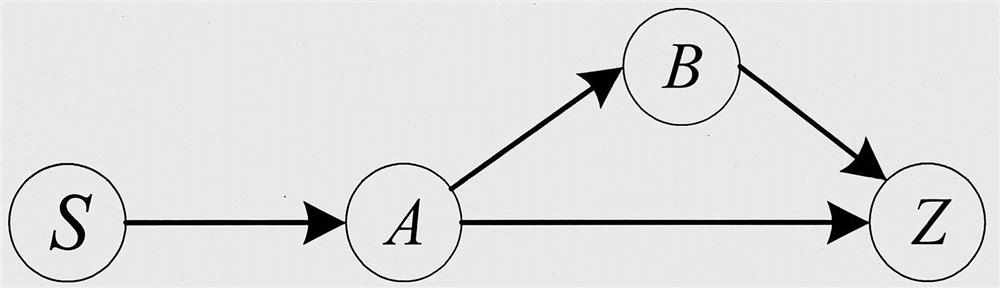
[0043] A minimum path solving method based on time-varying hop count based on dynamic neural network, the implementation of the overall process of constraints of the time-varying network hop number figure 1 Down; given a time-varying network of four nodes four sides (eg figure 1Disted), the transmission time of each of its strips is: Asking 0 hour, the number of hops from nodes S to Node Z does not exceed 3, and the specific embodiments include the following and steps:

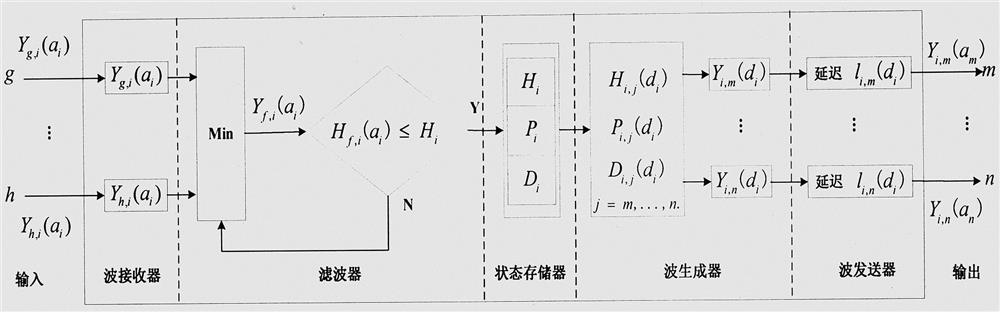
[0044] Step 1, design DN, each DN contains seven parts, such as image 3 Indicated.

[0045] Step 2, the dynamic neural network is constructed, and the parameters of DNN are initialized, and the specific steps are as follows:

[0046] Step 2.1, create a four neuronal neural network, such as Figure 4 Indicated;

[0047] Step 2.2, the neuron s is set as a source neuron, and the neuron z is set...

the structure of the environmentally friendly knitted fabric provided by the present invention; figure 2 Flow chart of the yarn wrapping machine for environmentally friendly knitted fabrics and storage devices; image 3 Is the parameter map of the yarn covering machine
Login to View More

PUM

No PUM Login to View More

Abstract

The invention provides a dynamic neural network (DNN), which is used for solving a time-varying hop count constrained shortest path problem (time-varying hop count constrained shortest path problem (HC-TSPP), which is used for solving a time-varying hop count constrained shortest path problem (HC-TSPP), which is used for solving a time-varying hop count constrained shortest path problem (HC-TSPP), which is used for solving a time-varying hop count constrained shortest path problem (HC-TSPP), and is used for solving a time-varying hop count constrained shortest path problem (HC-TSPP). The purpose of the HC-TSPP is to find a path with shortest transmission time and limited arc number. The proposed DNN is a novel neural network based on dynamic neurons. All neurons on the DNN are in parallel calculation, and each dynamic neuron is composed of seven parts: an input, a wave receiver, a filter, a state memory, a wave generator, a wave transmitter and an output. Waves are carriers for neuron communication, and each wave is composed of three parts. The reporting of the shortest path is based on a first wave that reaches the destination node and satisfies hop count constraints. Experimental results show that the method provided by the invention can solve the globally optimal solution of the problem.

Description

Technical field [0001] The present invention relates to the field of shortest path solving, and more particularly to a time-varying hop number based on a dynamic neural network. Background technique [0002] The shortest path problem is the shortest path problem that is looking for the shortest distance between the two nodes and the number of hops does not exceed the constraint. This issue is widely used in communication networks and project scheduling networks. As we know, this issue is first initialized by Dahl and Gouveia, and they study the shortest path problem with hopping on the network. So far, many methods have been used to solve the shortest path problem of hopular constraints on a static network. Although these methods have many advantages on solving the shortest path problem with hop constraints on the static network, it is difficult to solve the shortest path problem with hopped constraints on the non-static network (at time-changing network). Time-change network is ...

Claims

the structure of the environmentally friendly knitted fabric provided by the present invention; figure 2 Flow chart of the yarn wrapping machine for environmentally friendly knitted fabrics and storage devices; image 3 Is the parameter map of the yarn covering machine
Login to View More

Application Information

Patent Timeline
no application Login to View More
IPC IPC(8): G06Q10/04G06N3/04G06N3/08G06N3/063
Inventor 黄玮徐志磊王劲松
Owner TIANJIN UNIVERSITY OF TECHNOLOGY
Features
  • R&D
  • Intellectual Property
  • Life Sciences
  • Materials
  • Tech Scout
Why Patsnap Eureka
  • Unparalleled Data Quality
  • Higher Quality Content
  • 60% Fewer Hallucinations
Social media
Patsnap Eureka Blog
Learn More