
Method for screening medicine for relieving morphine tolerance
A morphine tolerance and drug technology, applied in drug combinations, pharmaceutical formulations, compound screening/testing, etc., to achieve the effect of solving tolerance problems
- Summary
- Abstract
- Description
- Claims
- Application Information
AI Technical Summary
Problems solved by technology
Method used
Image

Examples
Embodiment 1
[0043] Example 1: Determination of the expression level of TRPC5 protein in the formation of morphine tolerance (the western blot experiments in the present invention are all carried out with reference to the "Guidelines for Molecular Biology Experiments"):
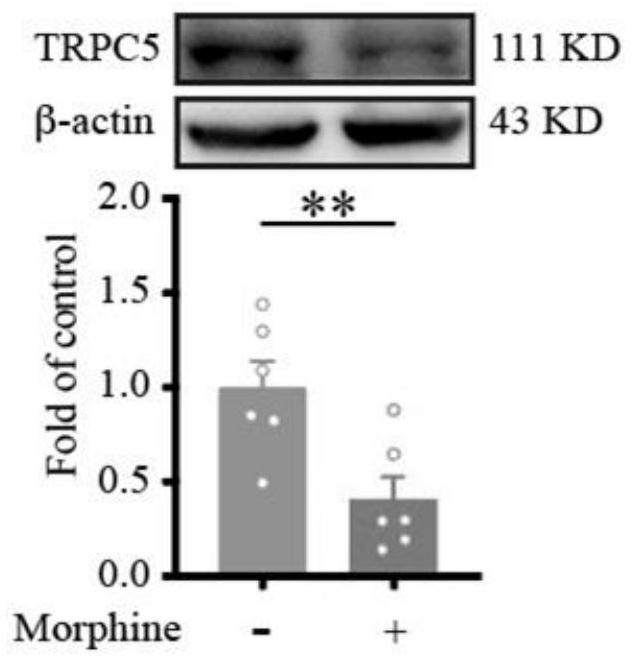
[0044] In vivo experiment: ICR mice were randomly divided into groups of 10. Each group was intrathecally injected with 10 μg (administration volume) / 10 μl (administration volume) morphine every day for 7 consecutive days. -L5), the protein expression of TRPC5 was detected by western blot. The experimental results showed that morphine could significantly down-regulate the protein level of TRPC5 (n=6), **p figure 2 shown).
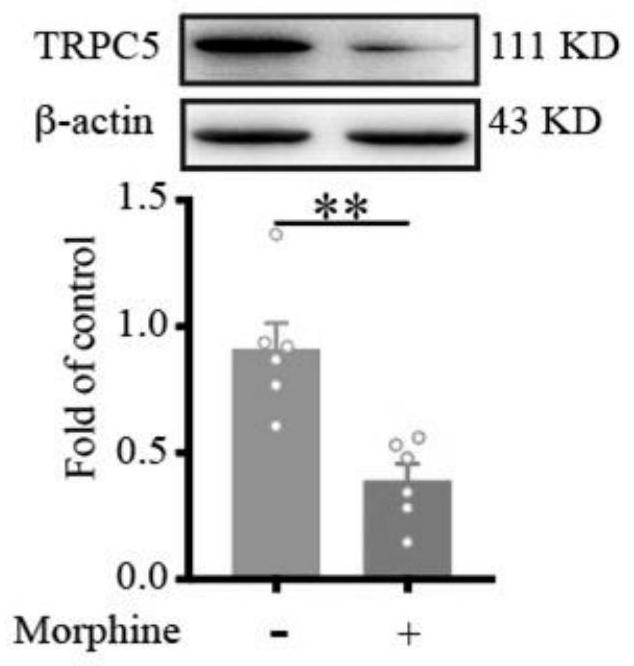
[0045] In vitro experiments: In neuronal cell line (SH-SY5Y), after stimulation with 200 μM final concentration of morphine for 14 h, the protein expression of TRPC5 was detected by western blot. The experimental results showed that morphine could significantly down-regulate neuronal cells Protein leve...
Embodiment 2
[0046] Example 2: TRPC5 protein was used as the target to detect the improvement effect of TRPC5 agonists (Riluzole hydrochoride) on morphine tolerance. By opening the TRPC5 channel, it promotes the influx of calcium ions, thereby enhancing the efflux of GABA, and improving the analgesic effect of morphine.
[0047] Riluzole hydrochloride powder was purchased from MCE with a solubility of 100 mg / ml in DMSO (dimethyl sulfoxide), 50 mg of the powder was dissolved in 500 μl DMSO to give a 100 mg / ml stock solution. The 10 mg / ml morphine stock solution was diluted 10-fold with physiological saline to obtain 10 mg / 10 ml morphine (solution 1). The groups were set as control group (normal saline, saline), morphine group, morphine and TRPC5 agonist (Riluzole hydrochoride) co-administration group, and TRPC5 agonist (Riluzole hydrochoride) group. Wherein, 100 mg / ml riluzole hydrochloride stock solution was dissolved in 10 mg / 10 ml morphine to obtain a solution (solution 2) containing 2 ...
Embodiment 3
[0049]Example 3: Using TRPC5 protein as a target to detect TRPC5 agonist (BTD, 6-methyl-N-[3-(tricyclo[3.3.1.13,7]decyloxy)propyl]-4H-1, Ameliorative effect of 2,4-benzothiadiazine-3-propionamide-1,1-nitrogen dioxide) on morphine tolerance. BTD powder was purchased from TOCRIS, and 10 mg of the powder was dissolved in 217.58 μl DMSO to prepare a BTD stock solution with a concentration of 100 mM, ie, 46 μg / μl. The groups were set as control group (normal saline, saline), morphine group, morphine and TRPC5 agonist (BTD) co-administration group, and TRPC5 agonist (BTD) group. Wherein, 46 μg / μl BTD stock solution was dissolved in 10 mg / 10 ml morphine, to obtain a solution (solution 3) containing 2 μg / 10 μl TRPC5 agonist (BTD) in 10 μg / 10 μl morphine.
[0050] ICR mice were randomly divided into groups of 10. Each group was injected intrathecally with 10 μl of normal saline, 10 μl of solution 1, 10 μl of solution 3, and 10 μl of TRPC5 agonist (2 μg / 10 μl, BTD) for 30 min every day...
PUM
 Login to View More
 Abstract
Description
Claims
Application Information
 Login to View More