
Branched benzene siliconic oil
A technology of phenyl silicone oil and branched chain type, applied in the field of branched chain type phenyl silicone oil and its preparation, can solve the problems of limited application, high refractive index, difficulty and the like, and achieve the effect of high safety
- Summary
- Abstract
- Description
- Claims
- Application Information
AI Technical Summary
Problems solved by technology
Method used
Image

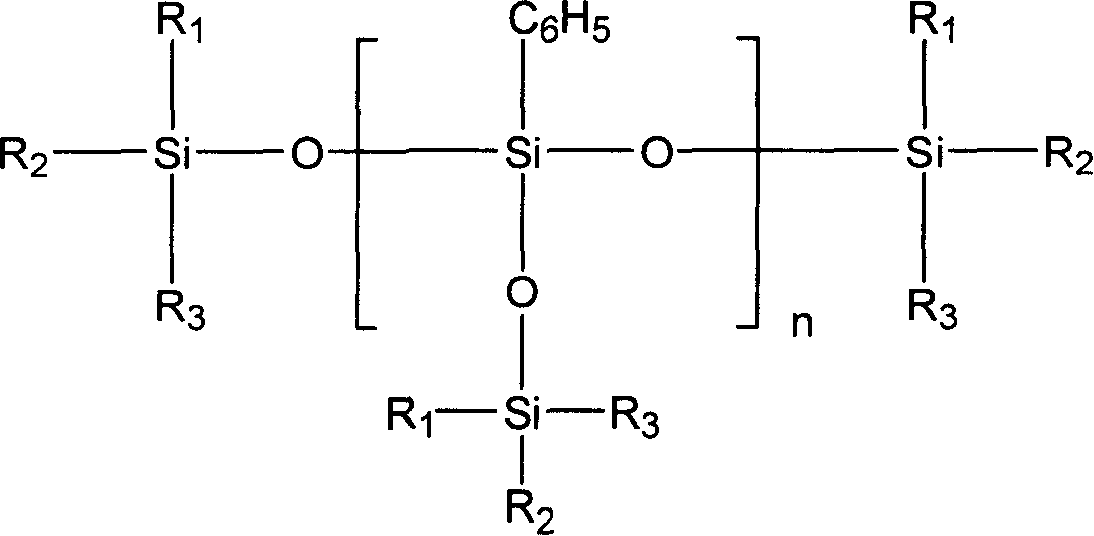
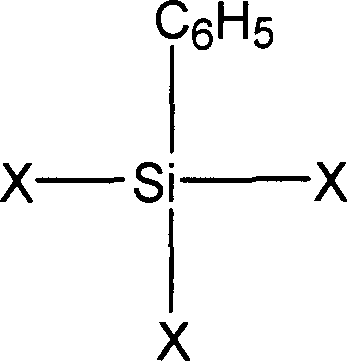
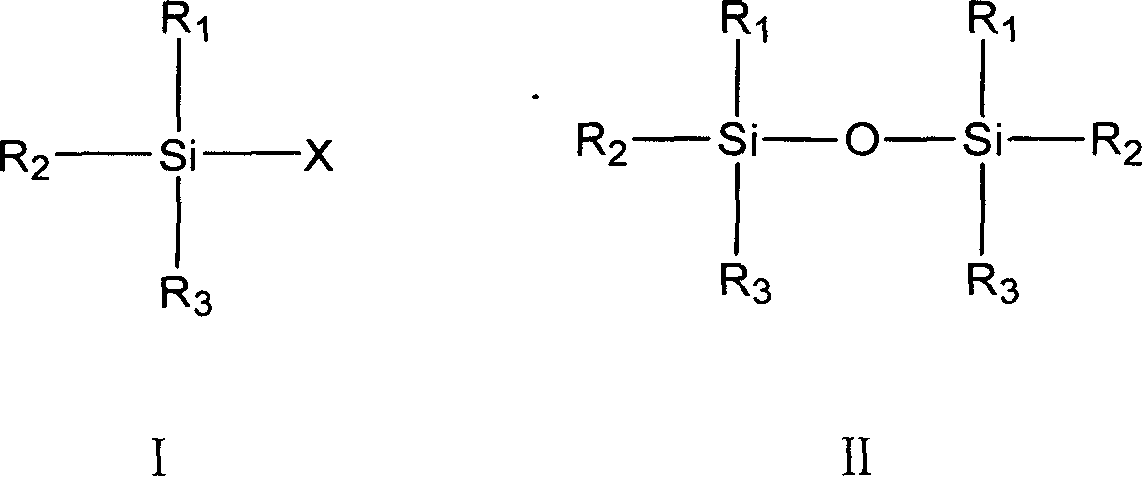
Examples
Embodiment 1
[0060] Add 565g of deionized water into a 1L four-necked flask and stir, mix 131g of phenyltrichlorosilane and 174g of trimethylchlorosilane evenly, and uniformly drop them into the flask within 8 hours, and control the reaction temperature at 5°C; After the temperature is raised to 60°C, react for another 1 hour. After the reaction, let stand to separate the water; wash the oil phase repeatedly with alkali and water until neutral; then distill under reduced pressure at 1.3KPa and 100°C for 4 hours; , adding activated carbon, raising the temperature to 50°C, stirring for 0.5 hours, and then suction filtering to obtain 132 g of a colorless and odorless product with a viscosity of 28 mPa.s, a refractive index of 1.4669, and a specific gravity of 1.005.
Embodiment 2
[0062] Add 290g of deionized water and 52g of hydrochloric acid with a mass concentration of 36% into a 1L four-necked flask and stir, mix 162g of phenyltriethoxysilane and 350g of trimethylethoxysilane evenly, and drop them evenly within 1 hour into the flask, control the reaction temperature at 50°C; after the dropwise addition, raise the temperature to 80°C, and react for another 6 hours; after the reaction, let stand to separate the water; wash the oil phase repeatedly with alkali and water until it is neutral; Distill under reduced pressure at ℃ for 4 hours; after cooling down to room temperature, add activated carbon, raise the temperature to 80 ℃, stir for 2 hours, and then filter with suction to obtain 160 g of a colorless and odorless product with a viscosity of 15 mPa.s, a refractive index of 1.4552, and a specific gravity of 0.9726.
Embodiment 3
[0064]Add 222g of deionized water and 72g of hydrochloric acid with a mass concentration of 38% into a 1L four-necked flask and stir, mix 196g of phenyltriethoxysilane and 400g of hexamethyldisiloxane evenly, and drop them evenly within 2 hours Into the flask, control the reaction temperature at 60°C; after the dropwise addition, raise the temperature to 75°C, and then react for 3 hours. Distill under reduced pressure at ℃ for 2 hours; after cooling down to room temperature, add activated carbon, raise the temperature to 40 ℃, stir for 4 hours, and then filter with suction to obtain 210 g of a colorless and odorless product with a viscosity of 20 mPa.s, a refractive index of 1.4600, and a specific gravity of 0.9804.
PUM
| Property | Measurement | Unit |
|---|---|---|
| Viscosity | aaaaa | aaaaa |
| Viscosity | aaaaa | aaaaa |
| Viscosity | aaaaa | aaaaa |
Abstract
Description
Claims
Application Information
 Login to View More