Check patentability & draft patents in minutes with Patsnap Eureka AI!

System and method for multi-site cellular manufacturing with transportation delays

a multi-site cellular manufacturing and transportation delay technology, applied in the field of planning and scheduling arts, can solve the problems of limited application of multi-site or shop environment, inability to explore the option of scheduling jobs among multiple single-site shops, and high computational cost of multi-site scheduling

Active Publication Date: 2020-08-04
XEROX CORP
View PDF37 Cites 0 Cited by
  • Summary
  • Abstract
  • Description
  • Claims
  • Application Information

AI Technical Summary

Benefits of technology

The solution improves overall efficiency in document production by reducing late jobs and average turnaround time, while maintaining backward compatibility with single-site scheduling algorithms, and effectively handles both single and multi-site scenarios without significant computational overhead.

Problems solved by technology

The absence of this capability in existing toolkits, limits their application to multi-site or shop environments.
LDP implementations have so far been applied to shops that assume a single geographical location (i.e., single-site shops), and the option to schedule jobs among multiple single-site shops has been left largely unexplored.
One reason for this is that multi-site scheduling can be computationally expensive, especially since some of the large single-site shops have already caused the current LDP toolkit to run out of memory or take several hours to find a complete schedule.
While some of these issues can be fixed with a more efficient implementation, the lack of a formal scheduling framework for dealing with shops spanning multiple geographical locations presents a challenge.
Simply put, there is currently no multi-site scheduling capability in LDP or similar products for the printing industry.

Method used

the structure of the environmentally friendly knitted fabric provided by the present invention; figure 2 Flow chart of the yarn wrapping machine for environmentally friendly knitted fabrics and storage devices; image 3 Is the parameter map of the yarn covering machine
View more

Image

Smart Image Click on the blue labels to locate them in the text.
Viewing Examples
Smart Image
  • System and method for multi-site cellular manufacturing with transportation delays
  • System and method for multi-site cellular manufacturing with transportation delays
  • System and method for multi-site cellular manufacturing with transportation delays

Examples

Experimental program
Comparison scheme
Effect test

case 1

[0031]In a multi-site setting, a shop can have zero, one and / or two local job lists, covering the following four cases:[0032] Zero local job list, if the shop does not have any local jobs (i.e., it only handles outsourced jobs).[0033]Case 2: One outsourceable local job list, if the shop only has outsourceable local jobs.[0034]Case 3: One non-outsourceable local job list, if the shop only has non-outsourceable local jobs.[0035]Case 4: Two local job lists, if the shop has both types of local jobs (i.e., outsourceable and non-outsourceable).

[0036]Note that only Case 3 above corresponds to the traditional single-site case, and all the other three cases are new concepts of multi-site scheduling with no obvious single-site counterparts. One reason to distinguish these four cases is to increase code re-use and ensure backward compatibility with single-site job lists and scheduling algorithms.

[0037]Next a particular scheduling algorithm is provided (as also described in a flow diagram in FI...

the structure of the environmentally friendly knitted fabric provided by the present invention; figure 2 Flow chart of the yarn wrapping machine for environmentally friendly knitted fabrics and storage devices; image 3 Is the parameter map of the yarn covering machine
Login to View More

PUM

No PUM Login to View More

Abstract

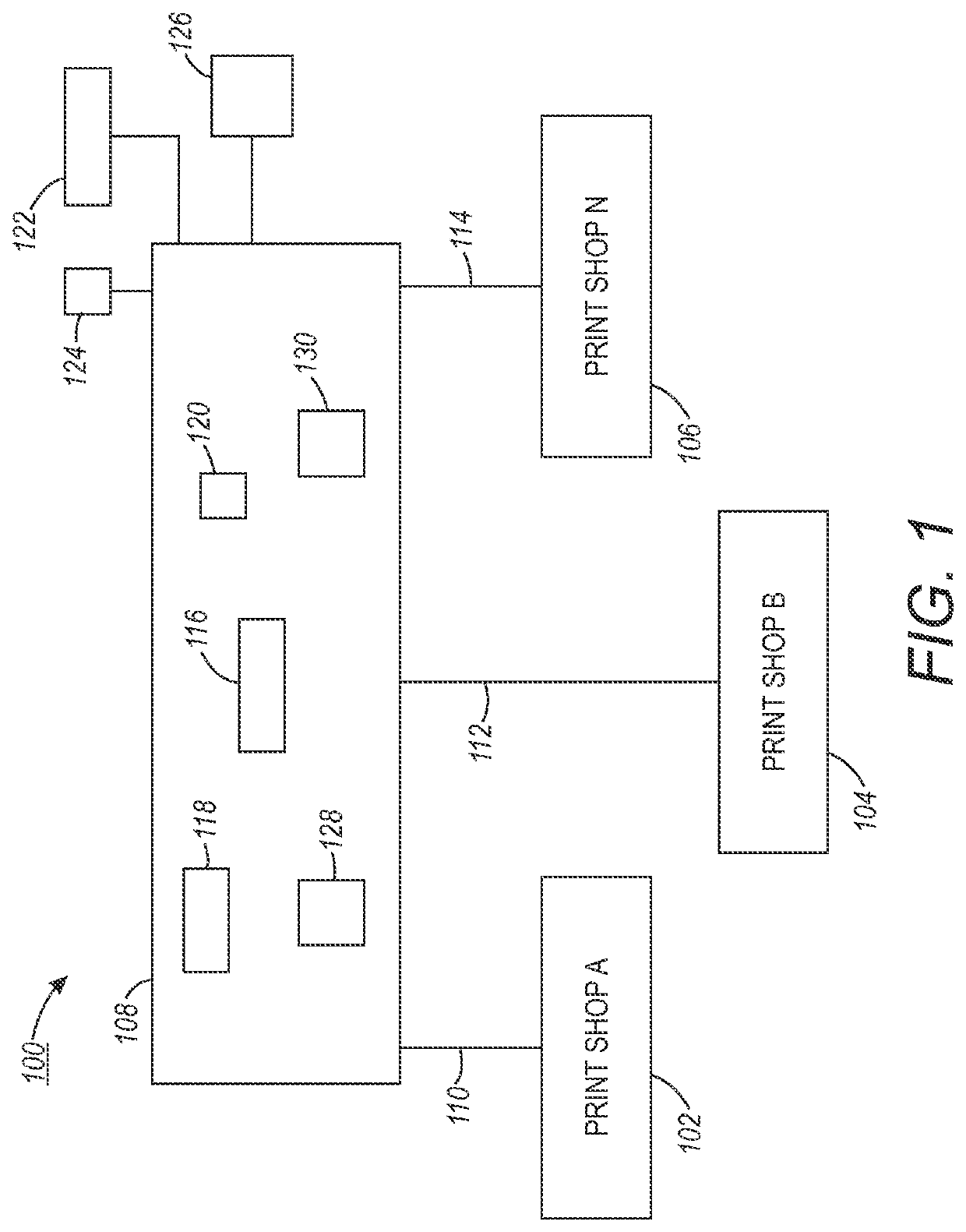
A system and method is used to manage scheduling of a plurality of print jobs in a multi-site print shop environment. The multi-site environment includes a plurality of print shops each having resources and equipment to complete at least one type of print job. Also included is a multi-site scheduler configuration arranged to assign and schedule print jobs to one of a home shop and a non-home shop. The assigning and scheduling is based on a fastest completion time, wherein a completion time of a print job in a home shop is defined as the actual time taken to complete the print job and a completion time of a print job in a non-home shop is defined as the actual time taken to complete the print job and a transportation delay.

Description

BACKGROUND[0001]The present application is directed to the planning and scheduling arts, and more particularly to planning and scheduling of jobs for the production or manufacture of products, where the products may be produced or manufactured at a plurality of distributed sites or shops.[0002]The problem of planning and scheduling in a distributed manufacturing environment with multiple shop locations is a natural extension to the basic “single-site” setup in which all production activities take place at one centralized location. To better consolidate resources and reduce costs, there is a need to provide high-throughput planning and scheduling capabilities for “multi-site” shops with geographical constraints. This feature is now missing from existing document production toolkits, such as the Lean Document Production (LDP) toolkit developed by Xerox Corporation. The absence of this capability in existing toolkits, limits their application to multi-site or shop environments.[0003]Le...

Claims

the structure of the environmentally friendly knitted fabric provided by the present invention; figure 2 Flow chart of the yarn wrapping machine for environmentally friendly knitted fabrics and storage devices; image 3 Is the parameter map of the yarn covering machine
Login to View More

Application Information

Patent Timeline
no application Login to View More
Patent Type & Authority Patents(United States)
IPC IPC(8): G06F3/12G06Q10/06H04N1/32
CPCH04N1/32545G06F3/126G06F3/1238G06F3/1282G06Q10/0631G06F3/1212
Inventor ZHOU, RONGRAI, SUDHENDUDO, MINH BINHLAMBRECHT, CRAIG
Owner XEROX CORP
Features
  • R&D
  • Intellectual Property
  • Life Sciences
  • Materials
  • Tech Scout
Why Patsnap Eureka
  • Unparalleled Data Quality
  • Higher Quality Content
  • 60% Fewer Hallucinations
Social media
Patsnap Eureka Blog
Learn More