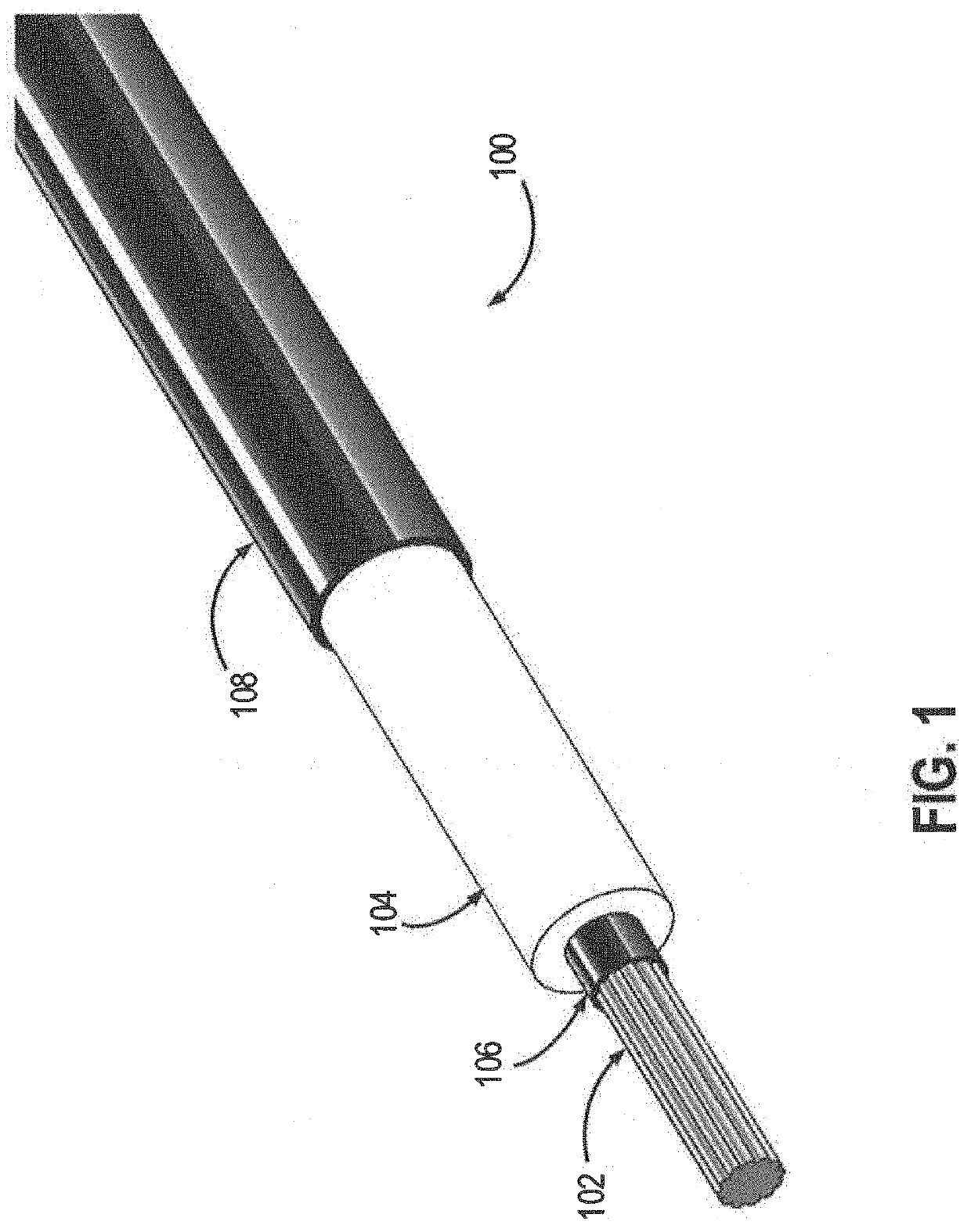
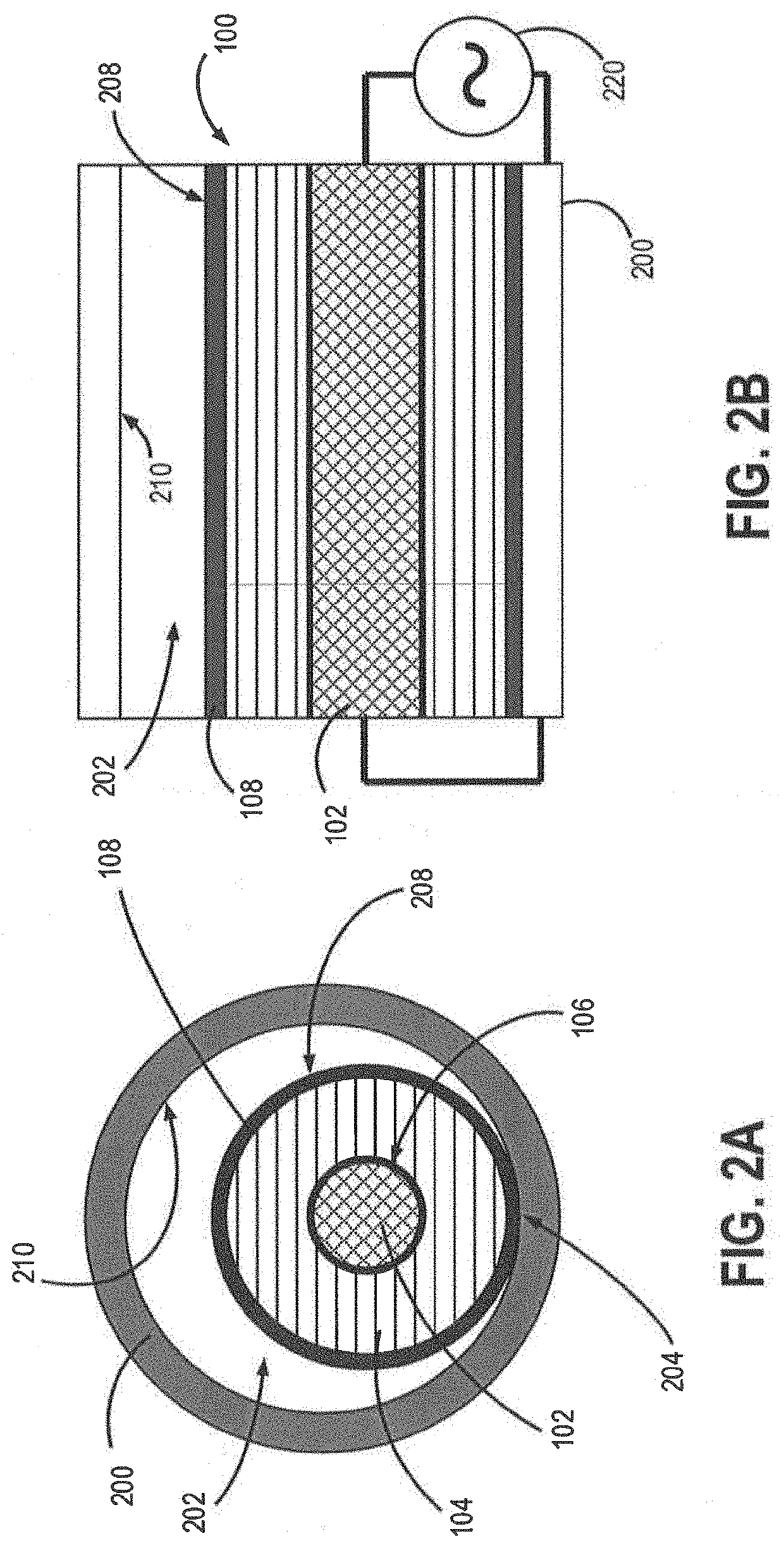
[0006]Embodiments of the invention overcome the aforementioned drawbacks by providing a heater cable that may be installed to heat long pipelines using as few discrete lengths of heater cable as possible, in order to maximize circuit lengths, which minimizes the number of discreet circuits needed for the pipeline. In particular, the invention provides a heater cable that can be rated at higher voltages while maintaining partial discharge at an acceptable level. The heater cable includes commonly-used materials, particularly electrical insulation materials, but is capable of withstanding a continuous applied voltage that exceeds the commonly applicable rated voltages of such materials without creating undesirable levels of partial discharge. The heater cable comprises a core conductor and an electrical insulation layer surrounding the core conductor. The heater cable further comprises an outer exposed semiconductive layer surrounding the electrical insulation layer. The semiconductive layer is in physical and electrical contact with an inner diameter of a ferromagnetic heat tube.
[0008]In one embodiment, the outer semiconductive layer has a resistivity whereby, when an alternating current is applied to the conductor at a voltage exceeding 5 kV up to about 10 kV or 14 kV (e.g., the outer semiconductive layer is over an insulating layer of silicone), partial discharge of the heater cable does not exceed 20 nanocoulombs. In another aspect, the outer semiconductive layer has a resistivity whereby, when an alternating current is applied to the conductor at a voltage between about 2.5 kV and about 5 kV or 7 kV (e.g., the outer semiconductive layer is over an insulating layer of perfluoroalkoxy polymer (PFA)), partial discharge of the heater cable does not exceed 1 nanocoulomb, and further may not exceed 10 picocoulombs. Additionally, in any aspect, no more than an insignificant portion of a return electric current, the return electric current flowing on the inner surface of the heat tube in opposite direction to the alternating current of the conductor, is diverted to the outer semiconductive layer, such that the loss by the heat tube of the insignificant portion does not affect heat output of the heat tube. The resistivity of the outer semiconductive layer can be between 10−1 and 105 ohm-cm inclusive, or more particularly between 5 and 1000 ohm-cm inclusive, and even more particularly between 5 and 50 ohm-cm inclusive. The outer semiconductive layer can be an extruded layer that is extruded onto the electrical insulation layer. Or, the outer semiconductive layer can be a semiconductive tape wrapped around the electrical insulation layer.
[0010]In another embodiment, the invention provides a heater cable for a skin effect heating system. The heater cable includes a core conductor, an electrical insulation layer surrounding the core conductor, and an outer semiconductive layer surrounding the electrical insulation layer, the outer semiconductive layer contacting an inner surface of a ferromagnetic heat tube such that the heater cable forms an electrical circuit with the heat tube and a power source applying an alternating current to the core conductor, the electrical circuit causing skin effect heating of the heat tube. The outer semiconductive layer reduces partial discharge of the heater cable when the alternating current is applied continuously to the core conductor at a voltage exceeding 3 kV, or more particularly 3.5 kV, or even more particularly 5 kV.
[0011]In one embodiment, for a cable having a silicone insulating layer, the outer semiconductive layer can have a resistivity that limits partial discharge of the heater cable to no greater than 20 nanocoulombs, or at or below 10 picocoulombs; the outer semiconductive layer can further prevent flow of a substantial portion of an electric current flowing on the inner surface of the heat tube into the outer semiconductive layer. The outer semiconductive layer can reduce partial discharge of the heater cable when the alternating current is applied continuously to the core conductor at a voltage of 10 kV to 14 kV, inclusive. In another embodiment, for a cable having a PFA insulating layer, the outer semiconductive layer can have a resistivity that limits partial discharge of the heater cable to at most 1 nanocoulomb, or more specifically at most 10 picocoulombs while a voltage of 3.5 kV to 7.5 kV, inclusive, or more particularly 3 kV or 3.5 kV or 5 kV, is applied to the core conductor.


 Login to View More