Method for estimating a probability distribution of the maximum coefficient of friction at a current and/or future waypoint of a vehicle
What is AI technical title?
AI technical title is built by Patsnap AI team. It summarizes the technical point description of the patent document.
a technology of probability distribution and current and/or future waypoints, applied in probabilistic networks, external condition input parameters, instruments, etc., can solve problems such as inability to predict the direction of the vehicle, the completeness of the physical model, and the need for knowledge of appropriate functional relationships
Active Publication Date: 2021-08-17
LUCAS AUTOMOTIVE GMBH +1
View PDF7 Cites 0 Cited by
Summary
Abstract
Description
Claims
Application Information
AI Technical Summary
This helps you quickly interpret patents by identifying the three key elements:
Problems solved by technology
Method used
Benefits of technology
Benefits of technology
[0008]The invention addresses the problem of specifying a method and the device for estimating a probability distribution of the maximum coefficient of friction at a current and / or future waypoint of a vehicle, which can be performed at runtime and efficiently combines both direct and indirect methods in the sense of a fusion of data.
[0013]A Bayesian network is a directed acyclic graph, the nodes of which represent random variables and the edges of which represent conditional dependencies. As is known to those skilled in the art, every node has a conditional probability distribution that depends on the probability distribution of the predecessor nodes. The use of the Bayesian network as a meta-model permits the computation of the probability distribution of the maximum coefficient of friction at the current waypoint of the vehicle by efficiently using a variety of existing data, preferably all existing data. At the same time, these basic data are used together with a probability distribution of the maximum coefficient of friction at the future waypoint to obtain a prediction quality for the maximum coefficient of friction at the future waypoint.
[0018]Expediently, the vehicle acceleration is additionally taken into consideration in the determination and / or evaluation of the likelihood-probability distribution. As a result, the quality of the estimation of the friction coefficient can be improved, since, in principle, this increases with increasing utilization of the coefficient of friction.
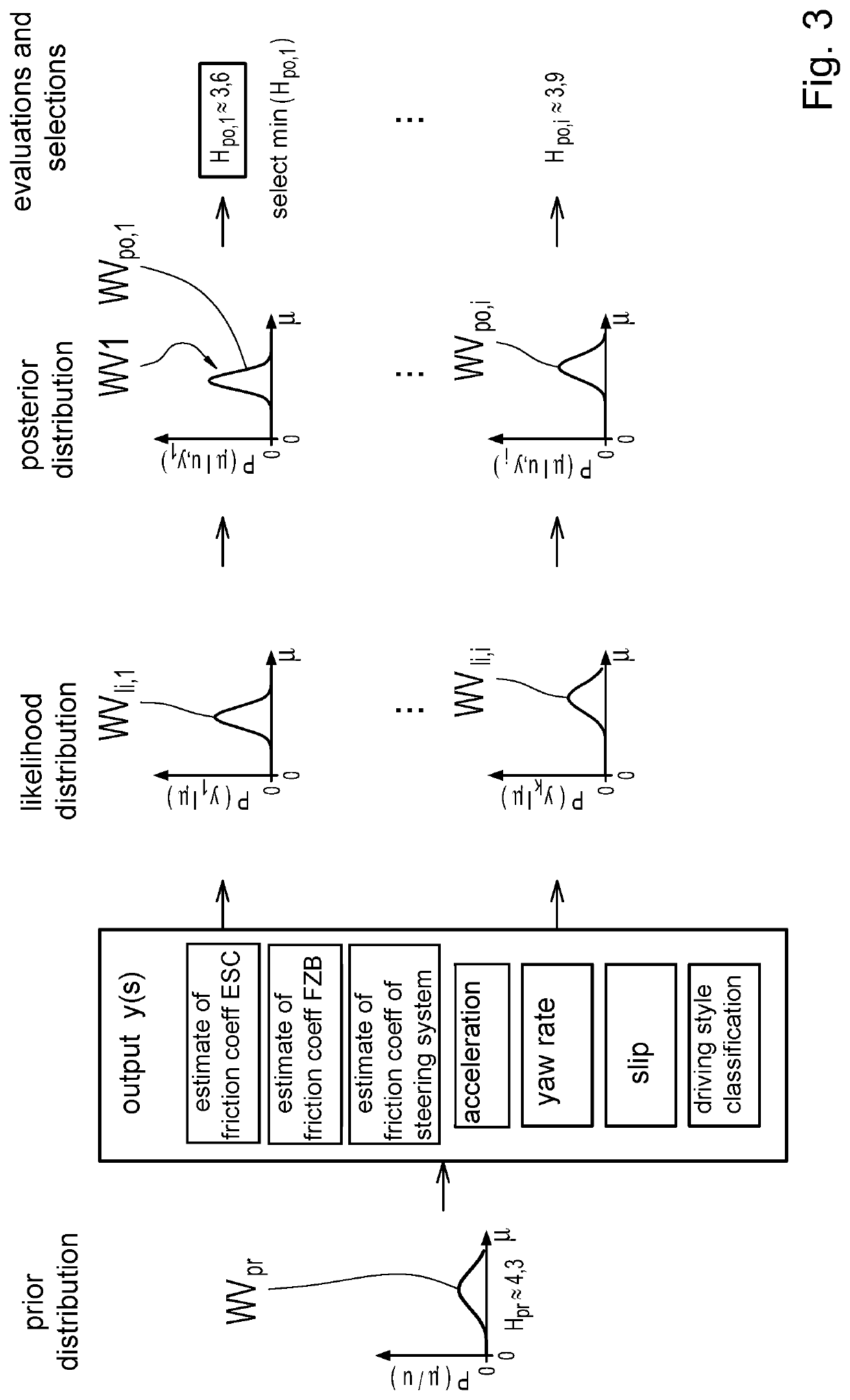
[0019]It may furthermore be advantageous if the evaluation of the relevant posterior probability distribution and the selection of one of the posterior probability distributions are performed by means of entropy. An evaluation of the selected posterior probability distribution can also be based on its entropy. In the present method, it is expedient if the smallest possible entropy is obtained, as then the determination of the maximum coefficient of friction at the current waypoint is the most accurate. If the entropy is high, however, the prediction quality on the maximum coefficient of friction at the current waypoint is negatively affected. Therefore, it is expedient if, in the case of a large entropy, a direct, active method is used, e.g. a targeted (wheel-specific) steering and / or braking / acceleration intervention. By increasing a force in the longitudinal and / or transverse direction, the statement quality improves at the output node of the Bayesian network. This results in an improved overall posterior probability distribution, in turn improving the prediction quality.
Problems solved by technology
Sudden changes in the coefficients of friction, such as those caused by changes in environmental conditions, can result in unstable driving situations and cause accidents.
It is particularly dangerous if the driver of the vehicle approaches a curve too fast due to an incorrect assessment of the existing maximum coefficient of friction.
Driver assistance systems that enable this intervention, however, require knowledge of the maximum coefficient of friction at a future waypoint of the vehicle.
The disadvantage is the required completeness of the physical model and the required knowledge of appropriate functional relationships.
This requires a high sensory effort.
Method used
the structure of the environmentally friendly knitted fabric provided by the present invention; figure 2 Flow chart of the yarn wrapping machine for environmentally friendly knitted fabrics and storage devices; image 3 Is the parameter map of the yarn covering machine
View more
Image
Smart Image Click on the blue labels to locate them in the text.
Viewing Examples
Smart Image
Click on the blue label to locate the original text in one second.
Reading with bidirectional positioning of images and text.
Smart Image
Examples
Experimental program
Comparison scheme
Effect test
Embodiment Construction
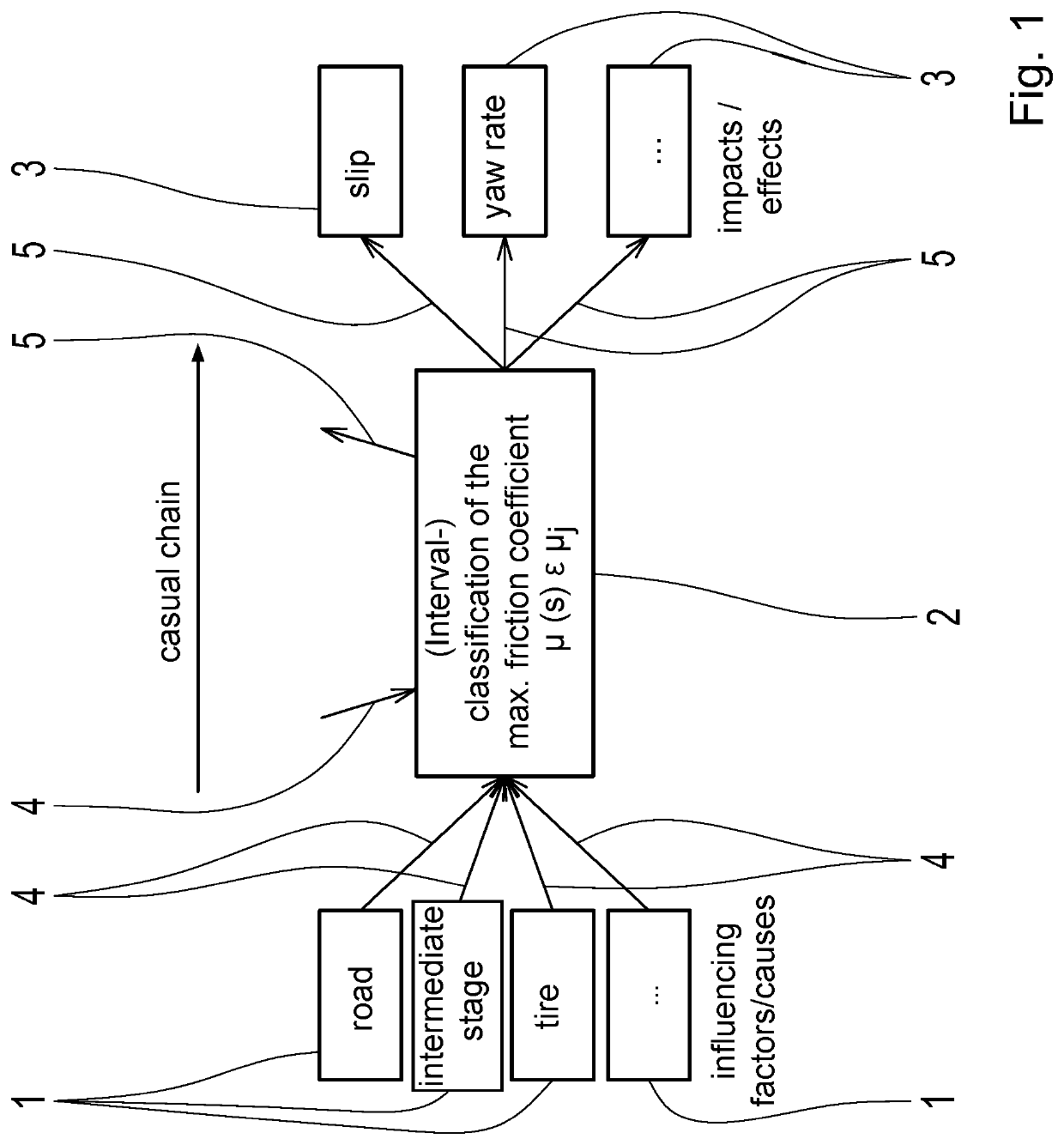
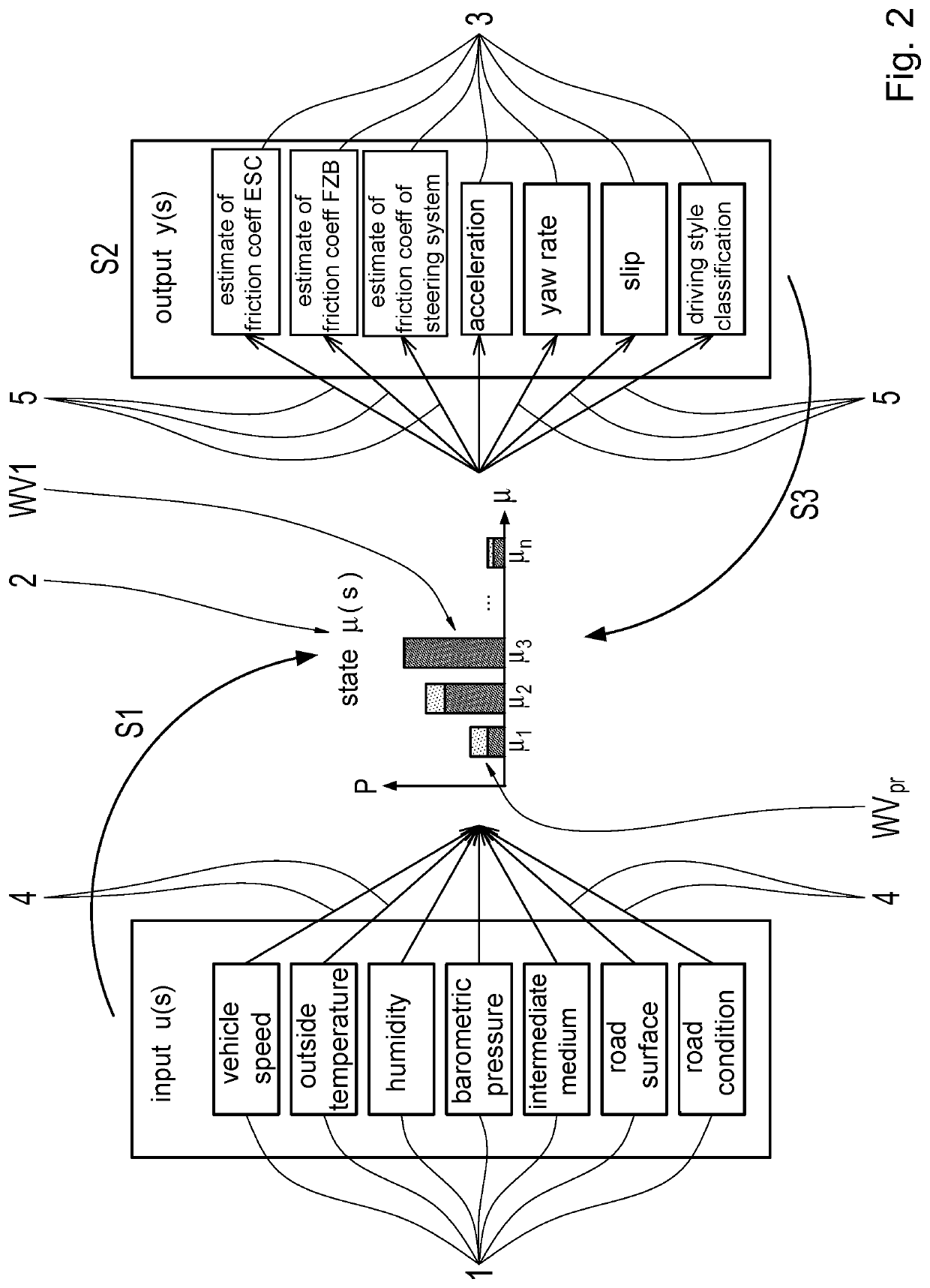
[0032]The method is based on a simplified Bayesian network, which consists of the nodes 1, 2, 3 and the edges 4, 5 and represents a three-stage causal chain, as shown in FIG. 1. The causal chain consists of influencing factors or causes u of the maximum coefficient of friction μ, the maximum coefficient of friction p itself and effects or effects y, which represent outputs of the Bayesian network according to FIG. 1. Interdependencies between the nodes 1 representing the influencing factors and the node 2 representing the maximum coefficient of friction are modeled as directed edges 4. Likewise, interdependencies between the node 2 representing the maximum coefficient of friction p and the node 2 representing the max. impact are modeled as directed edges 5. It will be appreciated that the Bayesian network may also include fewer (e.g., determination of a prior probability distribution at a future waypoint described below) or more than three causal stages. The latter is particularly t...
the structure of the environmentally friendly knitted fabric provided by the present invention; figure 2 Flow chart of the yarn wrapping machine for environmentally friendly knitted fabrics and storage devices; image 3 Is the parameter map of the yarn covering machine
Login to View More
PUM
Login to View More
Abstract
A method for estimating a probability distribution of the maximum coefficient of friction (μ) at a current and / or future waypoint (s, s*) of a vehicle. According to the method, a first probability distribution (WV1) for the maximum coefficient of friction (μ) at the waypoint (s) of the vehicle is determined by a Bayesian network from a first data set, which is, or was determined, for one, in particular current, waypoint (s) of the vehicle and which characterizes the maximum coefficient of friction (μ) at the waypoint (s) of the vehicle.
Description
[0001]This application is a National Stage completion of PCT / EP2017 / 061264 filed May 11, 2017, which claims priority from German patent application serial no. 10 2016 209 984.1 filed Jun. 7, 2016.FIELD OF THE INVENTION[0002]The invention relates to a method and a device for estimating a probability distribution of the maximum coefficient of friction at a current and / or at least one future waypoint of a moving vehicle.BACKGROUND OF THE INVENTION[0003]The detection or determination of the maximum coefficient of friction between tire and road surface or the detection of a road condition (for example, dry, wet, snowy and icy), from which a coefficient of friction can be derived, is an important prerequisite to assist the driver in his driving task and to avoid serious accidents. Generally, the assessment of the road conditions is up to the driver, who must adapt his / her driving style accordingly. Vehicle control systems such as Electronic Stability Control (ESC) / Traction Control System ...
Claims
the structure of the environmentally friendly knitted fabric provided by the present invention; figure 2 Flow chart of the yarn wrapping machine for environmentally friendly knitted fabrics and storage devices; image 3 Is the parameter map of the yarn covering machine
Login to View More
Application Information
Patent Timeline
Application Date:The date an application was filed.
Publication Date:The date a patent or application was officially published.
First Publication Date:The earliest publication date of a patent with the same application number.
Issue Date:Publication date of the patent grant document.
PCT Entry Date:The Entry date of PCT National Phase.
Estimated Expiry Date:The statutory expiry date of a patent right according to the Patent Law, and it is the longest term of protection that the patent right can achieve without the termination of the patent right due to other reasons(Term extension factor has been taken into account ).
Invalid Date:Actual expiry date is based on effective date or publication date of legal transaction data of invalid patent.


 Login to View More
  Login to View More