
Cell flow apparatus and method for real-time measurements of patient cellular responses
a cell flow and patient technology, applied in the field of patient cellular response real-time measurement, can solve the problems of abnormal cell response, tissue or organ malfunction, and the inability to distinguish between agonist and antagonist activity of the compound,
- Summary
- Abstract
- Description
- Claims
- Application Information
AI Technical Summary
Benefits of technology
Problems solved by technology
Method used
Image

Examples
example 2
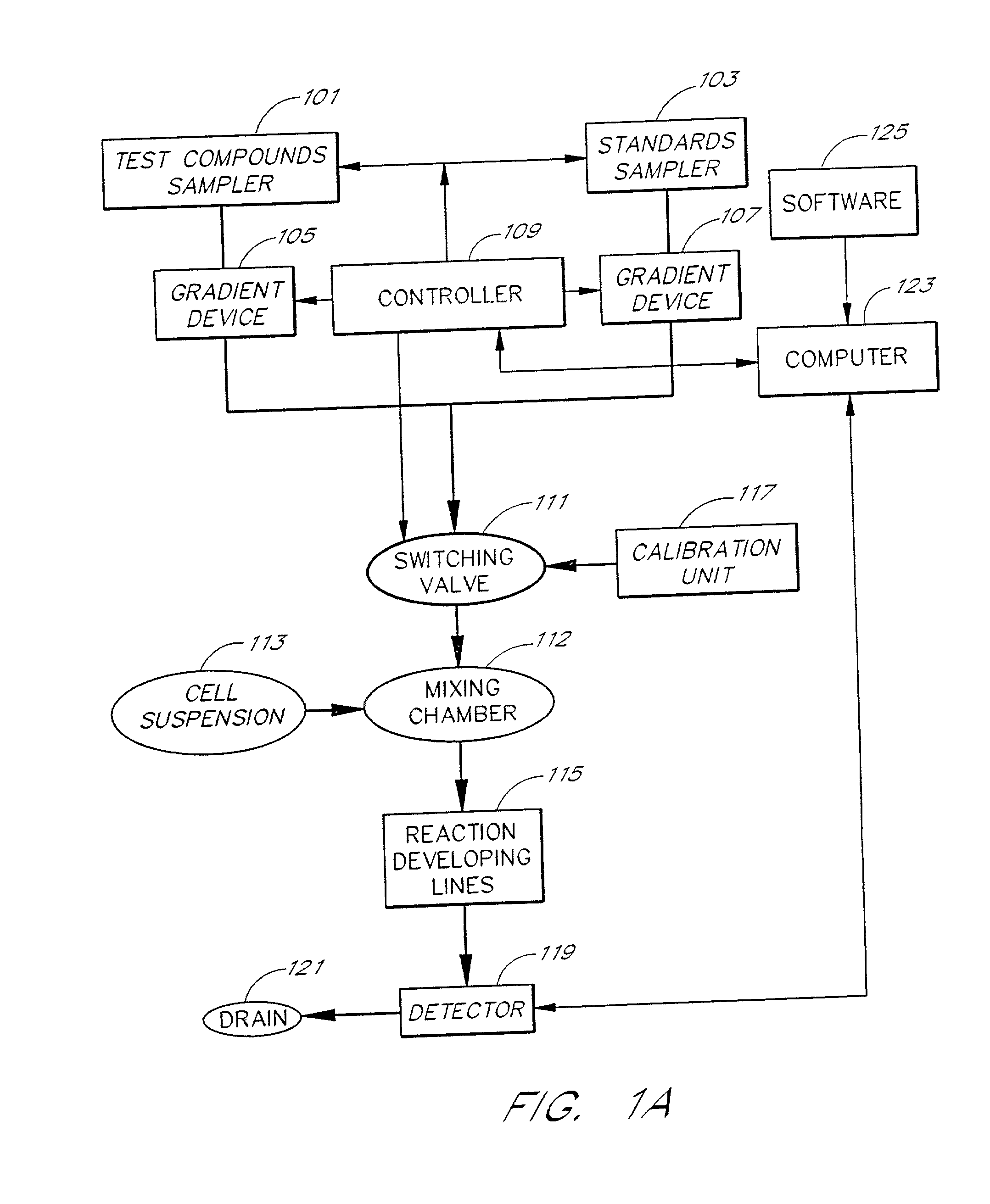
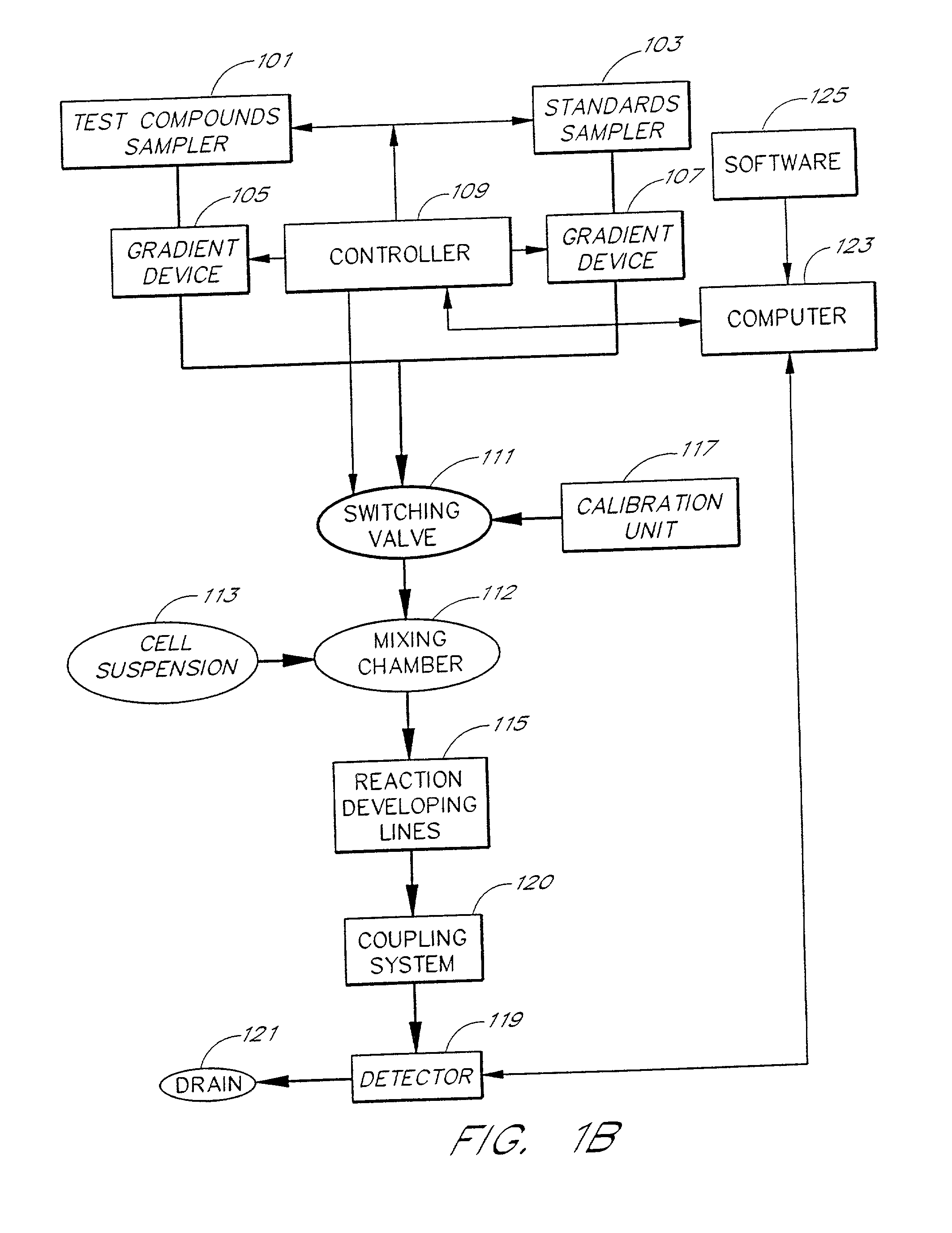
[0411] FIG. 12 illustrates the inhibition of ET-1 induced intracellular calcium mobilization with BQ-123 in TE-671 cells. The same cell physiometer apparatus and cell preparation procedure was used here as in Example 1.
[0412] In this experiment, ET-1 was introduced at a constant concentration from the "standard" sipper nozzle of the inventive apparatus and BQ-123 was introduced through the "compound" nozzle of the apparatus. In this example, as in Example 1, the concentration run was five minutes and the reaction time (from mixing to detection) was forty seconds.
[0413] Briefly, after calibration of the device of FIG. 4A with minimum and maximum standards (337, 339), ET-1 solution, an agonist standard solution, was directed at a predetermined concentration prepared by proportioning valve 327 by mixing it with DPBS buffer, through priming valve 329, mixing zone 331, diverting valve 333 and priming valve 341 and then into mixing zone 343, where it was mixed with a suspension of TE-671 ...
example 3
[0414] FIG. 13 shows the "null method" experiment design (Lazareno & Birdsall, 1993, incorporated herein by reference). This example uses the same instrument and the same reagents as in Examples 1 and 2.
[0415] In this example, a first concentration gradient of ET-1 coming from the "standard" nozzle 323 of the inventive apparatus is prepared with the buffer solution coming from the "compound" nozzle. When the final ET-1 concentration has reached the value of 40 pM, the gradient device 1 keeps the ET-1 concentration constant and gradient device 2 starts raising the concentration of the BQ-123 coming from the "compound" nozzle. One can switch the agonist gradient over to an antagonist at any predetermined concentration of the agonist.
example 4
[0416] The devices of the present invention may be used to determine the pattern of cell surface receptors expressed in one or more cell types as follows. Each of the different cell types to be tested is placed in one of a plurality of cell suspension reservoirs, or, if a single cell type is to be examined, an apparatus with a single cell suspension reservoir may be used to hold the cells. The effects of one or more test agents known to influence the activity of particular receptors are measured by combining the cell suspensions with the test agents to form a test mixture, directing the test mixture through a detection zone, and measuring the cellular response using the procedures described above. Preferably, the test agents comprise one or more receptor agonists. However, in some embodiments the test agent may be an antagonist or a mixture of an agonist and an antagonist.
[0417] The cellular response may be activation of cellular activity if the test agent is a receptor agonist. Alt...
PUM
| Property | Measurement | Unit |
|---|---|---|
| inner diameter | aaaaa | aaaaa |
| wavelengths | aaaaa | aaaaa |
| wavelengths | aaaaa | aaaaa |
Abstract
Description
Claims
Application Information
 Login to View More