In usage, the adhesive spray coats not only the elastic elements but also "oversprays" to other sites, causing a number of undesirable consequences.
First, the garment materials that are "oversprayed," e.g., portions of the topsheet, the bottom sheet, and the absorbent core, become rigid upon hardening of the "oversprayed" adhesive making the garment less comfortable for its wearer.
Second, the "overspray" coats parts of the
assembly machinery that must then be periodically cleaned of the adhesive.
Third, the elastic elements may not be uniformly coated with the adhesive due to the nature of the spraying operation, and therefore the elastic elements may not bond to the garment materials as well as if they had been more uniformly and completely coated with the adhesive.
Finally, the "overspray" is wasted adhesive, increasing the cost of materials for the finished garment.
Previous attempts have been made to reduce the amount of excess adhesive that is applied to the garment, but these efforts have proved inadequate for reducing garment stiffening caused by the "plywood effect" and for reducing the cost of the garment due to excessive adhesive use.
Louis et al., which is incorporated herein by reference in its entirety, discloses an adhesive pattern for applying adhesives to the gathers, but such adhesive patterns still contribute to excessive garment stiffness and cost.
U.S. Pat. No. 6,235,137 issued to Van Eperen et al., which is incorporated herein by reference in its entirety, discloses a method of
coating an elastic strand with a filament of adhesive, but this
coating process is still subject to overspraying, and does not provide a complete
coating of adhesive on the elastic.
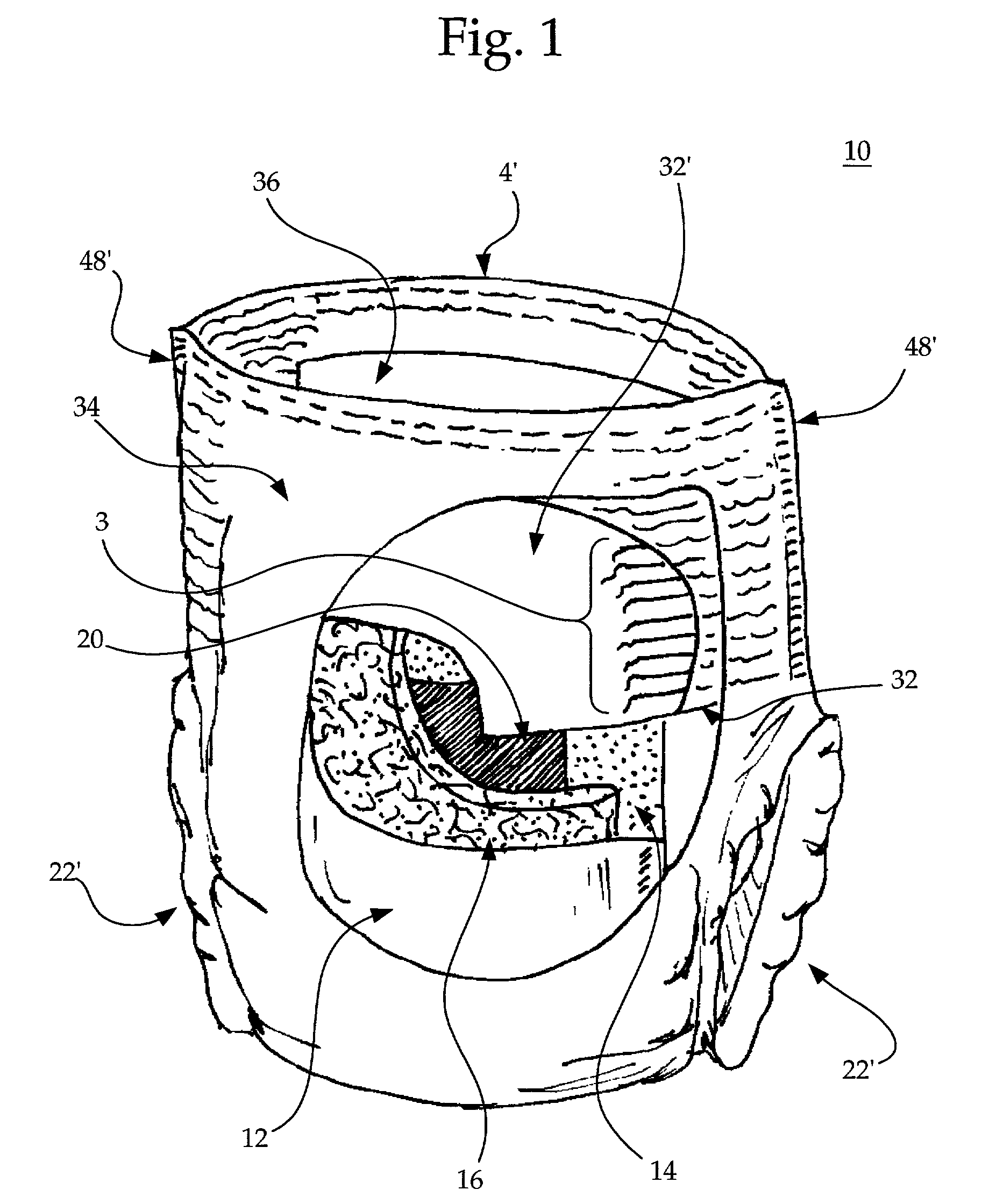
Absorbent garments often loosen during use for various reasons, such as inelastic stretching of the various components, changes in user size, and increased loading caused by the introduction of body exudates into the garment 10.
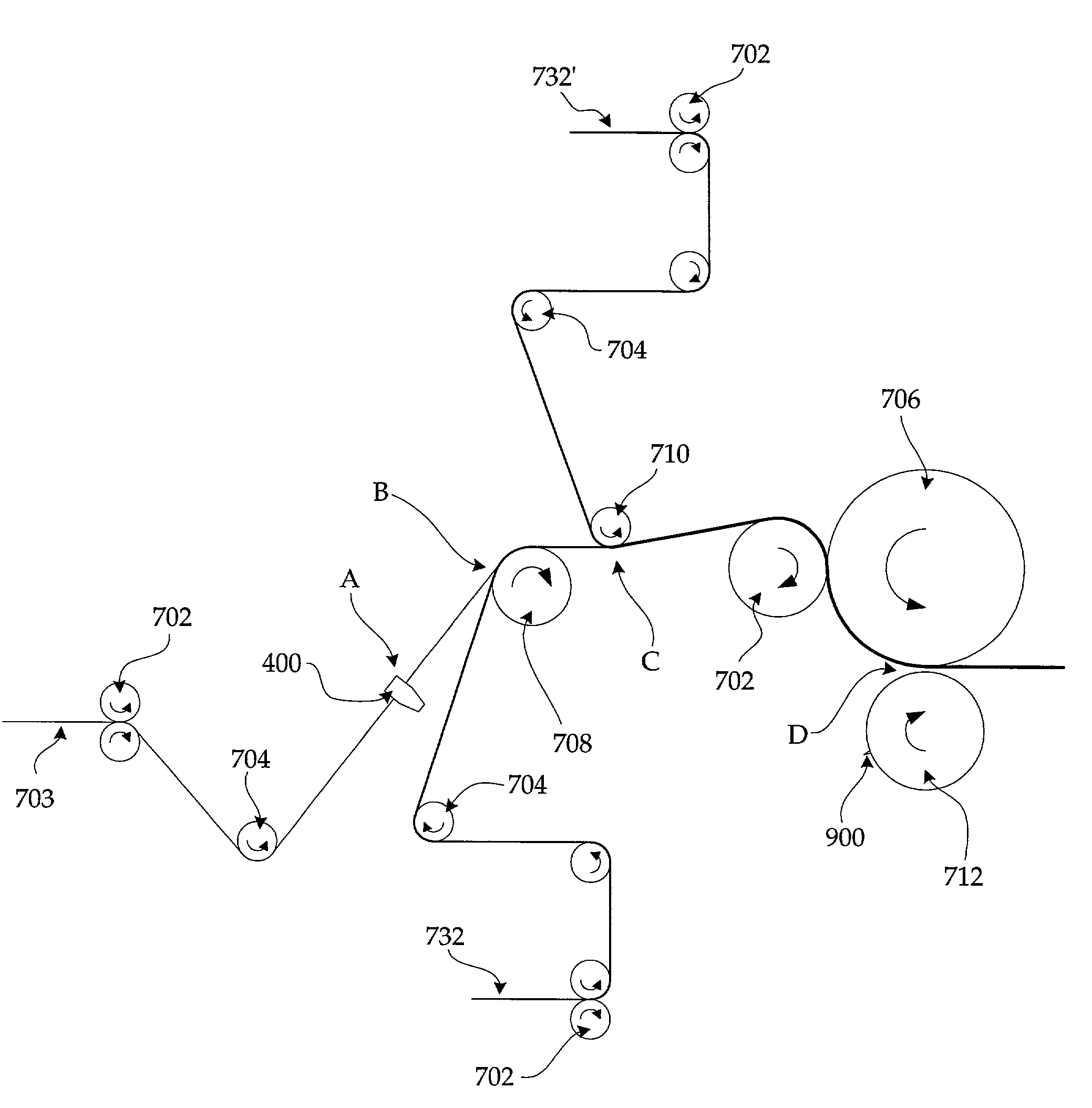
If the slot is too wide (dimension W in FIG. 6B) relative to the strand's periphery, e.g.,
diameter (dimension D in FIG. 6B), then an excessive amount of adhesive may pass through the adhesive passage 404, leading to, for example, wasted adhesive, clogging in the slot 404 and undesirable adhesive accumulations on other parts of the machinery and the garment.
If the adhesive passage 404 is too tall, excess adhesive may accumulate within the slot, degrading performance and requiring more frequent service.
If the strands 602 are moving too fast, then they may receive an insufficient amount of adhesive coating, and may spray adhesive outside the comb applicator 400, causing undesirable adhesive build-up on other parts of the
machine or the
assembly.
If the strands are moving too slow, then they may receive too much adhesive, and unapplied adhesive may flow out of the comb applicator 400 and build up on the surrounding machinery and assembly.
The flow rate of the adhesive may also
impact the adhesive application process.
The adhesive coating techniques of the prior art used multiple
pressurized spray guns to eject adhesive onto the elastic strands, leading to excessive adhesive usage and undesirable overspray.
Such techniques also do not fully and uniformly coat the elastic strands, thereby providing a weaker bond with the underlying
sheet material to which the elastic strands are attached.



 Login to View More