Unlock instant, AI-driven research and patent intelligence for your innovation.

Method, apparatus and system that cache promotion information within a processor separate from instructions and data

Active Publication Date: 2004-04-15
INTELLECTUAL DISCOVERY INC
View PDF24 Cites 18 Cited by
  • Summary
  • Abstract
  • Description
  • Claims
  • Application Information

AI Technical Summary

Problems solved by technology

If the processor does not have a reservation for the memory granule, the store-conditional instruction fails and the memory update is not performed.
This conventional lock acquisition sequence incurs high overhead not only because of its length but also because of the conditional nature of reservations.
That is, a first processor may lose a reservation for a lock before successfully acquiring the lock (through execution of a store-conditional instruction) if a second processor stores to (or acquires ownership of) the lock first.
Consequently, if a lock is highly contended, a processor may make a reservation for a lock and lose the reservation many times prior to successfully acquiring the lock through execution of a store-conditional instruction.
Consequently, the processors locked out of the interconnect may stall for lack of data while the reservation is held.
Obviously, this solution does not scale well, particularly for systems running code in which locks are highly contended.
First, conventional lock acquisition and release sequences that employ load-reserve and store-conditional instructions require the inclusion of special purpose reservation registers and reservation management circuitry within each processor, undesirably increasing processor size and complexity.
Second, as noted above, the typical lock acquisition and release sequence is inherently inefficient because of the conditional nature of reservations.
As a result, overall system performance degrades.
Third, the lock acquisition and release methodologies outlined above do not scale well.
For example, in the conventional lock acquisition instruction sequence, the overhead incurred in acquiring a lock increases with the scale of the data processing system.
Such design compromises, though viewed as necessary, significantly diminish the amount of useful work that can be effectively distributed over multiple processors.

Method used

the structure of the environmentally friendly knitted fabric provided by the present invention; figure 2 Flow chart of the yarn wrapping machine for environmentally friendly knitted fabrics and storage devices; image 3 Is the parameter map of the yarn covering machine
View more

Image

Smart Image Click on the blue labels to locate them in the text.
Viewing Examples
Smart Image
  • Method, apparatus and system that cache promotion information within a processor separate from instructions and data
  • Method, apparatus and system that cache promotion information within a processor separate from instructions and data
  • Method, apparatus and system that cache promotion information within a processor separate from instructions and data

Examples

Experimental program
Comparison scheme
Effect test

first embodiment

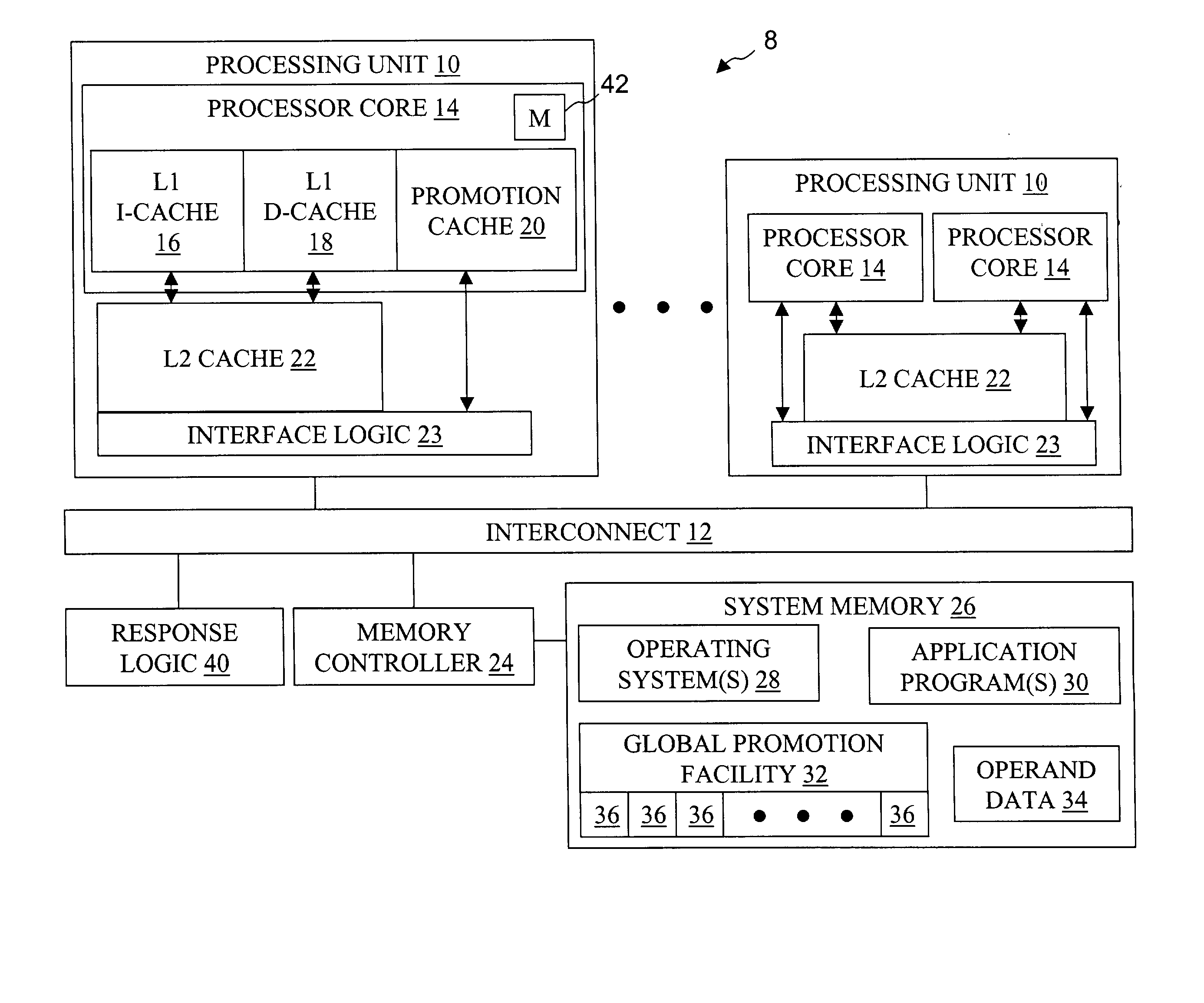
[0037] Referring now to FIG. 2A, there is depicted a more detailed block diagram of a processor core 14 in accordance with the present invention. As shown, processor core 14 has an instruction sequencing unit 50 that fetches instructions for processing from L1 I-cache 16 utilizing real addresses obtained by the effective-to-real address translation (ERAT) performed by instruction memory management unit (IMMU) 52. Of course, if the requested cache line of instructions does not reside in L1 I-cache 16, then ISU 50 requests the relevant cache line of instructions from L2 cache 22 via I-cache reload bus 54.

[0038] After instructions are fetched and preprocessing, if any, is performed, instructions are dispatched to execution units 60-68, possibly out-of-order, based upon instruction type. That is, condition-register-modifying instructions and branch instructions are dispatched to condition register unit (CRU) 60 and branch execution unit (BEU) 62, respectively, fixed-point and load / store...

second embodiment

[0040] In the processor architecture depicted generally in FIG. 2A, various execution units (and therefore differing instruction sequences) may be employed to access promotion cache 20 to acquire and release locks and perform other inter-component coordination functions. For example, FIG. 2A illustrates an implementation in which LSU 66 accesses promotion bits 36 (within optional promotion cache 20 or from global promotion facility 32) in response to special-purpose or general-purpose load and store instructions. FIG. 2B depicts an alternative second embodiment in which BEU 62 sets a promotion bit 36 (e.g., to acquire a lock) within optional promotion cache 20 or within global promotion facility 32 in response to a special branch instruction, and LSU 66 resets a promotion bit 36 (e.g., to release a lock) in response to a store instruction. Of these and other design options within the scope of the present invention, differing designs may be preferable, depending upon implementation-s...

the structure of the environmentally friendly knitted fabric provided by the present invention; figure 2 Flow chart of the yarn wrapping machine for environmentally friendly knitted fabrics and storage devices; image 3 Is the parameter map of the yarn covering machine
Login to View More

PUM

No PUM Login to View More

Abstract

A data processing system includes a global promotion facility and a plurality of processing units coupled by an interconnect. At least one processing unit among the plurality of processing units includes one or more second caches having cache arrays in which instructions and operand data are cached, an instruction sequencing unit, an execution unit that executes an acquisition instruction to acquire a promotion bit field within the global promotion facility exclusive of at least one other processing unit, and a promotion cache separate from the one or more second caches. In response to acquisition of the promotion bit field by the first processor, the promotion cache of the first processor stores the promotion bit field separately from instructions and operand data.

Description

[0001] 1. Technical Field[0002] The present invention relates in general to data processing and, in particular, to allocating and accessing resources within a data processing system. In at least one embodiment, the present invention relates still more particularly to a method and system for efficiently allocating and accessing promotion facilities, such as locks, in a data processing system.[0003] 2. Description of the Related Art[0004] In shared memory multiprocessor (MP) data processing systems, each of the multiple processors in the system may access and modify data stored in the shared memory. In order to synchronize access to a particular granule (e.g., cache line) of memory between multiple processors, programming models often require a processor to acquire a lock associated with the granule prior to modifying the granule and release the lock following the modification.[0005] In a multiprocessor computer system, multiple processors may be independently attempting to acquire th...

Claims

the structure of the environmentally friendly knitted fabric provided by the present invention; figure 2 Flow chart of the yarn wrapping machine for environmentally friendly knitted fabrics and storage devices; image 3 Is the parameter map of the yarn covering machine
Login to View More

Application Information

Patent Timeline
no application Login to View More
IPC IPC(8): G06F9/46G06F12/08
CPCG06F9/52G06F12/0815G06F9/30087G06F9/30072G06F9/3004
Inventor ARIMILLI, RAVI KUMARWILLIAMS, DEREK EDWARD
Owner INTELLECTUAL DISCOVERY INC