[0009] Accordingly, an object of the present invention is to provide a clamp for elongated objects such as pipe, in which the vibration absorbing mechanism for reducing the transmission of vibration between an elongated object and a support can be realized in a simple shape, and can reduce the transmission not only of vibration in the circumferential direction relative to the elongated object, but also of vibration having a component in the axial direction of the elongated object.
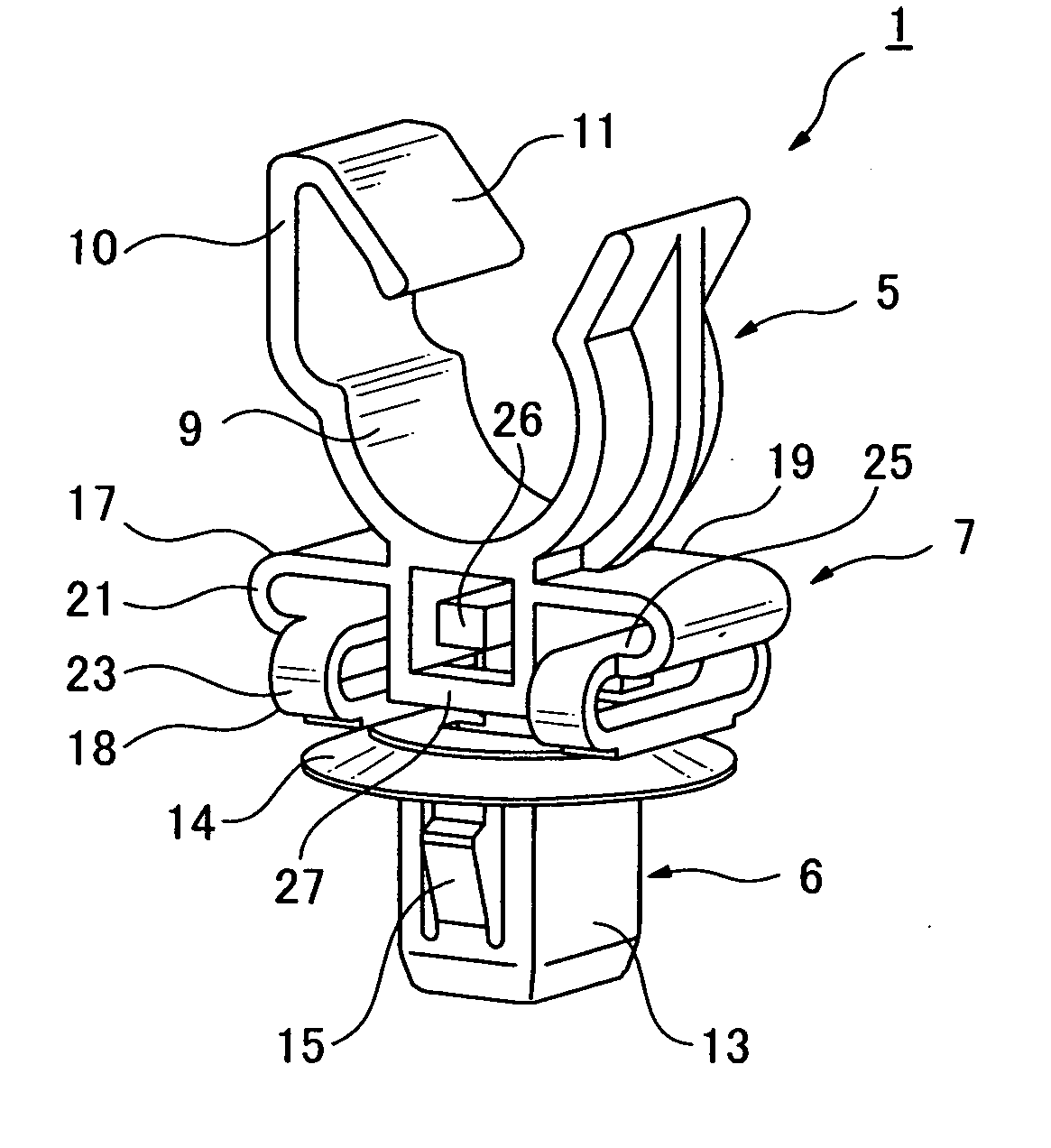
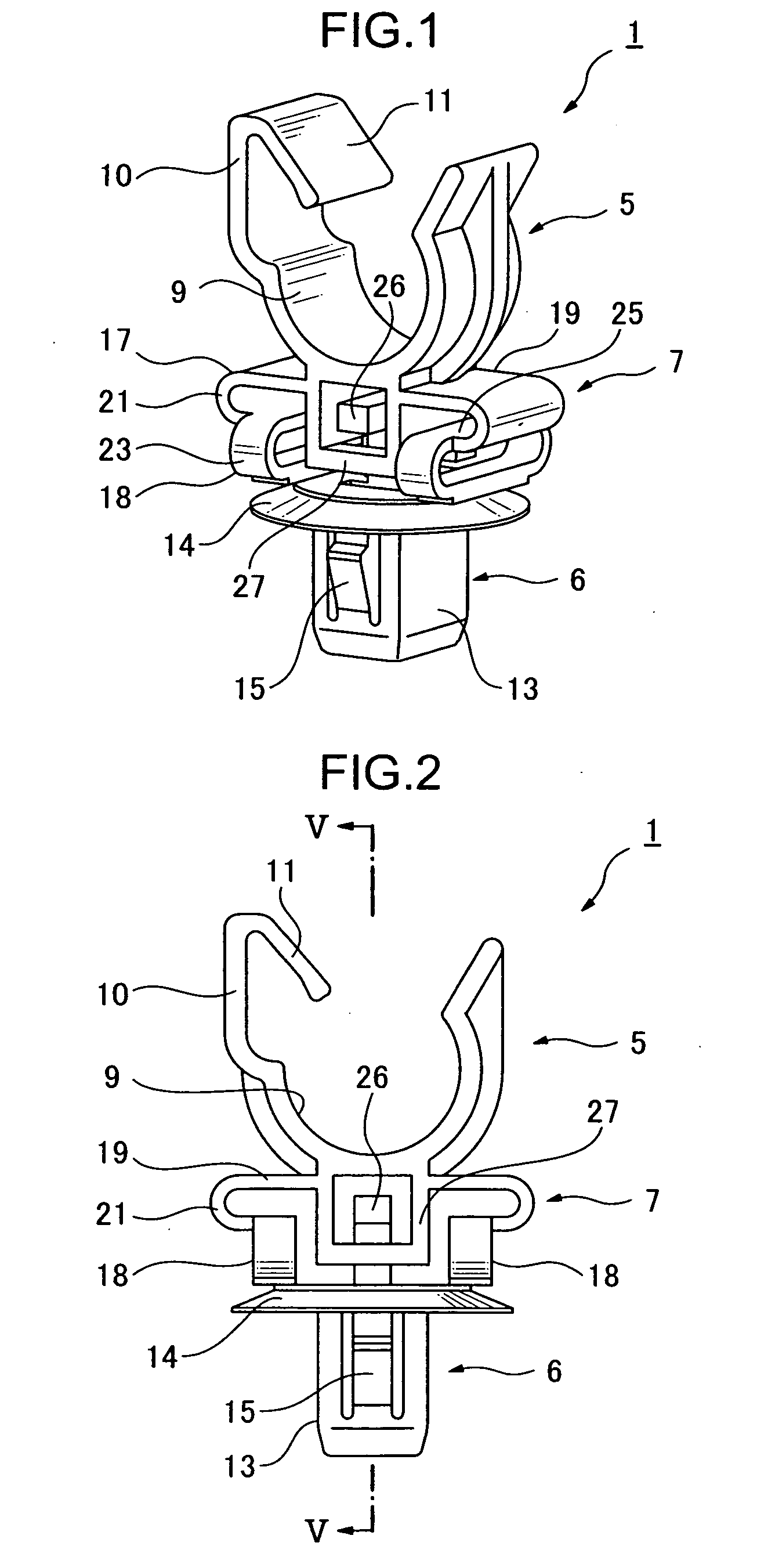
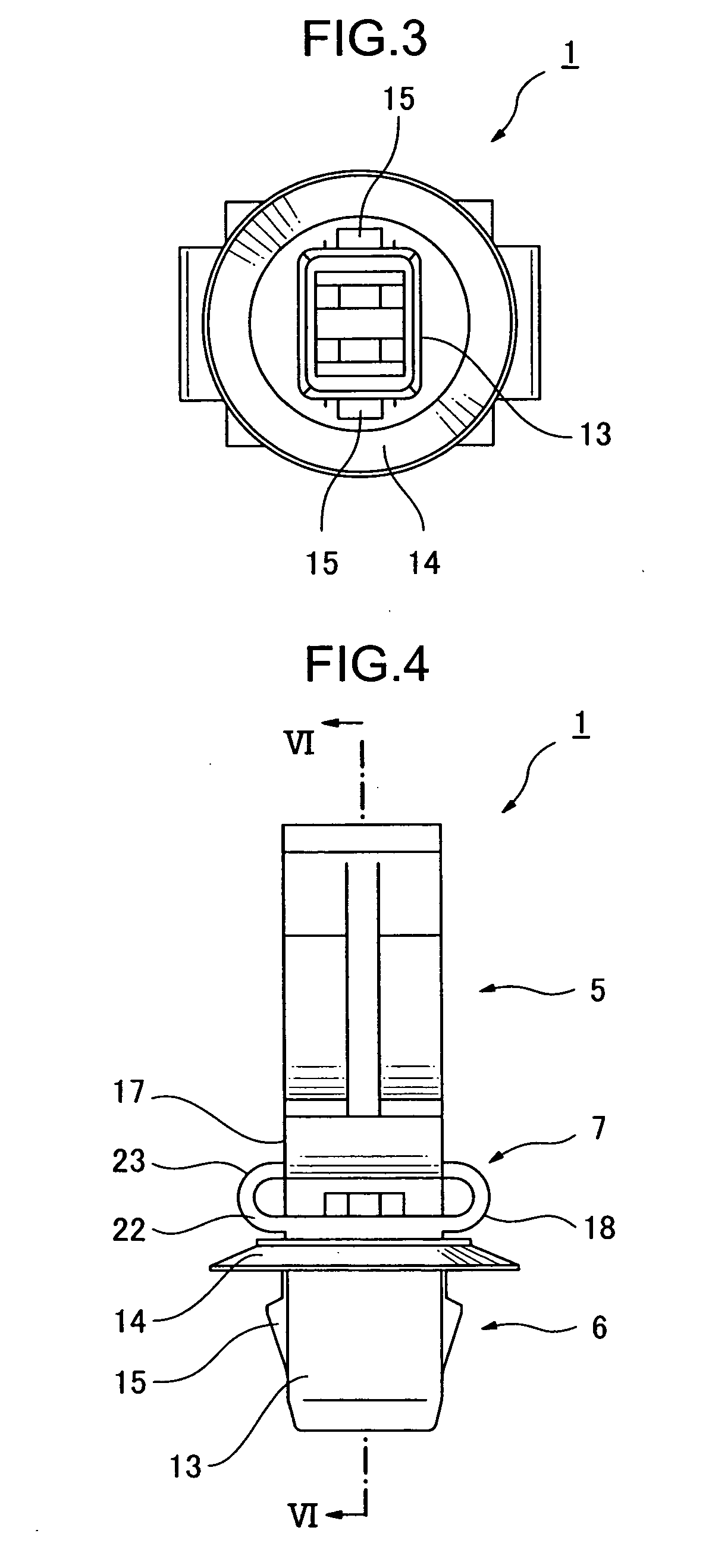
[0010] In a preferred, but non-limiting embodiment of the present invention, a clamp for an elongated object comprises a gripper unit for holding an elongated object such as a pipe or wire harness, and a securing unit for attachment to a support such as a body panel. The clamp is configured such that the elongated object is attached to the support by the elongated object being held by the gripper unit, and by the securing unit being attached to the support. A vibration absorbing unit is provided between the gripper unit and the securing unit, for reducing the transmission of vibration between the gripper unit and the securing unit. The vibration absorbing unit can bend in directions in which the gripper unit and the securing unit move relative to one another. The vibration absorbing unit includes a pair of first flexible curved arms and pairs of second flexible curved arms, the first curved arms and the second curved arms being superposed between the gripper unit and the securing unit, and being arranged so that bending directions thereof cross.
[0011] In this embodiment, no elastic soft material layer is required. The vibration absorbing mechanism of the invention can be realized in a simple shape; die costs can be held down to a low level; and the transmission not only of vibration in the circumferential direction relative to the elongated object such as pipe, but also of vibration having a component in the axial direction of the elongated object can be reduced.
[0012] In the elongated-object clamp described above, it is preferable that the gripper unit comprise a curved receptacle for accepting at least half of the circumference of a side surface of the elongated object, and an elastic holding piece for pressing, from above, a side surface of the elongated object in the curved receptacle, and that the securing unit comprise a shaft which extends below the gripper unit, shaped for attachment to the support. It is further preferable that the first curved arms and the second curved arms be arranged so that they cross at an angle of 90 degrees, so that the directions of bending are perpendicular to one another, so that one of the sets of curved arms can reduce the transmission of vibration in the circumferential direction relative to the elongated object, and the other set of curved arms can reduce the transmission of vibration having a component in the axial direction of the elongated object, whereby vibration in all directions can be absorbed.
[0013] In the elongated-object clamp described above, furthermore, it is preferable that the first curved arms be arranged on the underside of the gripper unit and that the second curved arms be arranged on the upper side of the securing unit, and that a regulating member be formed between the securing unit and the gripper unit, extending between the pairs of second curved arms to a position adjacent to the underside of the gripper unit, for regulating the amount of movement of the arms so that the
range of movement of the elongated object can be regulated. The regulating member is preferably a T-shaped member having a rod-shaped part which extends upward from the upper part of the securing unit and a horizontal part positioned adjacent to the underside of the gripper unit and extending to both sides in the width direction of the gripper unit.
[0014] In the elongated-object clamp described above, moreover, it is preferable that the horizontal part of the T-shaped regulating member be accommodated inside a frame part which extends below the gripper unit so as to prevent the gripper unit from becoming detached from the securing unit even if the first curved arms or second curved arms are damaged due to an
impact or the like. Thus, the elongated object can be prevented from falling away from the support.


 Login to View More
  Login to View More