
Mixed orientation and mixed material semiconductor-on-insulator wafer
a semiconductor and on-insulator technology, applied in semiconductor devices, single crystal growth, chemistry apparatus and processes, etc., can solve the problem of not emitted light as efficiently
- Summary
- Abstract
- Description
- Claims
- Application Information
AI Technical Summary
Benefits of technology
Problems solved by technology
Method used
Image

Examples
Embodiment Construction
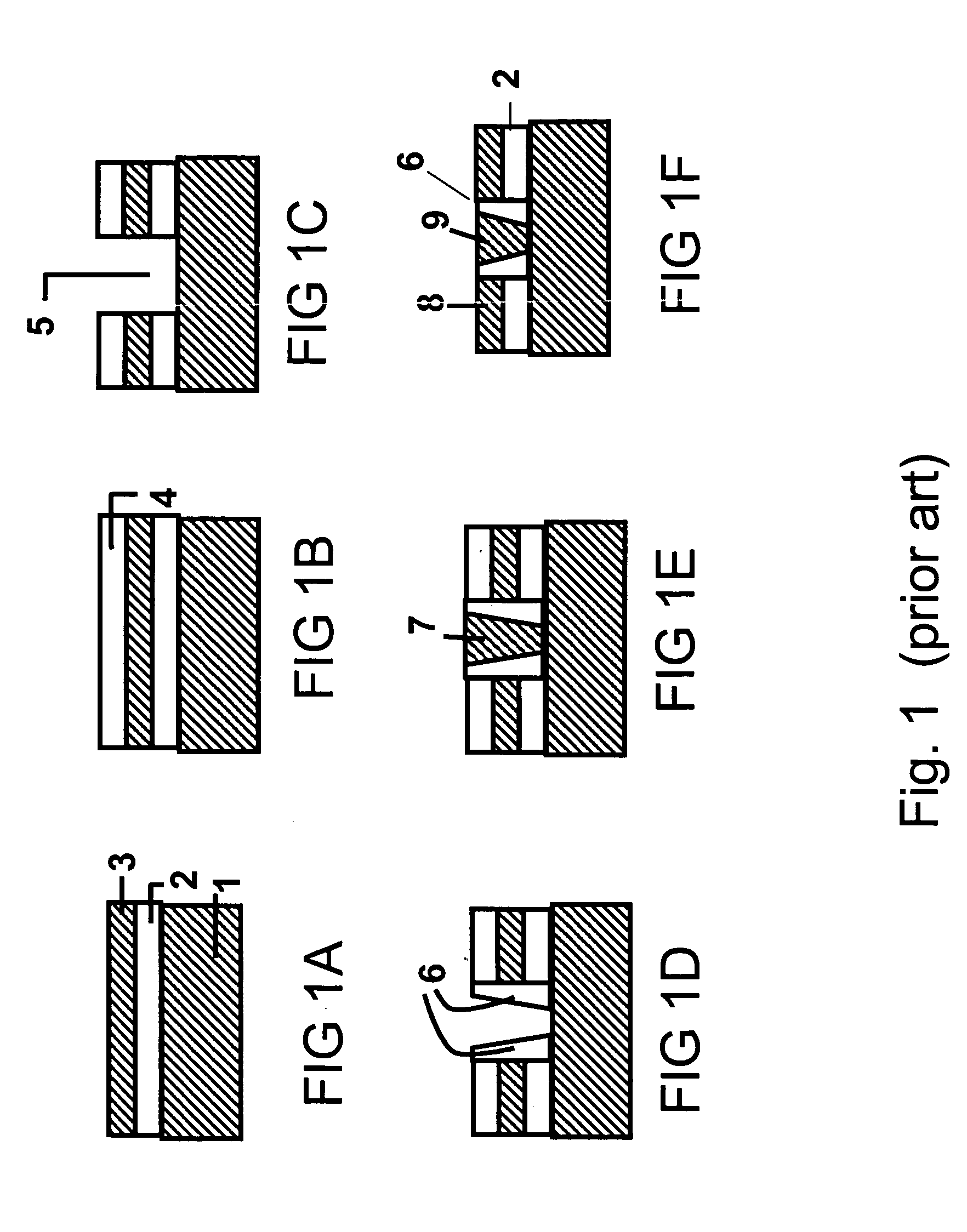
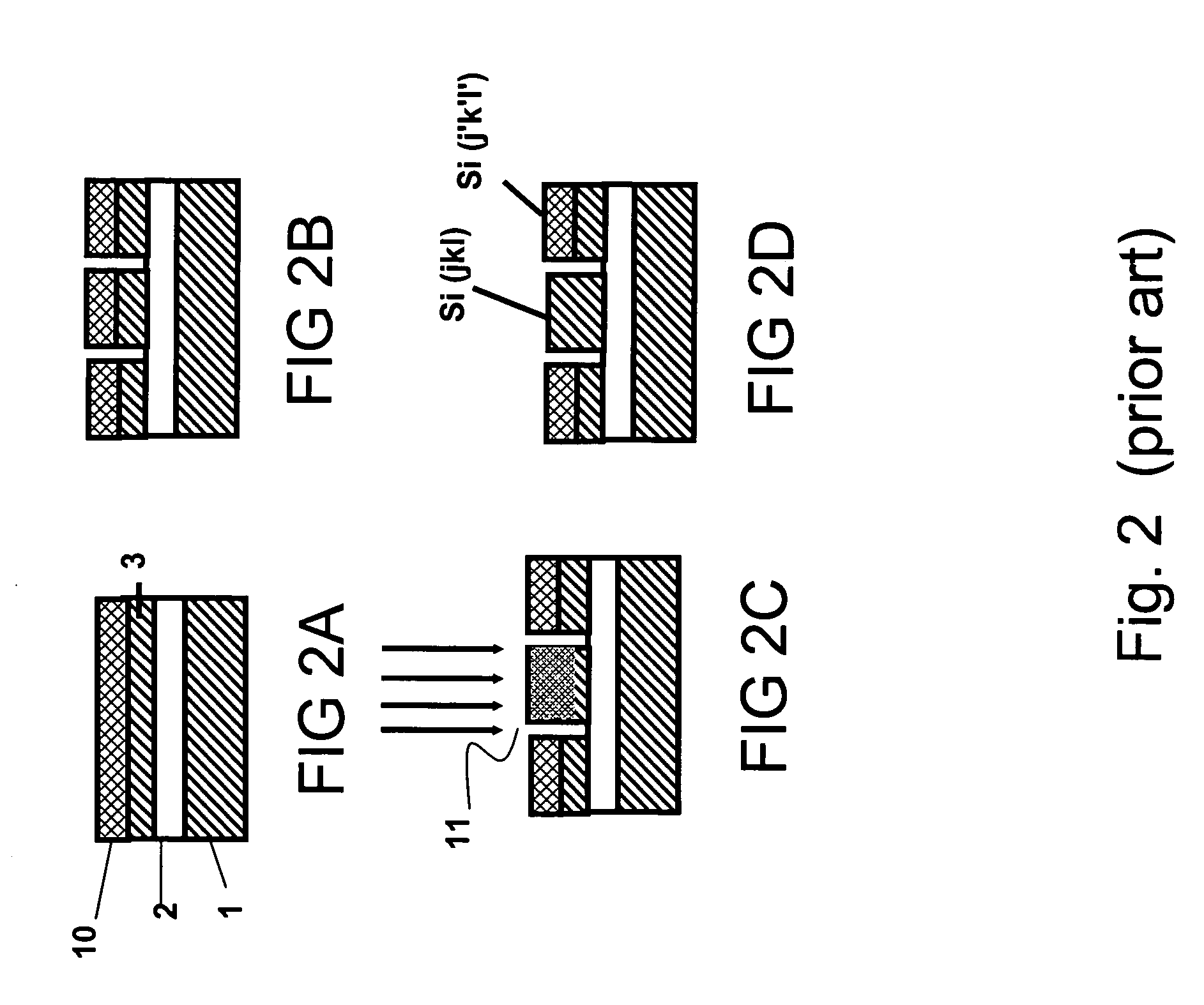
[0022] Examples of conventional approaches for producing planar hybrid substrates are shown in FIGS. 1 and 2. Referring to FIG. 1A, a silicon-on-insulator (“SOI”) wafer is prepared by interposing oxide layer 2 (buried oxide) between a handle wafer 1, having a first surface orientation (e.g., 100-orientation) and a SOI layer 3 having a second surface orientation (e.g., 110 orientation). In FIG. 1B oxide layer 4 is deposited over layer 3 as an insulation layer. In FIG. 1C, selected areas of the handle wafer are exposed by etching opening(s) 5 through layers 2-4. Dielectric sidewall spacers 6 are formed to limit silicon growth to layer 1. By allowing epitaxial silicon growth from layer 1, in FIG. 1E silicon layer 7 is formed having the same crystalline orientation as that of layer 1. The resulting structure is shown in FIG. 1F as having silicon layers 8 and 9 with different crystalline orientations and separated by oxide layer 2 and dielectric sidewall spacers 6. This approach is disad...
PUM
| Property | Measurement | Unit |
|---|---|---|
| crystalline orientation | aaaaa | aaaaa |
| chemical | aaaaa | aaaaa |
| semiconductor | aaaaa | aaaaa |
Abstract
Description
Claims
Application Information
 Login to View More