Check patentability & draft patents in minutes with Patsnap Eureka AI!

Bandwidth allocation protocol for shared wireless networks

a wireless network and bandwidth allocation technology, applied in the field of wireless communication, can solve the problems of increasing the number of users, preventing clients and preventing them from using the entire medium

Inactive Publication Date: 2006-06-29
LUCENT TECH INC
View PDF7 Cites 25 Cited by
  • Summary
  • Abstract
  • Description
  • Claims
  • Application Information

AI Technical Summary

Problems solved by technology

The IEEE 802.11e specification only provides eight classes and can only provide a statistical distribution of the wireless medium usage; it could not, for example, prevent a client from using the entire medium in a single-user scenario.
Moreover, once users pass the access control mechanisms, their usage of the medium is uncontrolled and determined by stochastical processes.
Collisions resulting in packet errors increase with the number of users, to a point where no one is able to make use of the network anymore.
Therefore, one problem is how to control or coordinate usage of a wireless network, allowing a wireless access point (AP) to control distribution of available bandwidth over a plurality of clients.
However, this mechanism does not provide controlled allocation of available transmission bandwidth.

Method used

the structure of the environmentally friendly knitted fabric provided by the present invention; figure 2 Flow chart of the yarn wrapping machine for environmentally friendly knitted fabrics and storage devices; image 3 Is the parameter map of the yarn covering machine
View more

Image

Smart Image Click on the blue labels to locate them in the text.
Viewing Examples
Smart Image
  • Bandwidth allocation protocol for shared wireless networks
  • Bandwidth allocation protocol for shared wireless networks
  • Bandwidth allocation protocol for shared wireless networks

Examples

Experimental program
Comparison scheme
Effect test

Embodiment Construction

[0023] Illustrative embodiments of the invention are described below. In the interest of clarity, not all features of an actual implementation are described in this specification. It will of course be appreciated that in the development of any such actual embodiment, numerous implementation-specific decisions must be made to achieve the developers' specific goals, such as compliance with system-related and business-related constraints, which will vary from one implementation to another. Moreover, it will be appreciated that such a development effort might be complex and time-consuming, but would nevertheless be a routine undertaking for those of ordinary skill in the art having the benefit of this disclosure.

[0024] Generally, a bandwidth allocation protocol may support Quality of Service (QoS) guarantees across a plurality of wireless client devices in multimedia shared wireless networks. A protocol extension to the IEEE 802.11 standard may be provided. Specifically, an additional ...

the structure of the environmentally friendly knitted fabric provided by the present invention; figure 2 Flow chart of the yarn wrapping machine for environmentally friendly knitted fabrics and storage devices; image 3 Is the parameter map of the yarn covering machine
Login to View More

PUM

No PUM Login to View More

Abstract

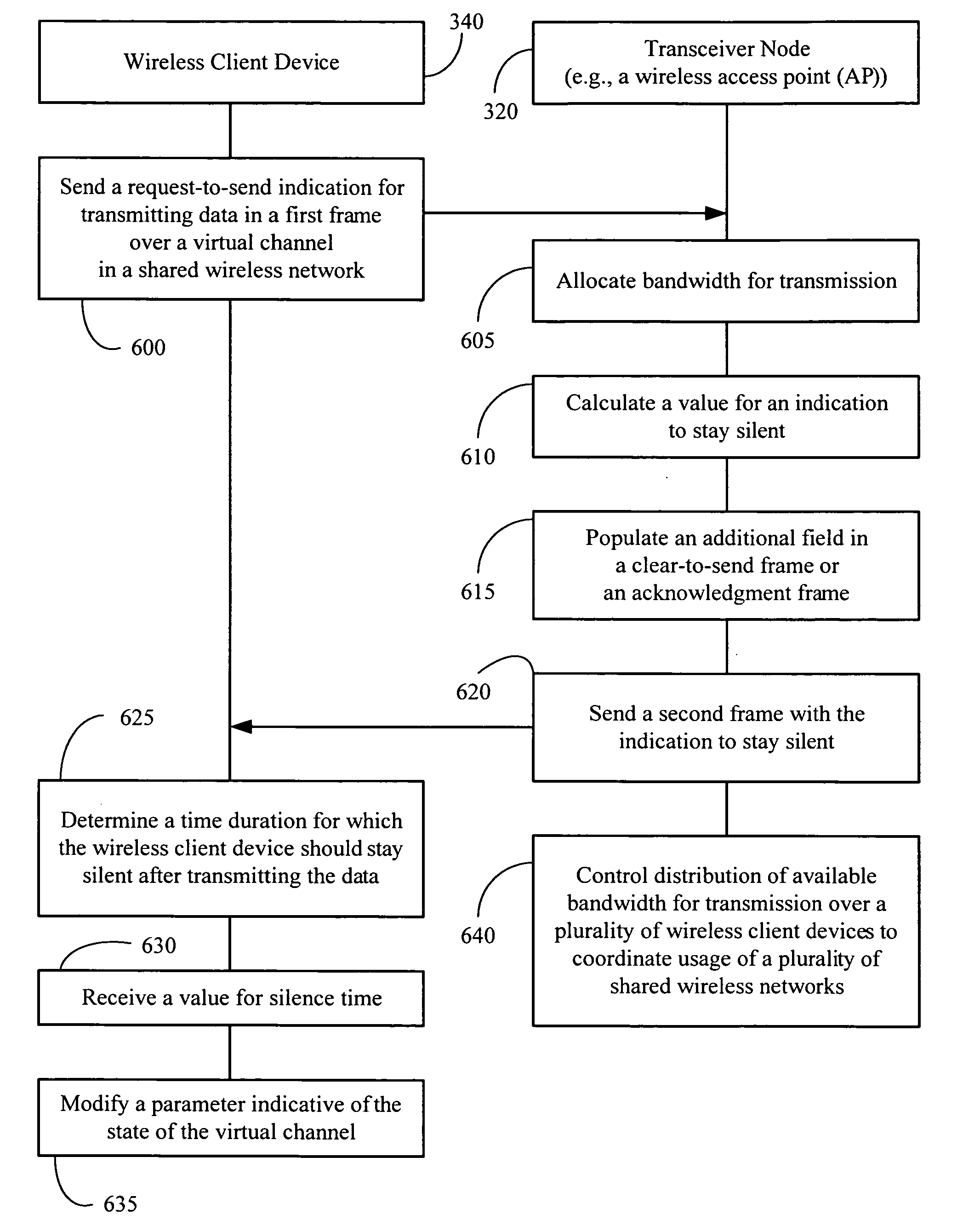
The present invention provides a method and an apparatus for allocating bandwidth for transmission to a first client device on a wireless network shared with a second client device. The method comprises sending a request-to-send indication to a transceiver node for transmitting data and in response to the request-to-send indication, receiving an indication at the first client device from the transceiver node to stay silent after transmitting the data. In this manner, in one embodiment, a controlled allocation of an available transmission bandwidth may be provided for shared wireless networks in a bi-directional communication system using a request-to-send (RTS) / clear-to-send (CTS) mechanism, controlling access to a wireless medium and coordinating usage of a wireless network. Specifically, an additional field, i.e., a “silence time” field may be added in a frame sent by an access point (AP). The “silence time” field may contain a value (e.g., in microseconds) that a receiver should minimally stay silent after transmitting the data. This additional field may be added to either an acknowledgement (ACK) frame for using a modified ACK frame or a CTS frame for using a RTS / CTS handshake (i.e., a modification to the CTS frame). Accordingly, a protocol extension to the Institute of Electrical and Electronics Engineers 802.11 standard defines a bandwidth allocation protocol which allows a wireless access point to control distribution of the available transmission bandwidth over a plurality of wireless client devices.

Description

BACKGROUND OF THE INVENTION [0001] 1. Field of the Invention [0002] This invention relates generally to telecommunications, and more particularly, to wireless communications. [0003] 2. Description of the Related Art [0004] Use of wireless networks is expected to increase dramatically as users discover the enhanced productivity and increased mobility that wireless communications provide. For example, a wireless local area network (LAN) lets users roam around a building with a laptop (equipped with a wireless LAN card) and stay connected to their network without being connected to a wire. The wireless LANs transfer data through the air using radio frequencies instead of cables, requiring a wired access point (AP) that plugs a plurality of wireless devices into a wired network. [0005] As users experience the convenience of wireless connectivity, they are beginning to demand support for the same applications they run over today's wired networks. To this end, an Institute of Electrical a...

Claims

the structure of the environmentally friendly knitted fabric provided by the present invention; figure 2 Flow chart of the yarn wrapping machine for environmentally friendly knitted fabrics and storage devices; image 3 Is the parameter map of the yarn covering machine
Login to View More

Application Information

Patent Timeline
no application Login to View More
Patent Type & Authority Applications(United States)
IPC IPC(8): H04L12/413H04Q7/00H04W28/20H04W72/12H04W74/06
CPCH04L41/0896H04W28/20H04W72/0453H04W72/1236H04W72/1278H04W74/004H04W74/006H04W74/06H04W84/12H04W72/543H04W72/20
Inventor VAN BEMMEL, JEROEN
Owner LUCENT TECH INC
Features
  • R&D
  • Intellectual Property
  • Life Sciences
  • Materials
  • Tech Scout
Why Patsnap Eureka
  • Unparalleled Data Quality
  • Higher Quality Content
  • 60% Fewer Hallucinations
Social media
Patsnap Eureka Blog
Learn More