System and method for bringing hypothermia rapidly onboard

US20060190066A1Inactive Publication Date: 2006-08-24ALSIUS
99 Cites 28 Cited by

Patent Information

Authority / Receiving Office
US · United States
Current Assignee / Owner
Publication Date
2006-08-24
Estimated Expiration
Not applicable · inactive patent

Smart Images

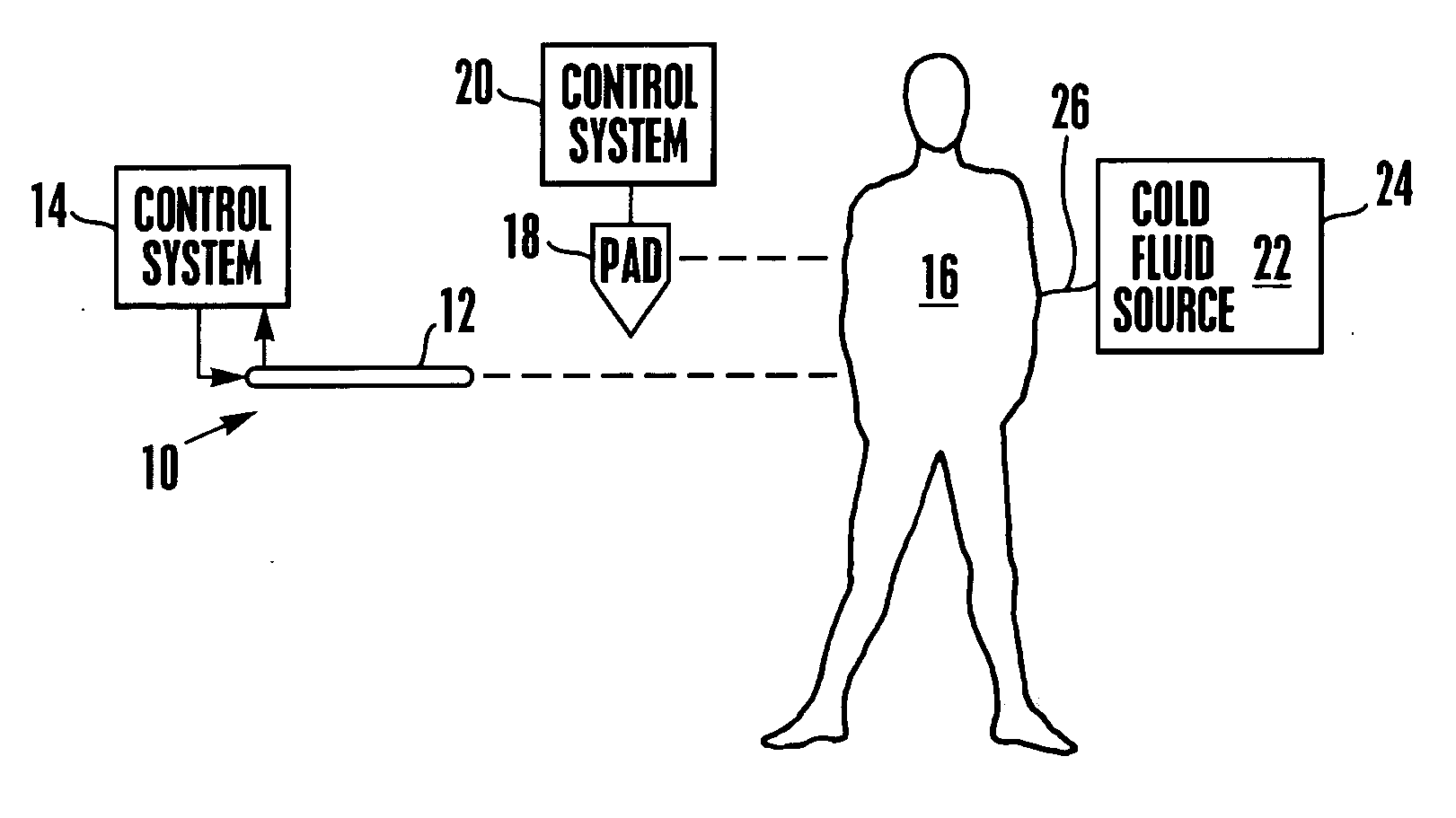
  • Figure 1
    Figure 1
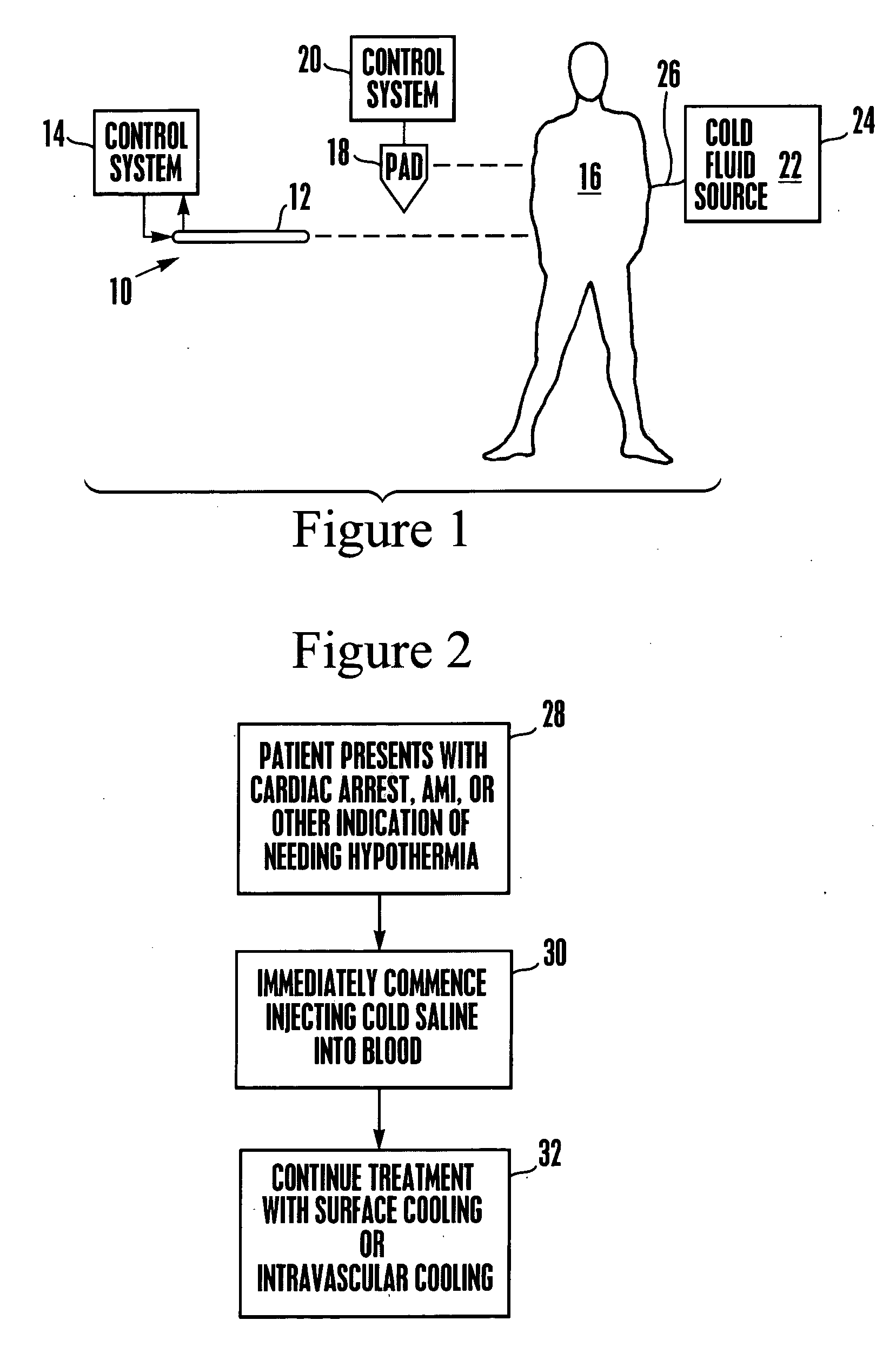
  • Figure 2
    Figure 2
Patent Text Reader

Abstract

An intravenous heat exchange catheter and / or an external cooling pad can be used to maintain hypothermia in, e.g., a cardiac arrest patient, but to accelerate the cooling process the patient first can be infused with cold saline before the opportunity arises to connect the catheter or pad to the patient.
Need to check novelty before this filing date? Find Prior Art

Description

I. FIELD OF THE INVENTION

[0001] The present invention relates generally to therapeutic hypothermia. II. BACKGROUND OF THE INVENTION

[0002] Intravascular catheters have been introduced for controlling patient temperature. Typically, a coolant such as saline is circulated through an intravascular heat exchange catheter, which is positioned in the patient's bloodstream, to cool or heat the blood as appropriate for the patient's condition. The coolant is warmed or cooled by a computer-controlled heat exchanger that is external to the patient and that is in fluid communication with the catheter.

[0003] For example, intravascular heat exchange catheters can be used to combat potentially harmful fever in patients suffering from neurological and cardiac conditions such as stroke, subarachnoid hemorrhage, intracerebral hemorrhage, cardiac arrest, and acute myocardial infarction, or to induce therapeutic hypothermia in such patients. Further, such catheters can be used to rewarm patients aft...

Examples

Embodiment Construction

[0014] Referring initially to FIG. 1, a system is shown, generally designated 10, that includes a heat exchange catheter 12 that is in fluid communication with a catheter temperature control system 14.

[0015] In accordance with present principles, the system 10 can be used to induce therapeutic hypothermia in a patient 16 using a catheter in which coolant circulates in a closed loop, such that no coolant enters the body. While certain preferred catheters are disclosed below, it is to be understood that other catheters can be used in accordance with present principles, including, without limitation, any of the catheters disclosed in the following U.S. patents, all incorporated herein by reference: U.S. Pat. Nos. 5,486,208, 5,837,003, 6,110,168, 6,149,673, 6,149,676, 6,231,594, 6,264,679, 6,306,161, 6,235,048, 6,238,428, 6,245,095, 6,251,129, 6,251,130, 6,254,626, 6,261,312, 6,312,452, 6,325,818, 6,409,747, 6,368,304, 6,338,727, 6,299,599, 6,287,326, 6,126,684. The catheter 12 may be ...