
Low-cure powder coatings and methods for using the same
a technology of thermosetting powder and coating composition, which is applied in the direction of pretreated surfaces, metal layered products, synthetic resin layered products, etc., can solve the problems of preventing their widespread production and use, mechanical stability, and packaging stability problems, so as to facilitate the reaction, improve the effect of coating properties, and reduce the risk of rus
- Summary
- Abstract
- Description
- Claims
- Application Information
AI Technical Summary
Benefits of technology
Problems solved by technology
Method used
Image

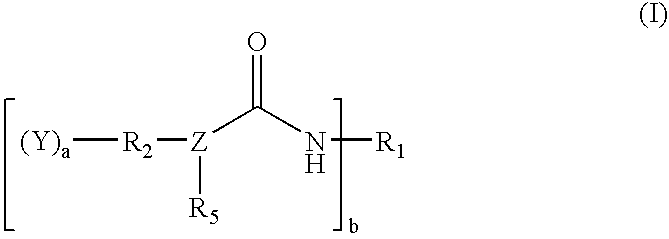
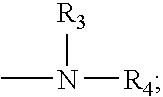
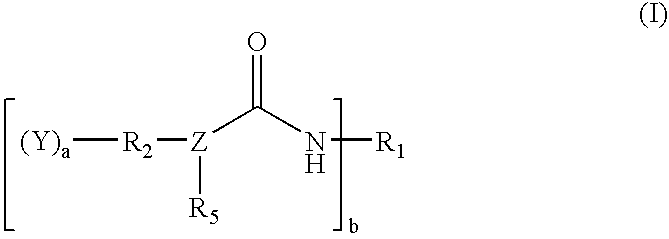
Examples
example 1
[0046] The following ingredients were used to prepare a catalyst of Formula I, wherein an acidic hydrogen-containing compound is used.
Percent byIngredientWeight, gEquivalentsweightDimethylaminopropylamine204.41.00023.95%Isophorone diisocyanate (“IPDI”)1222.21.00026.05%Bisphenol A (“BPA”)2426.63.7450.00%
1Available from Hüls America, Inc.
24,4′-Isopropylidenediphenol, available from Dow Chemical Co.
[0047] The dimethylaminopropylamine was charged to a suitable reactor and heated to 50° C. The IPDI was added through an addition funnel over a period of two hours. The temperature of the reaction mixture was allowed to increase to 90° C. during the addition. After the addition was complete the reaction mixture was heated to 130° C. and held at that temperature until infrared analysis indicated consumption of the isocyanate. The reaction mixture was then heated to 160° C. and the Bisphenol A was added. The reaction mixture was held at 160° C. until the solution turned clear, indicating c...
example 2
[0048] The following ingredients were used to prepare a catalyst of Formula I, wherein an acidic hydrogen-containing compound is not used.
Percent byIngredientWeight, gEquivalentsweightDimethylaminopropylamine204.41.00047.9%Isophorone diisocyanate (IPDI)222.21.00052.1%
[0049] The dimethylaminopropylamine was charged to a suitable reactor and heated to 50° C. The IPDI was added through an addition funnel over a period of two hours. The temperature of the reaction mixture was allowed to increase to 90° C. during the addition. After the addition was complete the reaction mixture was heated to 130° C. and held at that temperature until infrared analysis indicated consumption of the isocyanate. The reaction mixture was poured out hot and allowed to cool and solidify. The final solid product had a solids content of about 98 percent and a number average molecular weight of 336 as measured by gel permeation chromatography using polystyrene as a standard.
example 3
[0050] Samples 1 to 4 were prepared using the components and amounts shown in TABLE 1, including the products prepared according to Examples 1 and 2. The coatings were prepared by premixing the ingredients in a three-blade mixer rotating at 3500 rpm. The premix was then extruded in a 19 mm dual screw extruder operating at a temperature of 80° C. The extrudate was rapidly cooled and pressed into chip. The chip was micronized to an average particle size of 35 microns using a Hosokawa Air-Classifying Mill (ACM).
TABLE 1Sample 1Sample 2Sample 3Sample 4EPON 10013——340 g340 gEPON 20024——140 g140 gDER 6425—480 g——PD 9060480 g———(GMA Acrylic)6Product of Example 1 15 g 15 g 15 g—Product of Example 2——— 7.5 gBenzoin7 4 g 4 g 4 g 4 gModaflow8 9 g 9 g 9 g 9 gGoresil 2109 50 g 50 g 50 g 50 gTiO2150 g150 g150 g150 g
3EPON 1001 is a BPA epoxy having hydroxy functionality, a hydroxy equivalent weight of 389, standard hybrid type, with an epoxy equivalent weight is 550 from Resolution Performance Pr...
PUM
| Property | Measurement | Unit |
|---|---|---|
| temperature | aaaaa | aaaaa |
| temperature | aaaaa | aaaaa |
| temperature | aaaaa | aaaaa |
Abstract
Description
Claims
Application Information
 Login to View More