Unlock instant, AI-driven research and patent intelligence for your innovation.

Projector and method for manufacturing projector

a technology of projectors and manufacturing methods, applied in projectors, color television details, instruments, etc., can solve the problems of difficult to adjust the size of the illumination area, work that requires a lot of time and labor, and traditional projectors

Inactive Publication Date: 2007-02-15
COLUMBIA PEAK VENTURES LLC
View PDF6 Cites 5 Cited by
  • Summary
  • Abstract
  • Description
  • Claims
  • Application Information

AI Technical Summary

Benefits of technology

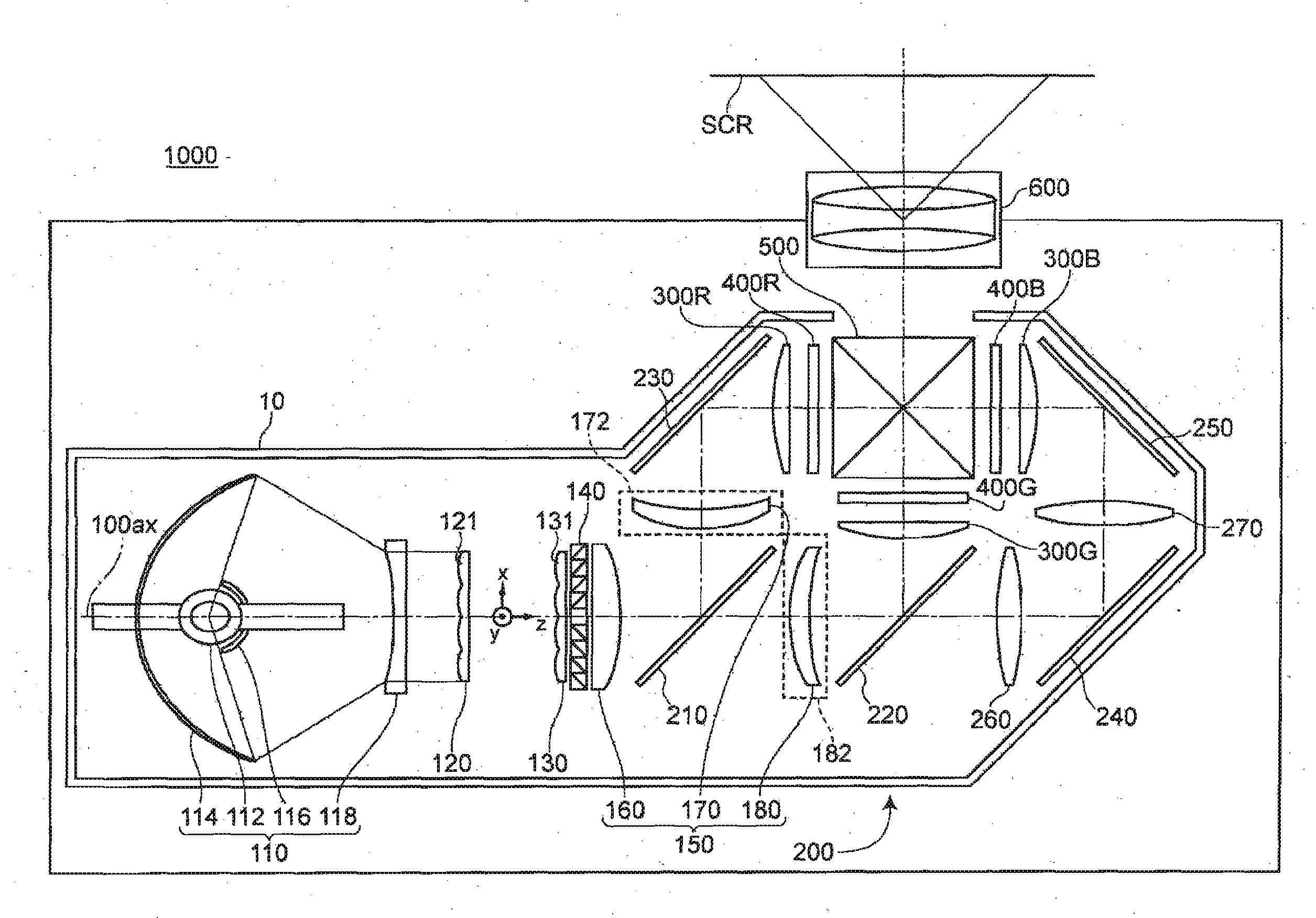
[0065] Also in the projector having the color separation light guiding system that split the light from the superimposing lens into the first to third color lights and the first to third electro-optic modulators that modulate the first to third color lights, respectively, and in which there are plural illumination areas superimposed by the superimposing system, the method as described above enables relatively free adjustment of the size of each illumination area in the first superimposing system that is formed by the superimposing lens and the first optical lens and that emits light illuminating the first electro-optic modulator and in the second superimposing system that is formed by the superimposing lens and the second optical lens and that emits light illuminating the second electro-optic modulator and / or the third electro-optic modulator.

Problems solved by technology

However, the traditional projector has the following two problems.
However, such work requires much time and labor.
Therefore, the traditional projector has a problem that it is not easy to adjust the size of the illumination area.
Therefore, the traditional projector has a problem that, if the electro-optic modulator is miniaturized, the illumination system or the color separation light guiding system before the change of the electro-optic modulator cannot be used as it is.
This problem occurs not only when the electro-optic modulator is miniaturized but also when the electro-optic modulator is increased in size
That is, the traditional projector has a problem that, if the size of the electro-optic modulator is changed, the illumination system or the color separation light guiding system before the change of the electro-optic modulator cannot be used as it is.
Therefore, the number of processes increases because of the redesign and the manufacturing cost of the projector increases.
Therefore, the light having a relatively long wavelength is more difficult to refract than the light having a relatively short wavelength.
In this case, if the distance between the first lens array and the second lens array is long, the thickness of the lens array unit is increased and therefore crack or break may occur at the time of manufacturing.
Also, if the thickness of the lens array unit is increased, the weight of the lens array unit increases and the material cost rises.

Method used

the structure of the environmentally friendly knitted fabric provided by the present invention; figure 2 Flow chart of the yarn wrapping machine for environmentally friendly knitted fabrics and storage devices; image 3 Is the parameter map of the yarn covering machine
View more

Image

Smart Image Click on the blue labels to locate them in the text.
Viewing Examples
Smart Image
  • Projector and method for manufacturing projector
  • Projector and method for manufacturing projector
  • Projector and method for manufacturing projector

Examples

Experimental program
Comparison scheme
Effect test

embodiment 1

[0075]FIG. 1 shows an optical system of a projector 1000 according to Embodiment 1. In the following description, the three directions orthogonal to each other are referred to as z-axis direction (direction of illumination optical axis 1000ax in FIG. 1), x-axis direction (direction parallel to the paper surface and orthogonal to the z-axis direction in FIG. 1), and y-axis direction (direction perpendicular to the paper surface and orthogonal to the z-axis direction in FIG. 1).

[0076] The projector 1000 according to Embodiment 1 is a projector including: a light source 110 that emits a luminous flux; a first lens array 120 having plural first small lenses 121 that split the luminous flux from the light source 110 into plural partial luminous fluxes; second lens array 130 having plural second small lenses 131 corresponding to the plural first small lenses 121; a polarization conversion element 140 that emits the respective partial luminous fluxes split by the first lens array 120 as s...

embodiment 2

[0144]FIG. 4 shows an optical system of a protector 1002 according to Embodiment 2. In FIG. 4, the same members as in FIG. 1 are denoted by the same numerals and will not be described further in detail.

[0145] The projector 1002 according to Embodiment 2 has basically the same construction as the projector 1000 according to Embodiment 1, but the directions of the first optical lens and the second optical lens and the construction of the first lens array and the second lens array are different from those in the projector 1000 according to Embodiment 1, as shown in FIG. 4.

[0146] In the projector 1002 according to Embodiment 2, the first optical lens 170 and the second optical lens 180 are arranged with their concave surfaces directed toward the light incident side, as shown in FIG. 4. Thus, the focal length f3 of the superimposing system 150 can be reduced while the focal position of the superimposing system 150 is maintained.

[0147] Also, in the projector 1002 according to Embodimen...

embodiment 3

[0150]FIG. 5 shows an optical system of a projector 1004 according to Embodiment 3. In FIG. 5, the same members as in FIG. 1 are denoted by the same numerals and will not be described further in detail.

[0151] The projector 1009 according to Embodiment 3 has basically the same construction as the projector 1000 according to Embodiment 1, but the directions of the first optical lens and the second optical tens and the construction of the first lens array and the second lens array are different from those in the projector 1000 according to Embodiment 1, as shown in FIG. 5.

[0152] In the projector 1004 according to Embodiment 3, the first optical lens 170 and the second optical lens 180 are arranged with their concave surfaces directed toward the light incident side, as shown in FIG. 5. Thus, the focal length f3 of the superimposing system 150 can be reduced while the focal position of the superimposing system 150 is maintained.

[0153] Also, in the projector 1004 according to Embodimen...

the structure of the environmentally friendly knitted fabric provided by the present invention; figure 2 Flow chart of the yarn wrapping machine for environmentally friendly knitted fabrics and storage devices; image 3 Is the parameter map of the yarn covering machine
Login to View More

PUM

No PUM Login to View More

Abstract

A projector includes: a light source that emits an illumination flux; a first lens array having plural first small lenses that split the illumination flux from the light source into plural partial luminous fluxes; a second lens array having plural second small lenses corresponding to the plural first small lenses; a superimposing lens that superimposes each partial luminous flux from the second lens array onto an illuminated area; an electro-optic modulator that modulates the light superimposed by the superimposing lens in accordance with image information; and a projection system that projects the light modulated by the electro-optic modulator; wherein the projector further has an optical lens arranged in an optical path between the superimposing lens and the electro-optic modulator, and the optical lens, together with the superimposing lens, forms a superimposing system that has a different focal length from the focal length of the superimposing lens and that has substantially the same focal position as the focal position of the superimposing lens.

Description

[0001] This application claims priority from Japanese Patent Application Nos. 2005-231708 and 2006-133593, the entire disclosures of which are hereby incorporated by reference in their entireties. BACKGROUND [0002] 1. Technical Field [0003] This invention relates to a projector and a method for manufacturing a projector. [0004] 2. Related Art [0005] Traditionally, a projector having a first lens array, a second lens array and a superimposing lens as a light equalizing system has been known, for example, as disclosed in JP-A-8-304739 FIG. 11). In the traditional projector, since light having relatively uneven in-plane light intensity distribution emitted from a light source is converted to light having relatively even in-plane light intensity distribution by the function of the first lens array, the second lens array and the superimposing lens as the light equalizing system, such light having relatively even in-plane light intensity distribution can be cast to an image forming area i...

Claims

the structure of the environmentally friendly knitted fabric provided by the present invention; figure 2 Flow chart of the yarn wrapping machine for environmentally friendly knitted fabrics and storage devices; image 3 Is the parameter map of the yarn covering machine
Login to View More

Application Information

Patent Timeline
no application Login to View More
Patent Type & Authority Applications(United States)
IPC IPC(8): G03B21/20
CPCG03B21/20H04N9/3105G03B21/208H04N9/3197H04N9/3152
Inventor AKIYAMA, KOICHI
Owner COLUMBIA PEAK VENTURES LLC
Features
  • R&D
  • Intellectual Property
  • Life Sciences
  • Materials
  • Tech Scout
Why Patsnap Eureka
  • Unparalleled Data Quality
  • Higher Quality Content
  • 60% Fewer Hallucinations
Social media
Patsnap Eureka Blog
Learn More