Check patentability & draft patents in minutes with Patsnap Eureka AI!

Decoding device, decoding method, and receiving apparatus

Inactive Publication Date: 2007-05-31
RENESAS ELECTRONICS CORP
View PDF8 Cites 27 Cited by
  • Summary
  • Abstract
  • Description
  • Claims
  • Application Information

AI Technical Summary

Benefits of technology

[0063] Because the present invention performs stop determination for determining whether or not to stop iterative decoding on each of a plurality of blocks divided from received data and further performs end determination for determining whether or not to end decoding process of the received data based on a stop determination result, the end determination of the decoding process of the received data can be performed during processing the receive data, thereby eliminating unnecessary processing.
[0064] The present invention provides a decoding device, a decoding method, and a receiving apparatus which eliminate unnecessary iterative decoding to enable an efficient decoding process.

Problems solved by technology

Further, because the determination on non-convergence is not performed in the related art C, iterative decoding is undesirably performed until reaching a maximum iterative number even if it is non-convergence.
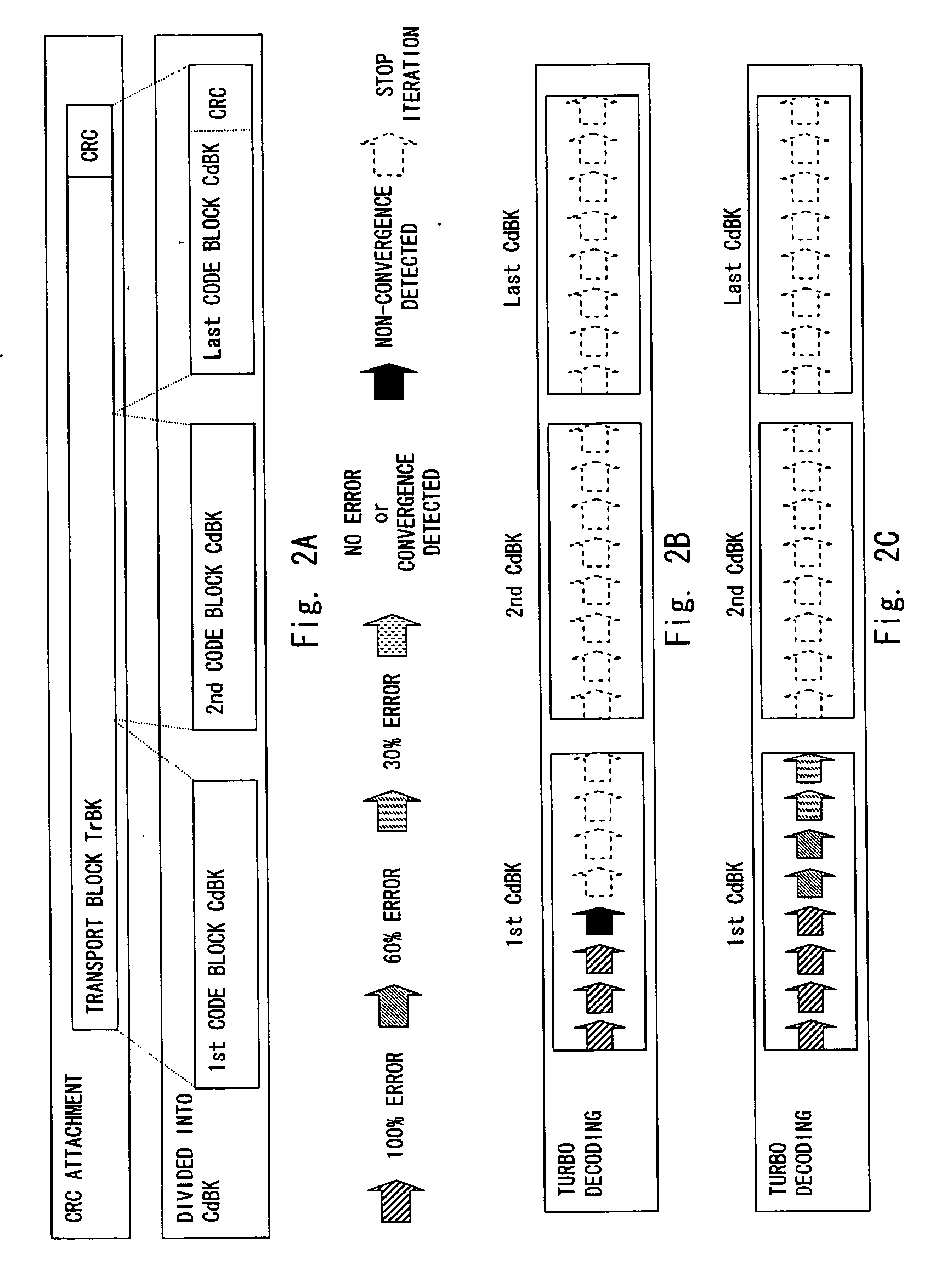
Further, if either of convergence or non-convergence is not detected in any code block CdBK as shown in FIG. 20B, the process can perform processing until a maximum iterative number is reached in all the code blocks CDBK, which results in useless iterative decoding.

Method used

the structure of the environmentally friendly knitted fabric provided by the present invention; figure 2 Flow chart of the yarn wrapping machine for environmentally friendly knitted fabrics and storage devices; image 3 Is the parameter map of the yarn covering machine
View more

Image

Smart Image Click on the blue labels to locate them in the text.
Viewing Examples
Smart Image
  • Decoding device, decoding method, and receiving apparatus
  • Decoding device, decoding method, and receiving apparatus
  • Decoding device, decoding method, and receiving apparatus

Examples

Experimental program
Comparison scheme
Effect test

first embodiment

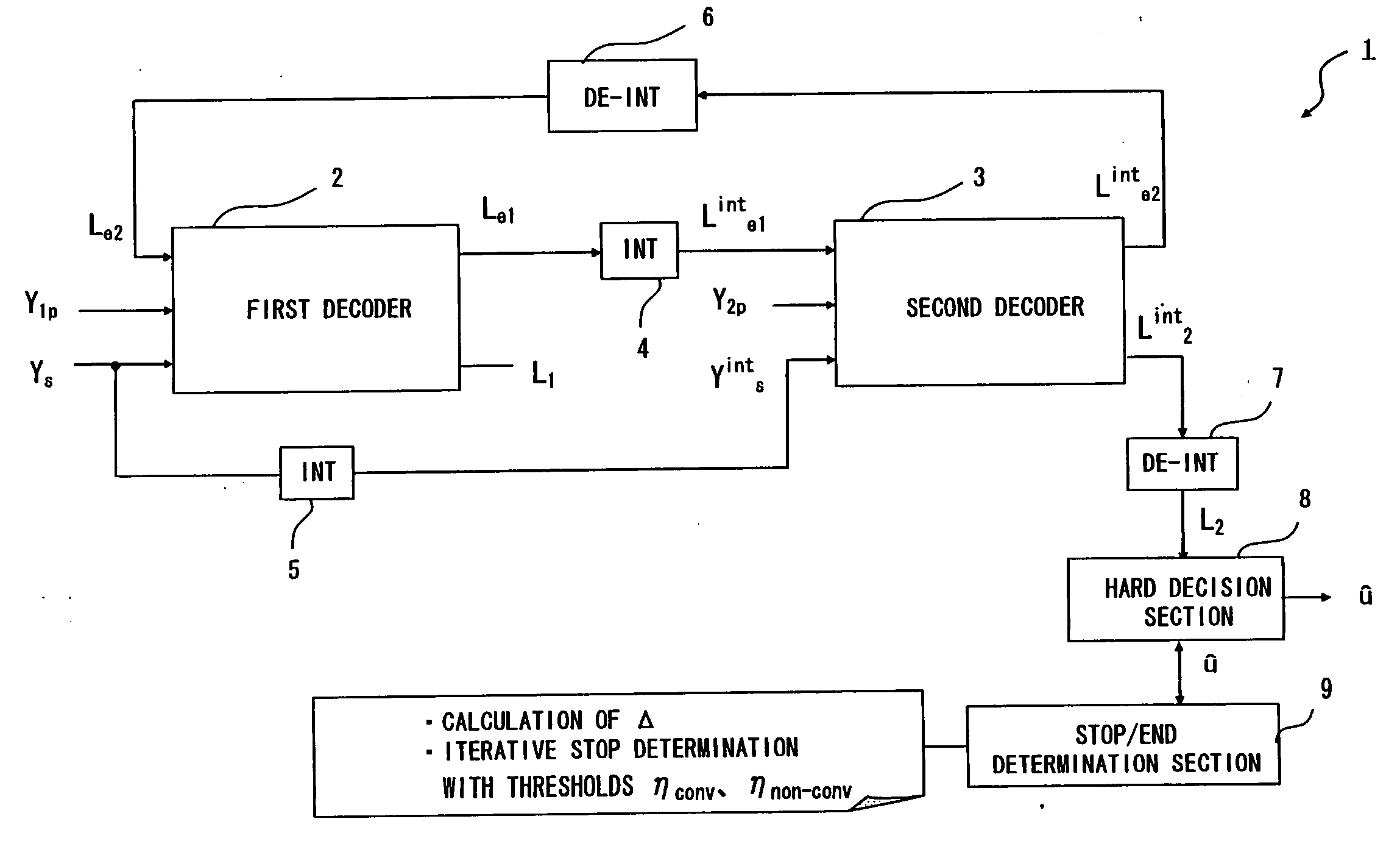
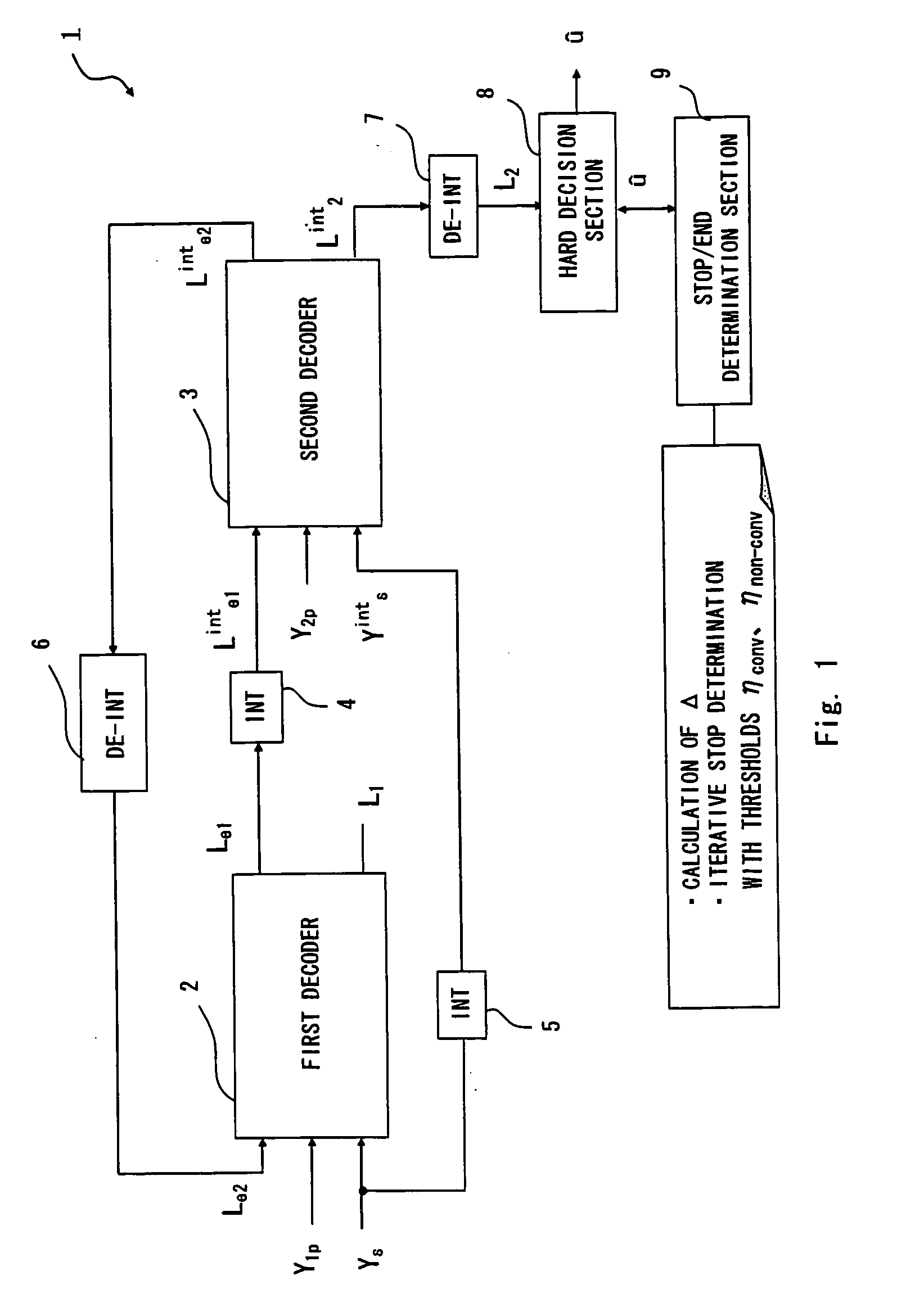
[0091]FIG. 1 is a view showing a decoding device 1 according to a first embodiment of the present invention. The decoding device 1 includes a first decoder 2, a second decoder 3, interleavers 4 and 5, de-interleavers 6 and 7, a hard decision section 8, and a stop / end determination section 9.

[0092] The decoding device 1 receives turbo codes as received data which are transmitted through a transmission line. The received data contains a first elemental code E and a second elemental code Eint which may be generated by an encoding device as shown in FIG. 12. The elemental codes E and Eint are composed of parity bits 1P, 2P and systematic bits U, Uint as described above. Because the systematic bits Uint of the second elemental code Eint can be obtained by interlaving the systematic bits U of the first elemental code E, the actually transmitted data are the systematic bits U and the parity bits 1P of the first elemental code E and the parity bits 2P of the second elemental code Eint. The...

second embodiment

[0123] A second embodiment of the present invention is described hereinafter. This embodiment further increases the efficiency of the stop determination process in a code block which is performed as described in the first embodiment to thereby further reduce the number of times of iterative decoding. FIG. 6 is a view showing a decoding device according to this embodiment. In the second embodiment shown in FIG. 6 and an alternative embodiment of the second embodiment shown in FIG. 8 described later, the same elements as in the first embodiment shown in FIG. 1 are denoted by the same reference numerals and not described in detail herein.

[0124] As shown in FIG. 6, the second embodiment is different from the first embodiment in that the output of a first decoder 12 is supplied to the hard decision section 8. Specifically, in this embodiment, the first decoder 12 supplies the logarithmic likelihood ratio L1 which is generated in the process of decoding to the hard decision section 8. Th...

third embodiment

[0152] A third embodiment of the present invention is described hereinafter. A receiving apparatus according to this embodiment includes the decoding device according to the first or the second embodiment. FIG. 11 is a view showing the receiving apparatus which includes the above-described decoding device 1, 11 or 21. In addition to the decoding device 1,the receiving apparatus 40 further includes an antenna 41, an amplifier 42, an RF section 43, a demodulator 44, a de-puncturing section 45, a controller 46 for controlling these elements and so on as shown in FIG. 11.

[0153] In the receiving apparatus 40, the received data received by the antenna 41 is supplied to the amplifier 42. The amplifier 42 amplifies the received data and supplies the amplified data to the RF section 43. The RF section 43 performs high frequency processing such as high frequency conversion and supplies the processed received data to the demodulator 44 for demodulation. The demodulated received data is then s...

the structure of the environmentally friendly knitted fabric provided by the present invention; figure 2 Flow chart of the yarn wrapping machine for environmentally friendly knitted fabrics and storage devices; image 3 Is the parameter map of the yarn covering machine
Login to View More

PUM

No PUM Login to View More

Abstract

A decoding apparatus includes a first decoder and a second decoder performing iterative decoding on each of a plurality of code blocks, each as a decoding unit, contained in a transport block, and a stop / end determination section determining whether or not to stop iterative decoding based on an output result from the second decoder. The stop / end determination section determines whether or not to stop the iterative decoding on each code block based on a determination result on whether error correction of iterative decoding in each code block is converted or not, and further determines whether or not to stop the iterative decoding of the transfer block based on the determination result in each code block. If it is determined that error correction of iterative decoding is not converted in one code block, the decoding process of the transport block containing the relevant code block is stopped.

Description

BACKGROUND OF THE INVENTION [0001] 1. Field of the Invention [0002] The present invention relates to a decoding device, a decoding method, and a receiving apparatus which decode received data based on likelihood information and, particularly, to a decoding device, a decoding method, and a receiving apparatus which perform a decoding process with improved efficiency. [0003] 2. Description of Related Art [0004] In a digital communication system, error correcting codes for correcting an error which occurs on a transmission line are used. Particularly in a mobile communication system where radio field intensity varies drastically due to fading and an error is likely to occur, a high correction capability is required for error correcting codes. Turbo codes, which are one example of error correcting codes, are notable as the codes having the error correction capability which is close to the Shannon limit and employed in the W-CDMA (Wideband Code Division Multiple Access) or CDMA-2000as th...

Claims

the structure of the environmentally friendly knitted fabric provided by the present invention; figure 2 Flow chart of the yarn wrapping machine for environmentally friendly knitted fabrics and storage devices; image 3 Is the parameter map of the yarn covering machine
Login to View More

Application Information

Patent Timeline
no application Login to View More
IPC IPC(8): H03M13/03
CPCH03M13/2975H03M13/3753H03M13/39H04L1/0051H03M13/2957H03M13/27H03M13/29
Inventor ORIO, MASAO
Owner RENESAS ELECTRONICS CORP
Features
  • R&D
  • Intellectual Property
  • Life Sciences
  • Materials
  • Tech Scout
Why Patsnap Eureka
  • Unparalleled Data Quality
  • Higher Quality Content
  • 60% Fewer Hallucinations
Social media
Patsnap Eureka Blog
Learn More