
Combination therapy and antibody panels
- Summary
- Abstract
- Description
- Claims
- Application Information
AI Technical Summary
Benefits of technology
Problems solved by technology
Method used
Image

Examples
example 1
Determining Variable Region Utilization in Tumor Associated Idiotypic Proteins from a Non-Hodgkin's B Cell Lymphoma Patient Population
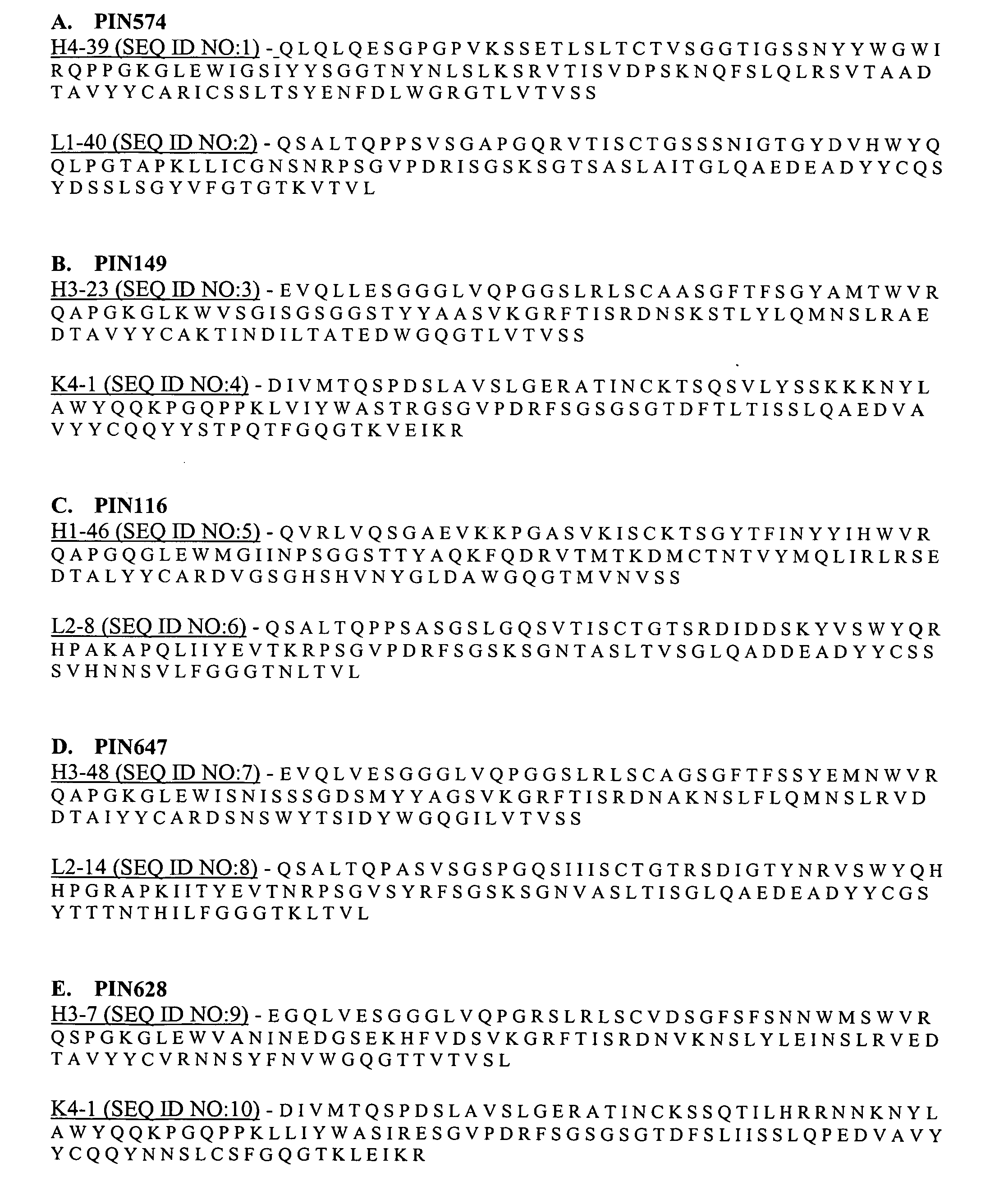
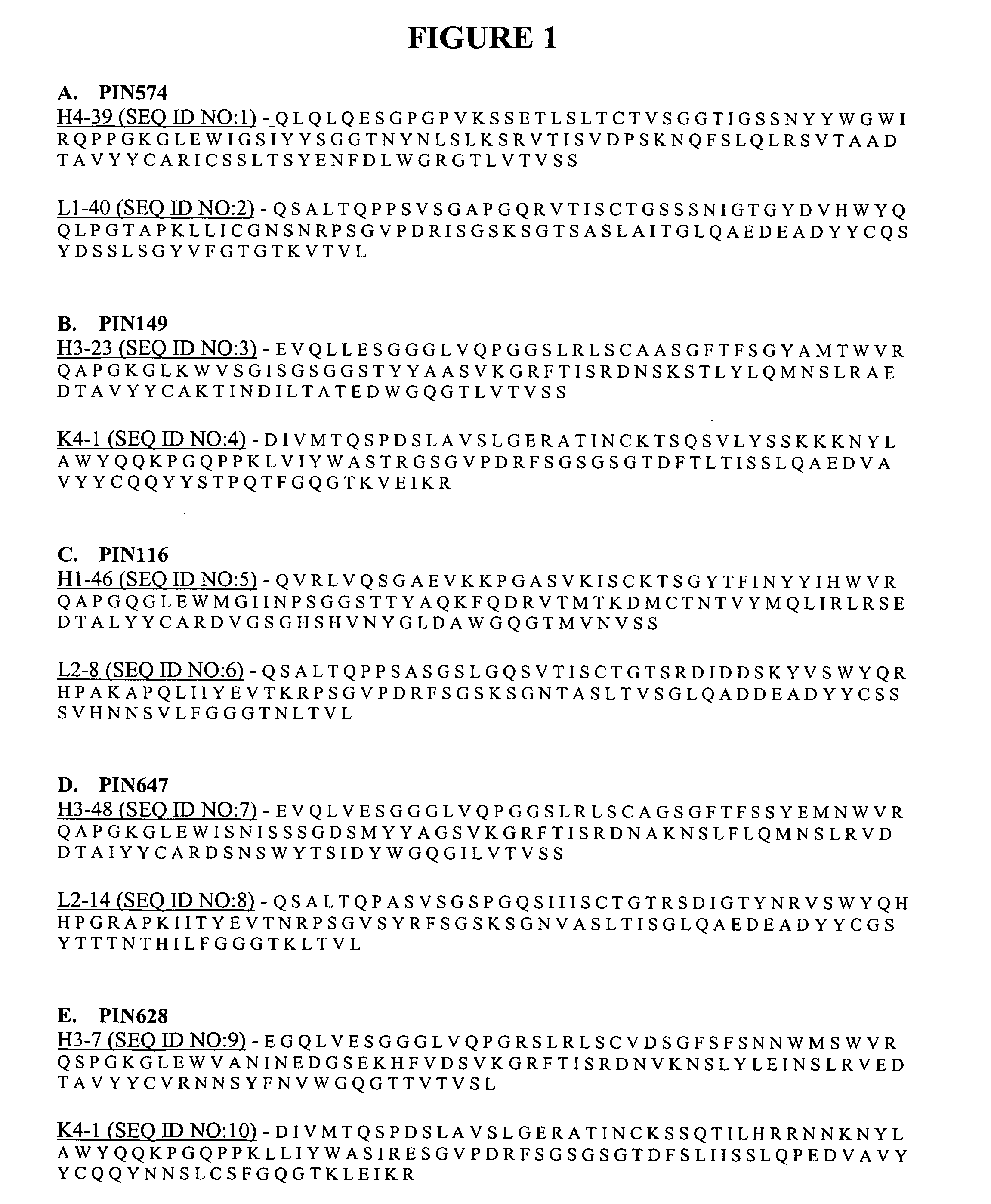
[0269] This example describes a determination of the variable region utilization of tumor-associated idiotypic proteins from a Non-Hodgkin's B Cell lymphoma patient population composed of over 500 patients. The first domain of the V region of an idiotypic protein is called framework 1 (FRI), which is about 25 amino acids in length and can be used to group the V region genes into families. There is more homology (>80% in FR1) within a family than between any two different families. The role of the FR is to create a scaffold for the CDRs to form the antigen-binding site. To ensure productive Ig folding amino acid usage in FR is more constrained than that for the CDRs.
[0270] To classify each of the Non-Hodgkin's B Cell lymphoma patients, the following was performed for each patient sample. First, suitable tumor samples are obtained at the clinical site...
example 2
Family Member- and Family-Specific mAbs
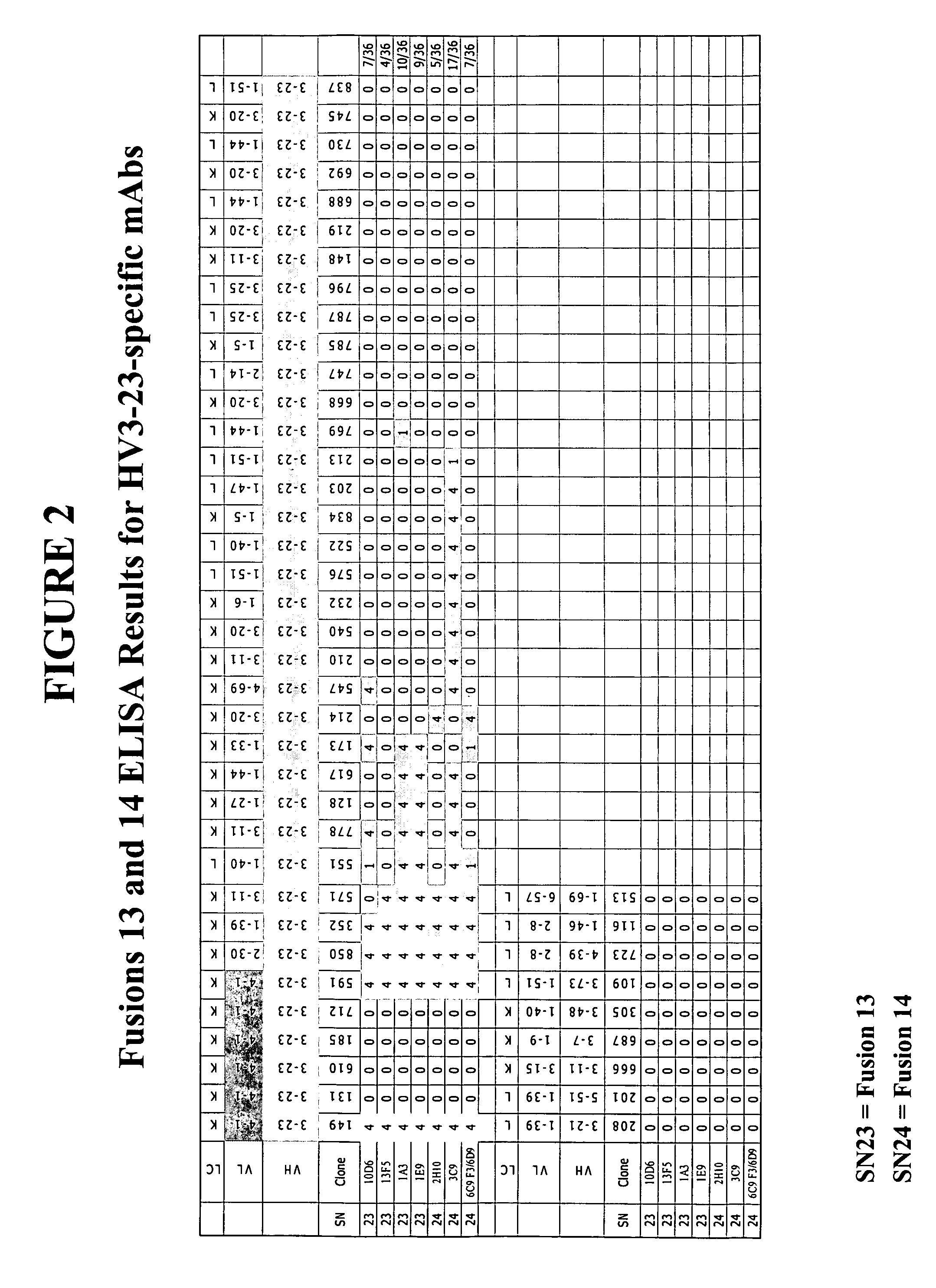
[0280] This example describes the creation of family-specific LV1, LV2, KV1 and HV4 mAbs and family member specific KV4-1, HV3-23, LV2-8, KV3-11 and KV1-5 mAbs. In particular, this example describes methods used to generate one LV1 reactive clone (20H5), nine LV2 reactive clones (6D7, 15E8, 19A11, 7H7, 13H10, 2C6, 2E6, 9E3, and 20C1), eleven KV4-1 reactive clones (15E1, 1E10, 1F10, 1G10, 6G2 / 6G7, 5G10, 10E7, 10H7 19C5, 20G11, and 7G3), two KV4-1+KV3 reactive clones (11H8 and 12C3), one KV4-1+KV1-9 reactive clone (9C2), eight HV3-23 reactive clones (10D6, 13F5, 1A3, 1E9, 2H10, 3C9, 6C9-F3, and 6D9), two LV2-8 reactive clones (12E9 and 11G3), two LV2+LV3-25 reactive clones (4A6 / A10 and 4H11), one HV4 reactive clone (15H5), one KV3-11 reactive clone (6B6), six KV1-5 reactive clones (2A6, 9G11, 12F10, 16A12, 17D9, and 21E9), eight KV1 reactive clones (3F3, 10A6, 12B9, 12H12, 24D3, 25G7, 29F1, and 30A7) and one KV1+KV6-21 reactive clone (9C5).
[028...
example 3
Further Characterization of Selected Clones
[0310] This example describes further characterization of certain clones described in Example 2. The variable regions from the following six clones were sequenced using standard sequencing procedures: clone 3C9, which is specific for family member HV3-23; clone 10H7, which is specific for family member KV4-1; clone 12C3, which is specific for family member KV4-1; clone 20H5, which is specific for family LV1; clone 15E8, which is specific for family LV2; and clone 4H11, which is cross reactive with VL2 and LV3-25. Binding constants were also determined for three of the clones that were sequences (clones 3C9, 10H7, and 20H5), as well as for two additional clones (clone 6C9, which is specific for HV-23, and clone 15E1, which is specific for KV4-1).
[0311]FIG. 6 shows the results of sequencing clone 3C9, which is specific for family member HV3-23. In particular, FIG. 6A shows the amino acid sequence (SEQ ID NO:11) and nucleic acid sequence (SE...
PUM
 Login to View More
 Abstract
Description
Claims
Application Information
 Login to View More