

System and method for clustering wireless devices in a wireless network
a wireless network and wireless computing technology, applied in the field of wireless computing devices clustering in a wireless network, can solve the problems of limiting functionality, affecting communication, and hoc mode not being able to support a large number of users,
- Summary
- Abstract
- Description
- Claims
- Application Information
AI Technical Summary
Problems solved by technology
Method used
Image

Examples
Embodiment Construction
[0006] The present invention may be further understood with reference to the following description and the appended drawings, wherein like elements are provided with the same reference numerals. The present invention describes a system and method for clustering wireless devices in a wireless network. In particular, the present invention relates to an improved wireless network architecture that, for example, uses location information of wireless computing units to form clusters thereof. As will be understood by the following description, the present invention may be utilized to limit power consumption by the wireless devices and improve throughput in the wireless network.
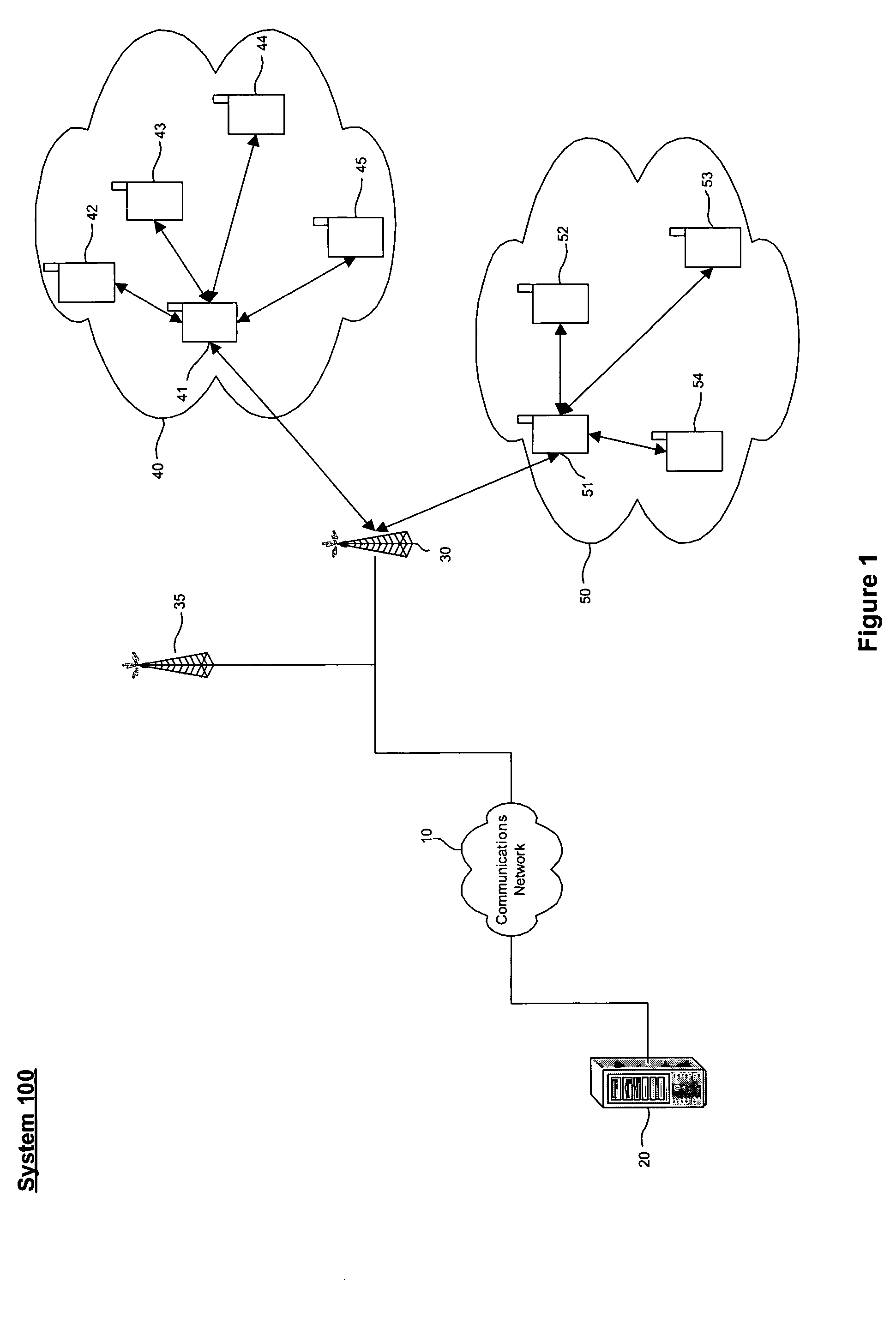
[0007]FIG. 1 shows an exemplary embodiment of a system 100 according to the present invention. The system 100 may include a communications network 10 (e.g., a wired / wireless LAN, WAN or the Internet) having at least one access point / port (“AP”), such as an AP 30 and / or an AP 35, providing access thereto. The system ...
PUM
 Login to View More
 Abstract
Description
Claims
Application Information
 Login to View More