Conjugate vaccines for non-proteinaceous antigens

a vaccine and non-proteinaceous technology, applied in the field of conjugated vaccines for non-proteinaceous antigens, can solve the problem that lipids tend to be only weakly immunogenic, and achieve the effects of strong and rapid immune response, strong and rapid effect, and high levels of antigen-specific igm

a vaccine and non-proteinaceous technology, applied in the field of conjugated vaccines for non-proteinaceous antigens, can solve the problem that lipids tend to be only weakly immunogenic, and achieve the effects of strong and rapid immune response, strong and rapid effect, and high levels of antigen-specific igm

US20070231344A1Inactive Publication Date: 2007-10-04THE BRIGHAM & WOMEN S HOSPITAL INC +1

Image

Smart Image Click on the blue labels to locate them in the text.
Viewing Examples
Smart Image
  • Conjugate vaccines for non-proteinaceous antigens
  • Conjugate vaccines for non-proteinaceous antigens
  • Conjugate vaccines for non-proteinaceous antigens

Examples

Experimental program
Comparison scheme
Effect test

examples

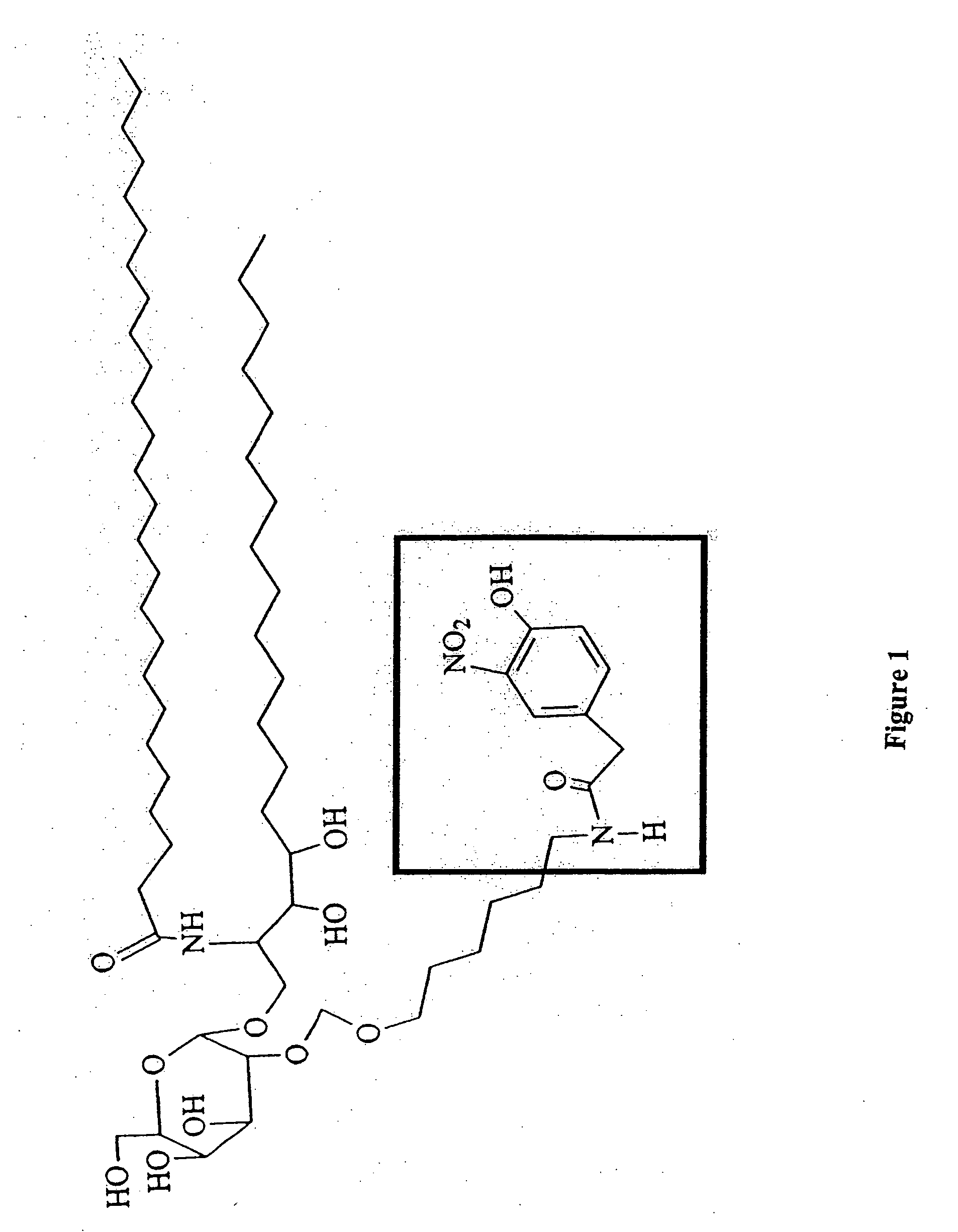
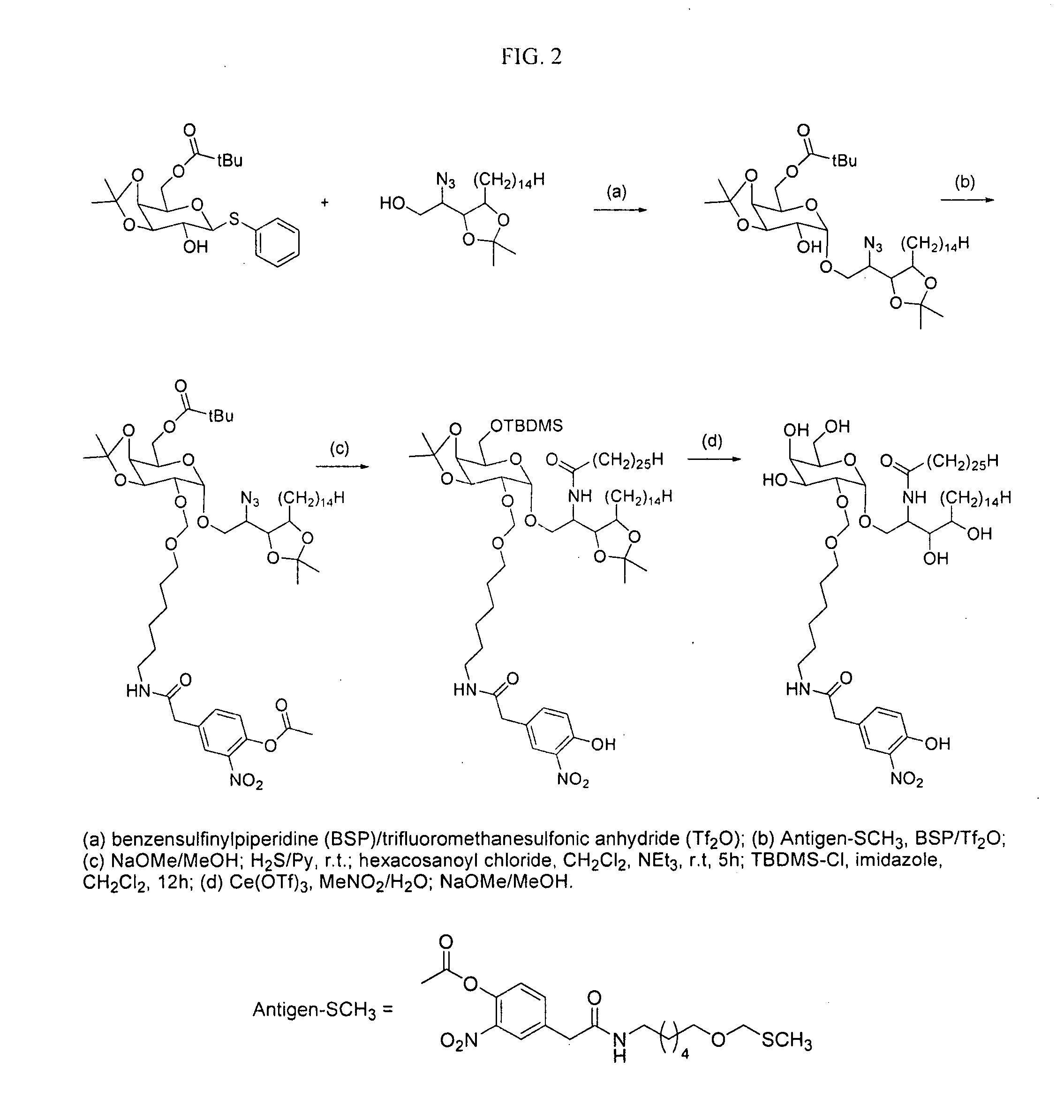
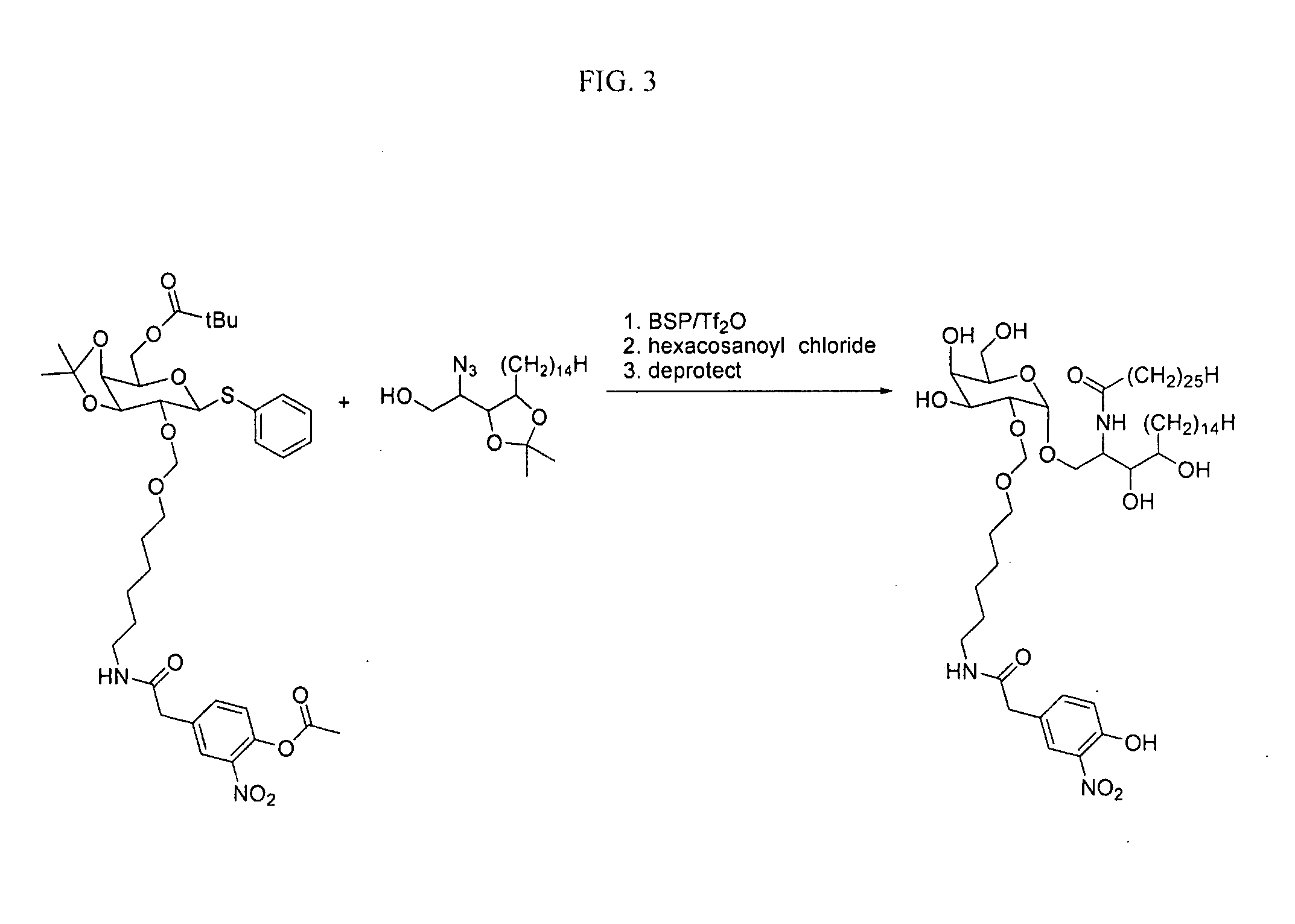
[0169] There are a growing number of recently described lipid antigens presented by the MHC I-like CD1d antigen presenting molecule that are recognized by a specialized subset of rapid-responding T cells, the NK T cells. Isotype-switched antibodies to lipid antigens have been isolated following infection or during autoimmune disease. This suggests that NK T cells may be helping B cells improve their response to antigens presented by CD1d. To investigate this possibility, a haptenated lipid antigen (NP-α-GalCer, see FIG. 1) which will be recognized by NP-specific B cells as well as α-GalCer-specific NK T cells we synthesized.

[0170] In vivo immunization of mice with NP-α-GalCer stimulated a strong IgG antibody response specific for NP. This antibody production was CD1d and Jα281 NK T cell dependent. Specific antibody was also produced in response to NP-α-GalCer more rapidly and to a higher titer than antibody was produced in response to challenge with a haptenated protein antigen, NP...

the structure of the environmentally friendly knitted fabric provided by the present invention; figure 2 Flow chart of the yarn wrapping machine for environmentally friendly knitted fabrics and storage devices; image 3 Is the parameter map of the yarn covering machine
Login to View More

PUM

PropertyMeasurementUnit
pharmaceutical compositionaaaaaaaaaa
compositionsaaaaaaaaaa
covalentaaaaaaaaaa
Login to View More

Abstract

The present invention is directed to pharmaceutical compositions that can be used to immunize subjects using, for example, lipid, glycan, or nucleic acid antigens. These antigens are conjugated to a glycosphingolipid.

Description

RELATED APPLICATIONS [0001] This application claims priority to U.S. Provisional Application Ser. No. 60 / 730862, entitled “CONJUGATE VACCINES FOR NON-PROTEINACEOUS ANTIGENS”, filed on Oct. 28, 2005, the entire contents of which are incorporated by reference herein.STATEMENT OF GOVERNMENT FUNDING [0002] The United States Government has a paid-up license in this invention and the right in limited circumstances to require the patent owner to license others under reasonable terms as provided for by the terms of NIH Grant No. R37AI28973, awarded by the Department of Health and Human Services.FIELD OF THE INVENTION [0003] The present invention is concerned with pharmaceutical compositions that can be used to induce an immune response in a subject. The compositions are characterized by the presence of a conjugate formed between an antigen, preferably a lipid or glycan, and a glycosphingolipid, preferably α-galactosylceramide. The compositions provide a strong and rapid response and may be ...

Claims

the structure of the environmentally friendly knitted fabric provided by the present invention; figure 2 Flow chart of the yarn wrapping machine for environmentally friendly knitted fabrics and storage devices; image 3 Is the parameter map of the yarn covering machine
Login to View More

Application Information

Patent Timeline
04 Oct 2007
Publication
US20070231344A1
IPC
A61K39/385; A61K39/09; A61K39/095; A61K39/112; A61K39/145
CPC
A61K39/0012; A61K2039/6012; A61K39/385; Y02A50/30
Inventors
LEADBETTER, ELIZABETH; BRENNER, MICHAEL B.