Silica-Containing Conjugated Diene Based Rubber Composition and Molding
a technology of conjugated diene and rubber, which is applied in the field of new silica-containing rubber compositions, can solve the problems of poor mechanical strength and wear resistance, etc., and achieve the effects of high fuel efficiency, wet grip performance, mechanical strength, wear resistance and low temperature brittleness resistan
- Summary
- Abstract
- Description
- Claims
- Application Information
AI Technical Summary
Benefits of technology
Problems solved by technology
Method used
Image

Examples
example 1
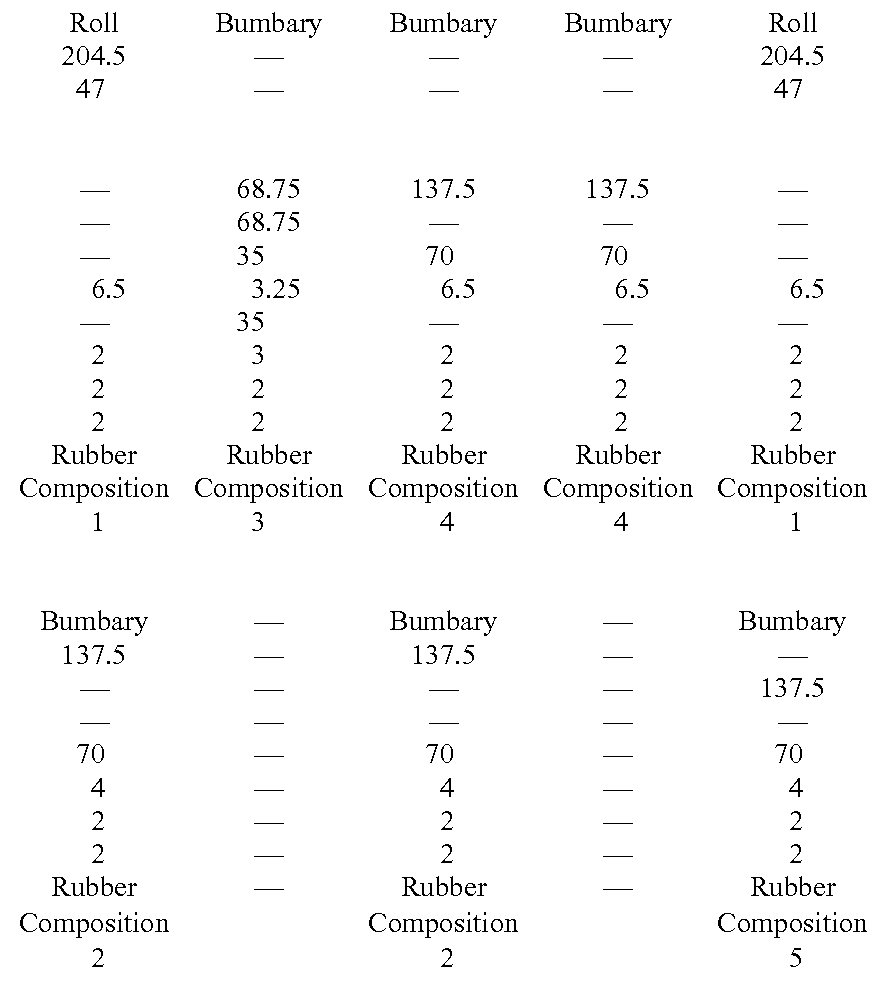
[0163] First, in the first step, the SBR-silica mixture (A1) obtained in the section of production of the A1 was mixed with a silane coupling agent (Si75 made by Degussa), zinc oxide (having a grain size of 0.4 μm, zinc oxide #1 made by Honjo Chemical Corporation), stearic acid and antioxidant (Nocrac 6C made by Ouchishinko Chemical Industrial Co., Ltd.) in blending quantities shown in Table 1 by a 50° C. open roll, so that a rubber composition 1 was obtained. In this step, a temperature of the rubber composition 1 became 80° C. or so and heated for about 4 minutes.
[0164] Next, in the second step, by using a Bumbary mixer (Labo Plastomill: model 100C, mixer type B-250 made by Toyo Seiki Seishaku-sho Ltd.), SBR in a blending quantity shown in Table 1 (Nipol 9521 having bound styrene amount of 45%, glass transition temperature of −28° C., oil extension amount of 27.3% and Mooney's viscosity of 50 made by Zeon Corporation) was masticated for 0.5 minute, then, compounding agents of car...
example 2
[0184] First, in the first step, by using a Bumbary mixer, the SBR-silica mixture (A2) obtained in the section of production of the A2 in a blending quantity shown in Table 3 was masticated for 0.5 minute, then, a silane coupling agent (Si69 made by Degussa), zinc oxide (zinc oxide #1), stearic acid and antioxidant (Nocrac 6C) in blending quantities shown in Table 3 were added and kneaded for 4.5 minutes, so that a rubber composition 6 was obtained. A temperature of the rubber composition 6 was in a range of about 110° C. to 150° C. and heated for about 4 minutes in this step.
[0185] Next, in the second step, by using a Bumbary mixer, solution polymerization terminally modified SBR (Nipol NS-116R having bound styrene amount of 21%, vinyl bonding amount of 63% at a part of butadiene monomer units, glass transition temperature of −25° C. and Mooney's viscosity of 45 made by Zeon Corporation) in a blending quantity shown in Table 3 was masticated for 0.5 minute, then, compounding agent...
example 3
[0202] First, in the first step, by using a Bumbary mixer, the SBR-silica mixture (A3) in a blending quantity shown in Table 5 obtained by the section of production of the A3 was masticated for 0.5 minute, then, a silane coupling agent (Si69), carbon black (Seast 7HM), process oil, zinc oxide, stearic acid, paraffin wax and antioxidant (Nocrac 6C) in blending quantities shown in Table 5 were added and kneaded for 4.5 minutes, so that a rubber composition 11 was obtained. The temperature at the end of the kneading was 145° C.
[0203] Next, in the second step, by using a Bumbary mixer, the rubber composition 11 in a blending quantity shown in Table 5 was masticated for 0.5 minute, then, polybutadiene rubber in a blending quantity shown in Table 5 (high-cis BR: Nipol BR1220N having cis bonding amount of 97%, glass transition temperature of −110° C., Mooney's viscosity of 43.5 wt % and toluene solution viscosity of 96 cps. Made by Zeon Corporation) was added and kneaded for 3.5 minutes. ...
PUM
| Property | Measurement | Unit |
|---|---|---|
| glass transition temperature | aaaaa | aaaaa |
| glass transition temperature | aaaaa | aaaaa |
| glass transition temperature | aaaaa | aaaaa |
Abstract
Description
Claims
Application Information
 Login to View More