Hydrocyanation process with reduced yield losses

a technology of yield loss and hydrocyanation process, which is applied in the field of hydrocyanation, can solve the problems of undesirable 2pn production and detriment to catalyst efficiency, and achieve the effects of less process equipment, reduced cost, and reduced yield loss

a technology of yield loss and hydrocyanation process, which is applied in the field of hydrocyanation, can solve the problems of undesirable 2pn production and detriment to catalyst efficiency, and achieve the effects of less process equipment, reduced cost, and reduced yield loss

US20080015382A1Active Publication Date: 2008-01-17INV NYLON CHEM AMERICAS LLC

Image

Smart Image Click on the blue labels to locate them in the text.
Viewing Examples
Smart Image
  • Hydrocyanation process with reduced yield losses
  • Hydrocyanation process with reduced yield losses
  • Hydrocyanation process with reduced yield losses

Examples

Experimental program
Comparison scheme
Effect test

example 1

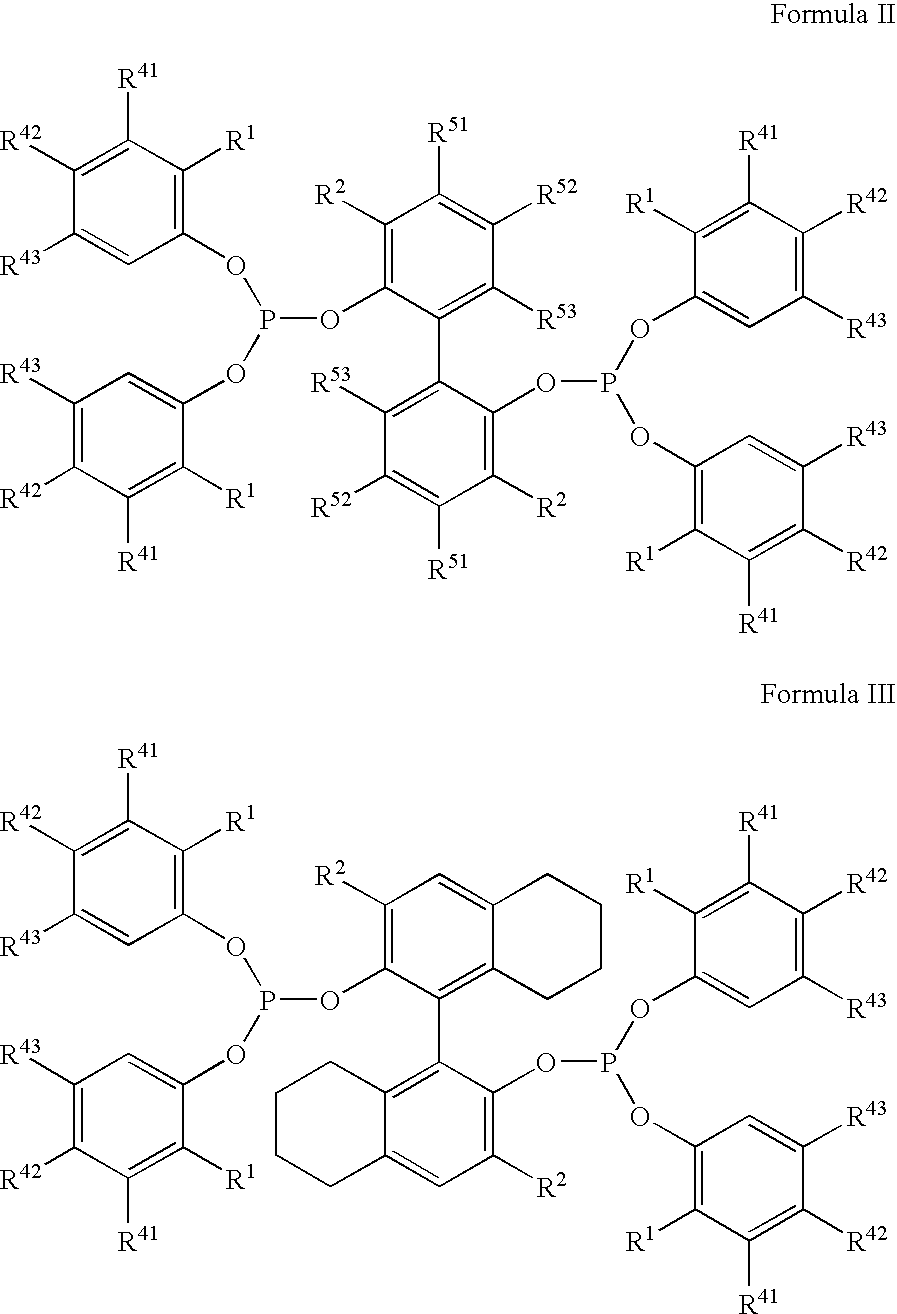
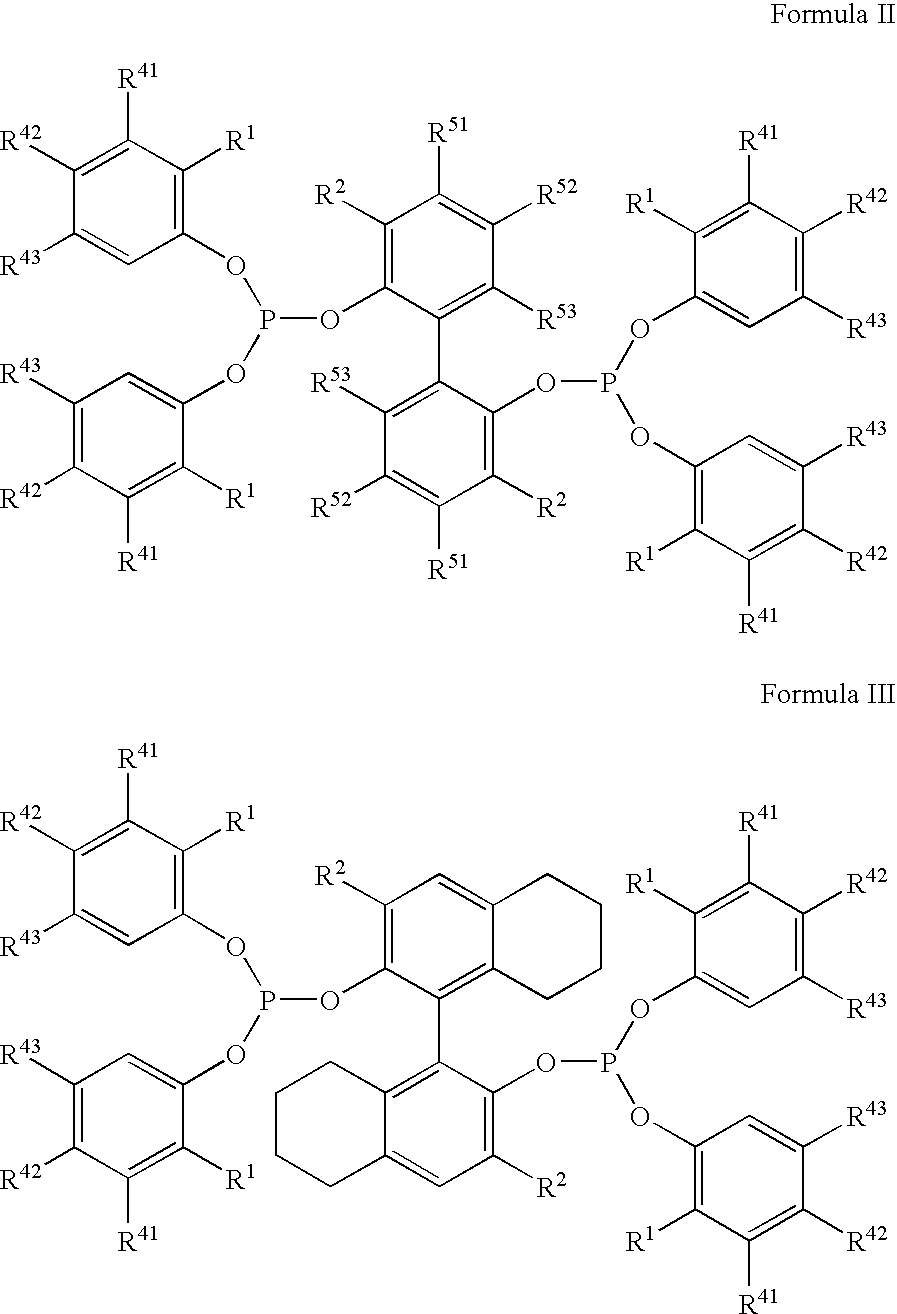
[0181]The inventive continuous hydrocyanation process was demonstrated using Ligand “A,” shown below, and FeCl2 as the Lewis acid promoter.

[0182]Target reaction rate=1.6×10⁻⁴ moles HCN / liter—second[0183]Temperature=50° C.[0184]mol % 2PN feed=12.8%

The target feed rates of the reaction components were as follows.

[0185]

ReagentFeed Rate, g / hrHCNa0.293,4PN (3PN + 4PN)1.012PN0.15Ni catalyst, calculated as Ni metal0.0010Total Ligandb0.029FeCl2 promoter0.0015Notes:aHCN excluding PN solvent.bMixture of Ligand “A” and corresponding monodentate phosphites as described above.

[0186]The overall feed molar ratio of 2PN to all unsaturated nitriles was about 0.13 and the overall feed molar ratio of HCN to all unsaturated nitriles was about 0.75.

[0187]The averaged GC analyses of reactor product samples taken from 92 to 100 hours from the inception of continuous flow indicated the following steady-state results.

3,4PN Conversion  86%mol % DN's73.6%mol % 2PN product14.0%mol % 3PN product11.8%2PN Yield 1...

example 2

[0189]The inventive continuous hydrocyanation process was demonstrated using Ligand “A” and ZnCl2 as the Lewis acid promoter.[0190]Target reaction rate=1.6×10⁻⁴ moles HCN / liter—second[0191]Temperature=50° C.[0192]mol % 2PN feed=20.6%

The target feed rates of the reaction components were as follows.

[0193]

ReagentFeed Rate, g / hrHCNa0.293,4PN (3PN + 4PN)0.942PN0.25Ni catalyst, calculated as Ni metal0.0013Total Ligandb0.027ZnCl2 promoter0.0020Notes:aHCN excluding PN solvent.bMixture of Ligand “A” and corresponding monodentate phosphites as described above.

[0194]The overall feed molar ratio of 2PN to all unsaturated nitrites was about 0.21 and the overall feed molar ratio of HCN to all unsaturated nitrites was about 0.70.

[0195]The averaged GC analyses of reactor product samples taken from 49 to 53 hours from the inception of continuous flow indicated the following steady-state results.

3,4PN Conversion90.7%mol % DN's71.9%mol % 2PN product20.3%mol % 3PN product7.2%2PN Yield0.0%Linearity95.0%...

example 3

[0205]The inventive continuous hydrocyanation process was demonstrated using Ligand “B,” shown below, and FeCl2 as the Lewis acid promoter.

[0206]Target reaction rate=1.6×10⁻⁴ moles HCN / liter—second[0207]Temperature=50° C.[0208]mol % 2PN feed=15.4%

The target feed rates of the reaction components were as follows.

[0209]

ReagentFeed Rate, g / hrHCNa0.293,4PN (3PN + 4PN)0.952PN0.175Ni catalyst, calculated as Ni metal0.0013Total Ligandb0.029FeCl2 promoter0.0019Notes:aHCN excluding PN solvent.bMixture of Ligand “B” and corresponding monodentate phosphites as described above.

[0210]The overall feed molar ratio of 2PN to all unsaturated nitrites was about 0.15 and the overall feed molar ratio of HCN to all unsaturated nitrites was about 0.80.

[0211]The averaged GC analyses of reactor product samples taken from 69 to 78 hours from the inception of continuous flow indicated the following steady-state results.

3,4PN Conversion92.3%mol % DN's77.4%mol % 2PN product15.6%mol % 3PN product6.4%2PN Yield0.3...

the structure of the environmentally friendly knitted fabric provided by the present invention; figure 2 Flow chart of the yarn wrapping machine for environmentally friendly knitted fabrics and storage devices; image 3 Is the parameter map of the yarn covering machine
Login to View More

PUM

PropertyMeasurementUnit
molar ratioaaaaaaaaaa
feed molar ratioaaaaaaaaaa
temperatureaaaaaaaaaa
Login to View More

Abstract

The invention provides a hydrocyanation process for the production of adiponitrile and other dinitriles having six carbon atoms, the process comprising:a) forming a reaction mixture in the presence of at least one Lewis acid, said reaction mixture comprising ethylenically unsaturated nitriles having five carbon atoms, hydrogen cyanide, and a catalyst precursor composition, by continuously feeding ethylenically unsaturated nitriles, hydrogen cyanide, and a catalyst precursor composition;b) controlling X and Z, wherein X is the overall feed molar ratio of 2-pentenenitriles to all unsaturated nitriles and Z is the overall feed molar ratio of hydrogen cyanide to all unsaturated nitriles, by selecting a value for X in the range from about 0.001 to about 0.5, and a value for Z in the range from about 0.5 / 1 to about 0.99 / 1, such that the value of quotient Q, whereinQ=X[(moles3PN+4PNinthefeed) / (molesallunsaturatednitrilesinthefeed)]-Zis in the range from about 0.2 to about 10, wherein 3PN is 3-pentenenitriles and 4PN is 4-pentenenitrile; andc) withdrawing a reaction product mixture comprising adiponitrile;wherein the ratio of the concentration of 2-pentenenitriles to the concentration of 3-pentenenitriles in the reaction mixture is from about 0.2 / 1 to about 10 / 1;wherein the catalyst precursor composition comprises a zero-valent nickel and at least one multidentate phosphorus-containing ligand;wherein the multidentate phosphorus-containing ligand is selected from the group consisting of a phosphite, a phosphonite, a phosphinite, a phosphine, and a mixed phosphorus-containing ligand or a combination of such members; andwherein the multidentate phosphorus-containing ligand gives acceptable results according to at least one protocol of the 2-Pentenenitrile Hydrocyanation Test Method.

Description

CROSS-REFERENCE TO RELATED APPLICATIONS[0001]This application claims benefit of priority from Provisional Application No. 60 / 830,986, filed Jul. 14, 2006. This application hereby incorporates by reference Provisional Application No. 60 / 830,986 in its entirety. This application relates to commonly-assigned applications filed concurrently on Jul. 12, 2007 as Attorney Dockets PI1535USNA, PI1710USNA, PI1711USNA and PI1715USNA.FIELD OF THE INVENTION[0002]The present process is directed to the hydrocyanation of ethylenically unsaturated nitriles having five carbon atoms to produce adiponitrile (ADN) and other dinitriles. More particularly, this invention relates to a process for the hydrocyanation of 3-pentenenitriles (3PN) and / or 4-pentenenitrile (4PN), and optionally 2-pentenenitriles (2PN), using a catalyst precursor composition comprising a zero-valent nickel and at least one multidentate phosphorus-containing ligand in the presence of at least one Lewis acid promoter.BACKGROUND OF TH...

Claims

the structure of the environmentally friendly knitted fabric provided by the present invention; figure 2 Flow chart of the yarn wrapping machine for environmentally friendly knitted fabrics and storage devices; image 3 Is the parameter map of the yarn covering machine
Login to View More

Application Information

Patent Timeline
17 Jan 2008
Publication
US20080015382A1
IPC
C07C253/10
CPC
C07C253/10; C07C255/04
Inventors
FOO, THOMAS; GARNER, JAMES MICHAEL