[0012]Another
advantage of the present invention is that the UV radiation filter is no longer exposed to high thermal stress because it is no longer located in the direct vicinity of the
xenon radiator. Since some distance away from the
xenon radiator, because of the
temperature control, no such fluctuations in temperature occur as in the vicinity of the xenon radiator, the transmission characteristic of the UV radiation filter can now be maintained constant, it being particularly when using an
edge filter such as a WG320 filter that the edge length can be maintained constant due to the temperature being relatively stable. This now makes it possible, for example, to satisfy the tolerances specified for determining the light protection factor in accordance with pertinent standards, for example DIN 67501 or the COLIPA method. A further
advantage of the device in accordance with the invention is that due to the fact that the UV radiation filter is no longer in the direct vicinity of the xenon radiator, there is now greater freedom in designing the UV radiation filter, particularly the thickness of the UV radiation filter.
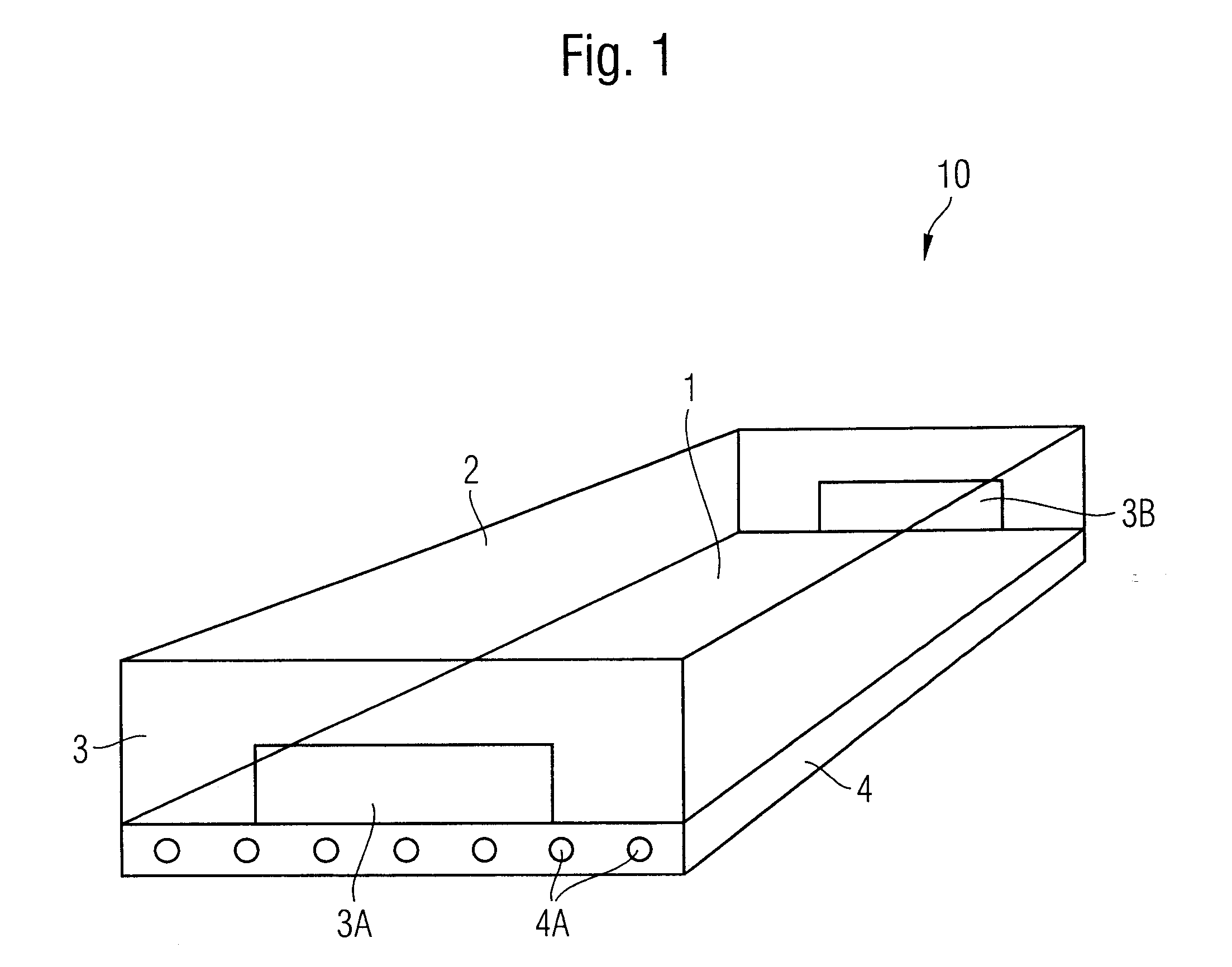
[0013]In one preferred embodiment of the device in accordance with the invention it is provided for that the enclosure comprises a bottom wall for mounting the specimen, an UV radiation filter sited facing the bottom wall and a plurality of sidewalls interconnecting the bottom wall and the UV radiation filter. In this arrangement it may be provided for in particular that the top wall facing the bottom wall of the enclosure is formed entirely by the UV radiation filter. It is, however, just as possible that the UV radiation filter is formed by a window within the top wall.
[0014]The UV radiation filter has preferably the shape of a rectangular disk, the enclosure comprising four sidewalls each of which joins the four side edges of the UV radiation filter to the bottom wall to make it possible to configure the enclosure light-tight so that no
stray light whatsoever or substantially no
stray light of the xenon radiator attains the specimen. In this arrangement the light-tight seal of the enclosure may be achieved by commercially available seals.
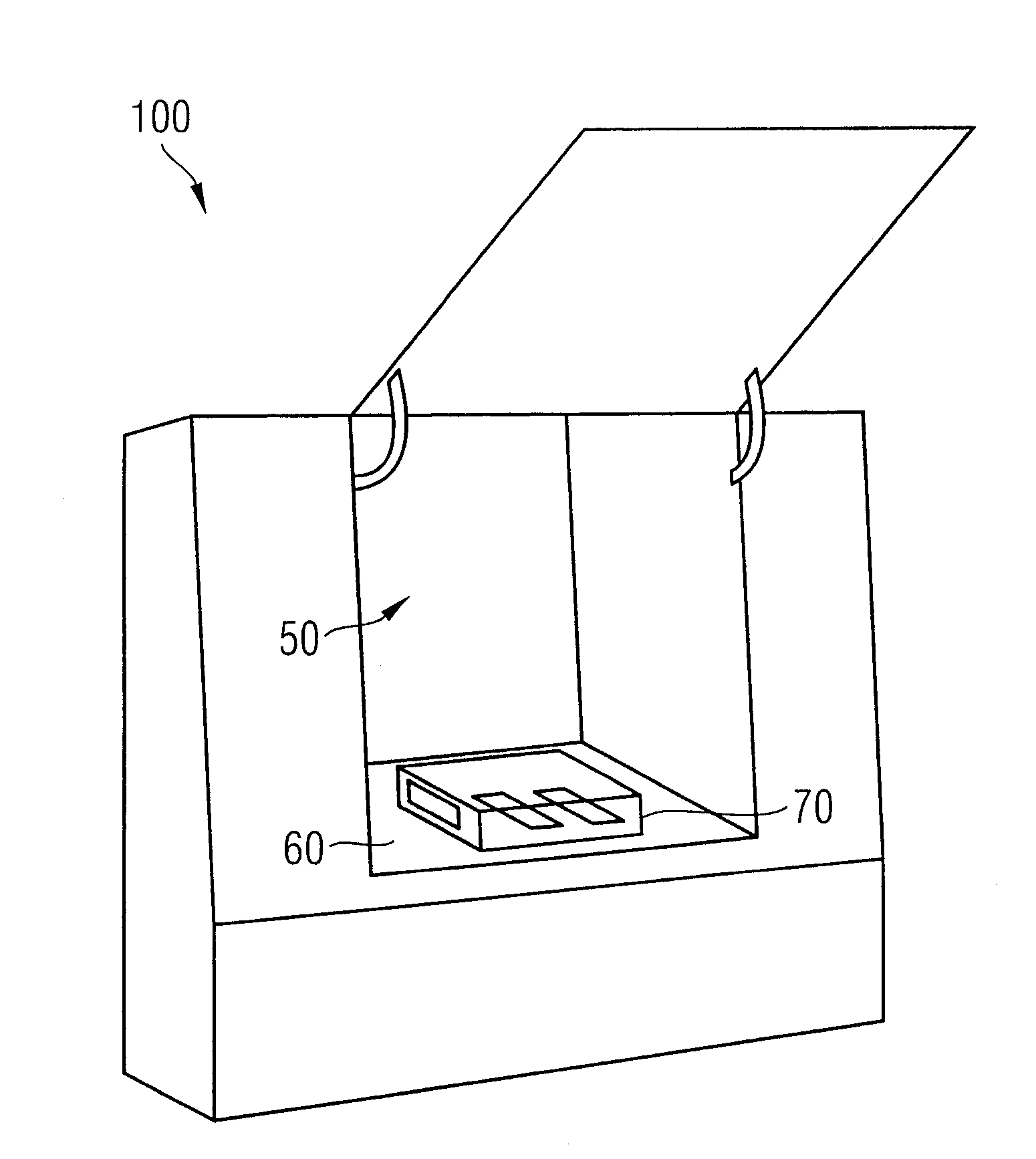
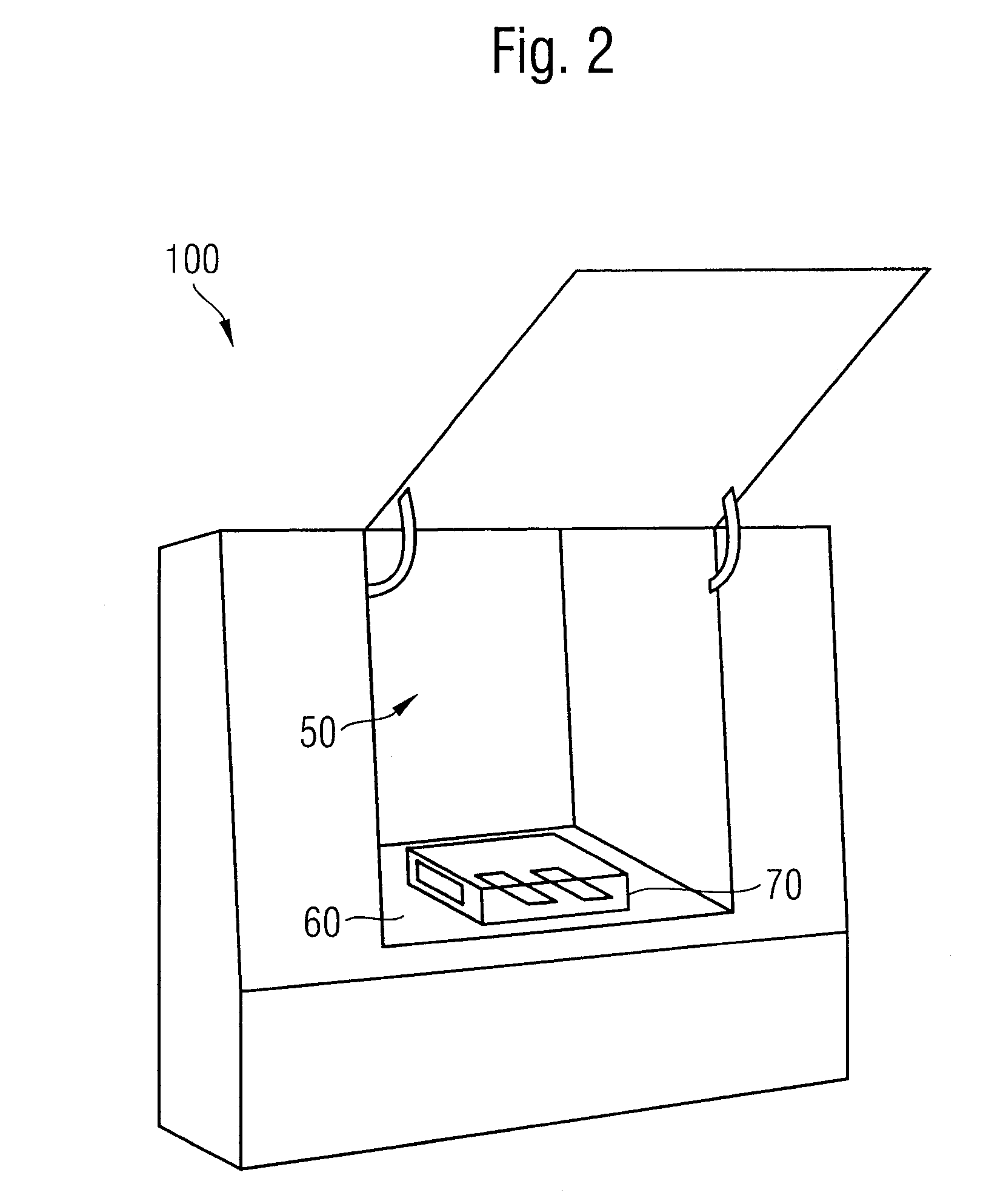
[0015]With weathering apparatuses a distinction is made generally between weathering apparatuses with immobile specimens, such as the SUNTEST apparatus of the applicant, and weathering apparatuses having mobile specimens. With weathering apparatuses having immobile specimens surfaces are provided for mounting the specimens on an inner wall of the weathering chamber which is usually the horizontal bottom plate of the weathering chamber, these specimens mostly being rectangular plates of standard size. Facing the bottom plate, i.e., on a top horizontal inner wall, the UV radiation sources are mounted. With weathering apparatuses having mobile specimens, by contrast, the UV radiation source is arranged as a central rod-shaped radiation source and the specimens are mounted on a frame which can be made to rotate. Here too, the likewise usually plate-type specimens having the surface to be tested are exposed to the radiation source continually during rotation.
[0016]The device in accordance with the invention can be put to use in both types of weathering apparatuses. In a weathering apparatus in which the specimens are immobile the bottom wall of the enclosure is formed by the mounting surface, formed generally by a portion of an inner wall of the weathering chamber, whereas in a weathering apparatus in which the specimens are mobile an enclosure is provided which is movable within the weathering chamber, it in particular being made to
orbit the UV radiation source. In this arrangement the enclosure can be secured to a frame capable of being rotated within the weathering chamber, the top wall of the enclosure comprising the UV radiation filter always facing the UV radiation source.
[0017]In weathering apparatuses having immobile specimens, such as the SUNTEST apparatus of the applicant, it is provided for, as a rule, that air is circulated within the weathering chamber such that the air streams over the specimens substantially in a laminar flow in thus ensuring a constant ambient temperature in the direct vicinity of the specimen. This is achievable with a device in accordance with the invention by the two facing sidewalls of the enclosure being formed with ports for passage of a gaseous medium. Preferably, in this case, feeder lines, such as flexible conduits or the like, are directly connected to the ports, so that the ports too, are sealed off to prevent the ingress of
stray light into the interior of the enclosure.


 Login to View More
  Login to View More