Contained drive system for chain conveyor belt to reduce catenary sag

US20090020397A1Active Publication Date: 2009-01-22DORNER MFG. CORP.
22 Cites 14 Cited by

Patent Information

Authority / Receiving Office
US · United States
Current Assignee / Owner
Publication Date
2009-01-22

Smart Images

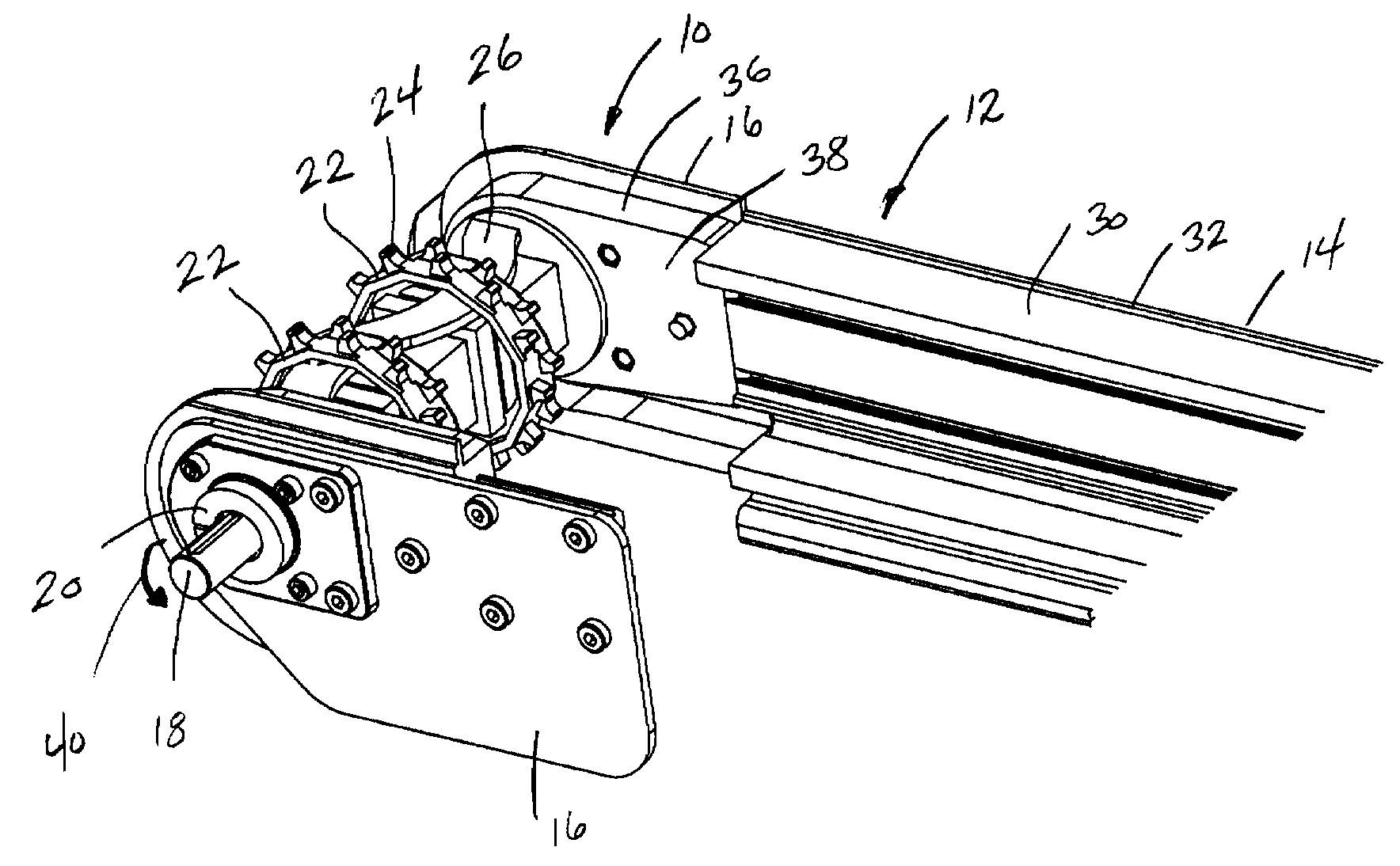
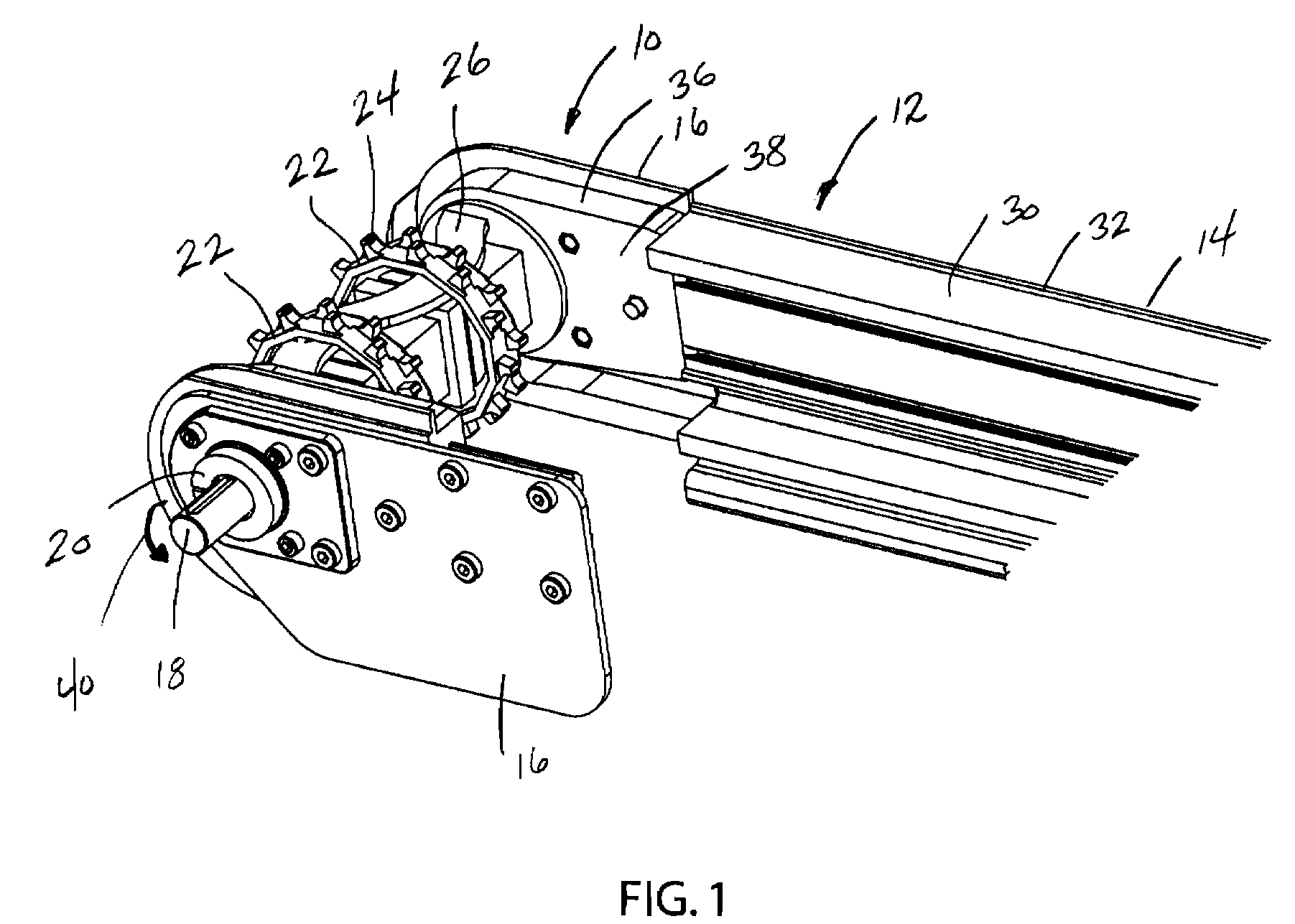
  • Figure 1
    Figure 1
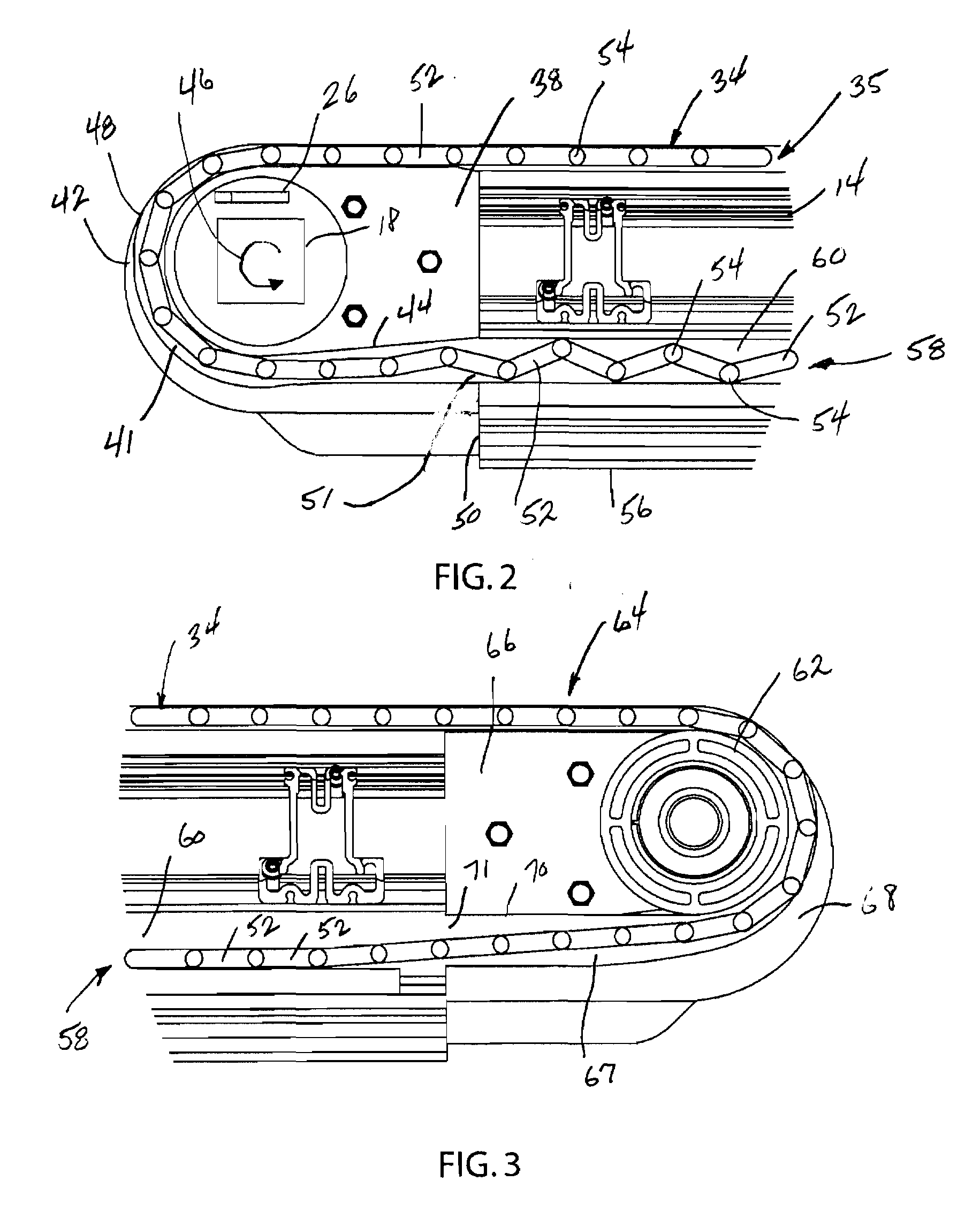
  • Figure 2
    Figure 2
  • Figure 3
    Figure 3
Patent Text Reader

Abstract

A conveyor frame assembly for use with a conveyor belt formed from individual links each joined together at pivot points. The conveyor frame assembly includes a drive assembly that pulls the conveyor belt around a drive roller to transition between the upper and lower runs of the conveyor belt. The drive end includes a support block that encloses the side edges of the conveyor belt as the conveyor belt transitions over the drive sprockets. The side frame members each include a continuous retaining channel having a height greater than the thickness of the conveyor belt. The retaining channels formed on opposite sides of the conveyor frame assembly allow the lower run of the conveyor belt to “tent” by creating an angle between adjacent links of the conveyor belt assembly. The tenting of the lower run of the conveyor belt eliminates catenary sag.
Need to check novelty before this filing date? Find Prior Art

Description

CROSS-REFERENCE TO RELATED APPLICATION

[0001] The present application is based on and claims priority to U.S. Provisional Patent Application Ser. No. 60 / 950,659 filed on Jul. 19, 2007.BACKGROUND OF THE INVENTION

[0002] The present invention generally relates to a conveyor frame assembly for use with a plastic chain conveyor belt. More specifically, the present invention relates to a conveyor assembly that reduces the catenary sag of the lower run of the conveyor belt downstream from the drive roller.

[0003] In many conveyor applications, a plastic chain conveyor belt is utilized to move materials throughout a facility. The plastic chain conveyor belt includes individual links that run across the width of the conveyor belt such that the conveyor belt can assume a flat transporting condition yet can transition over both a drive roller and an idler roller to create the upper and lower runs of the conveyor belt.

[0004] Since plastic chain conveyor belts can be used to move a large number of pro...

Examples

Embodiment Construction

[0016]FIG. 1 illustrates the drive end 10 of a conveyor assembly 12 including a pair of spaced side frame members 14, of which only one is shown in FIG. 1. The drive end 10 includes a pair of spaced side brackets 16 that are each connected to one of the side frame members 14. The side brackets 16 each rotatably support a drive shaft 18 operatively connected to a drive motor (not shown). In the embodiment shown in FIG. 1, the drive shaft 18 is rotatably supported within a bearing assembly 20 contained in each of the side brackets 16. The drive shaft 18 receives a plurality of drive sprockets 22, each of which include a series of spaced teeth 24 that engage the individual links of a conveyor belt. As shown in FIG. 1, a sprocket connector 26 links the series of drive sprockets 22 to provide the desired spacing of the drive sprockets 22 along the length of the drive shaft 18.

[0017]As can best be seen in FIGS. 1 and 5, the side frame member 14 is an extruded aluminum member that includes...