
Vehicle lane discrimination in an electronic toll collection system
- Summary
- Abstract
- Description
- Claims
- Application Information
AI Technical Summary
Benefits of technology
Problems solved by technology
Method used
Image

Examples
Embodiment Construction
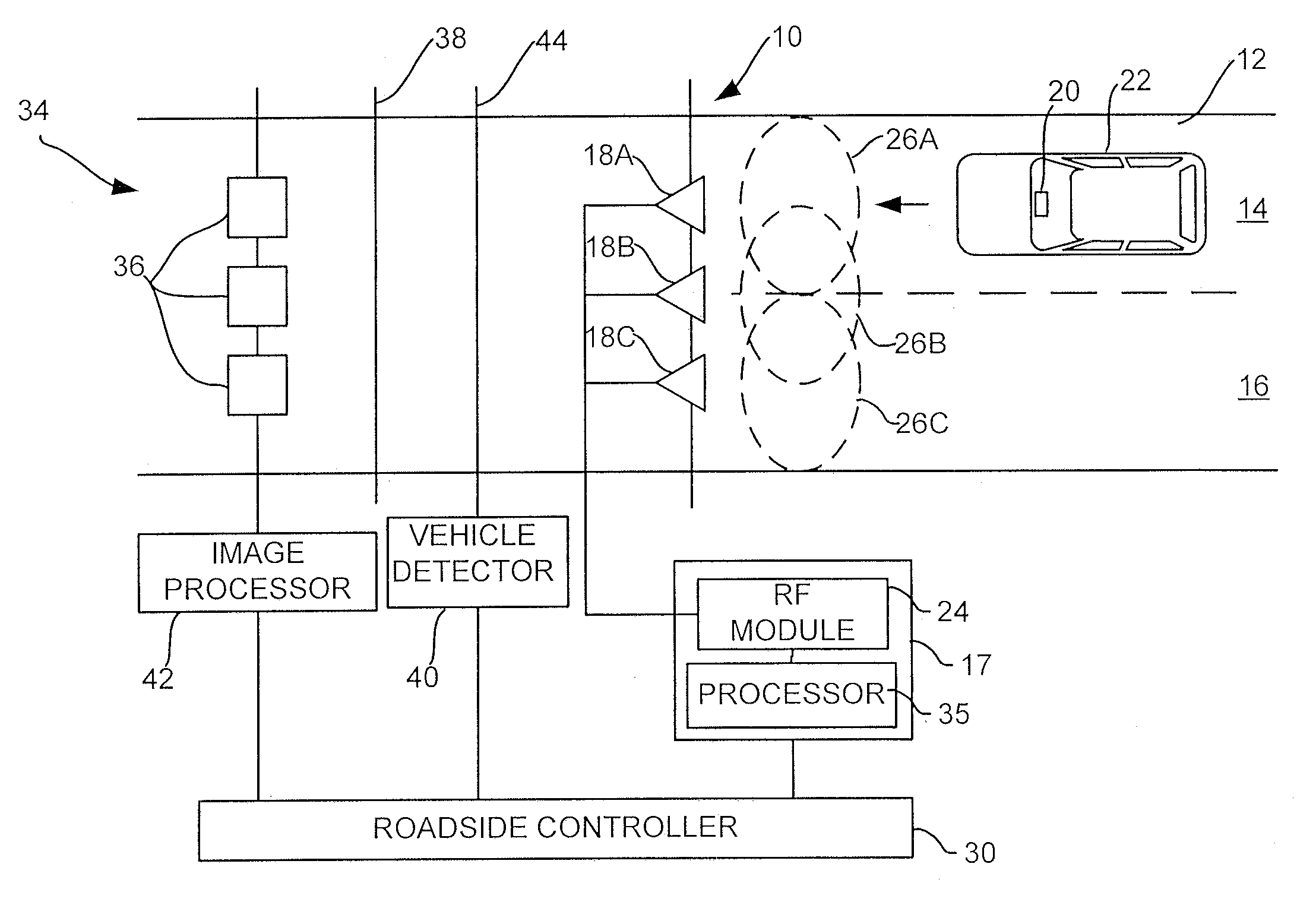
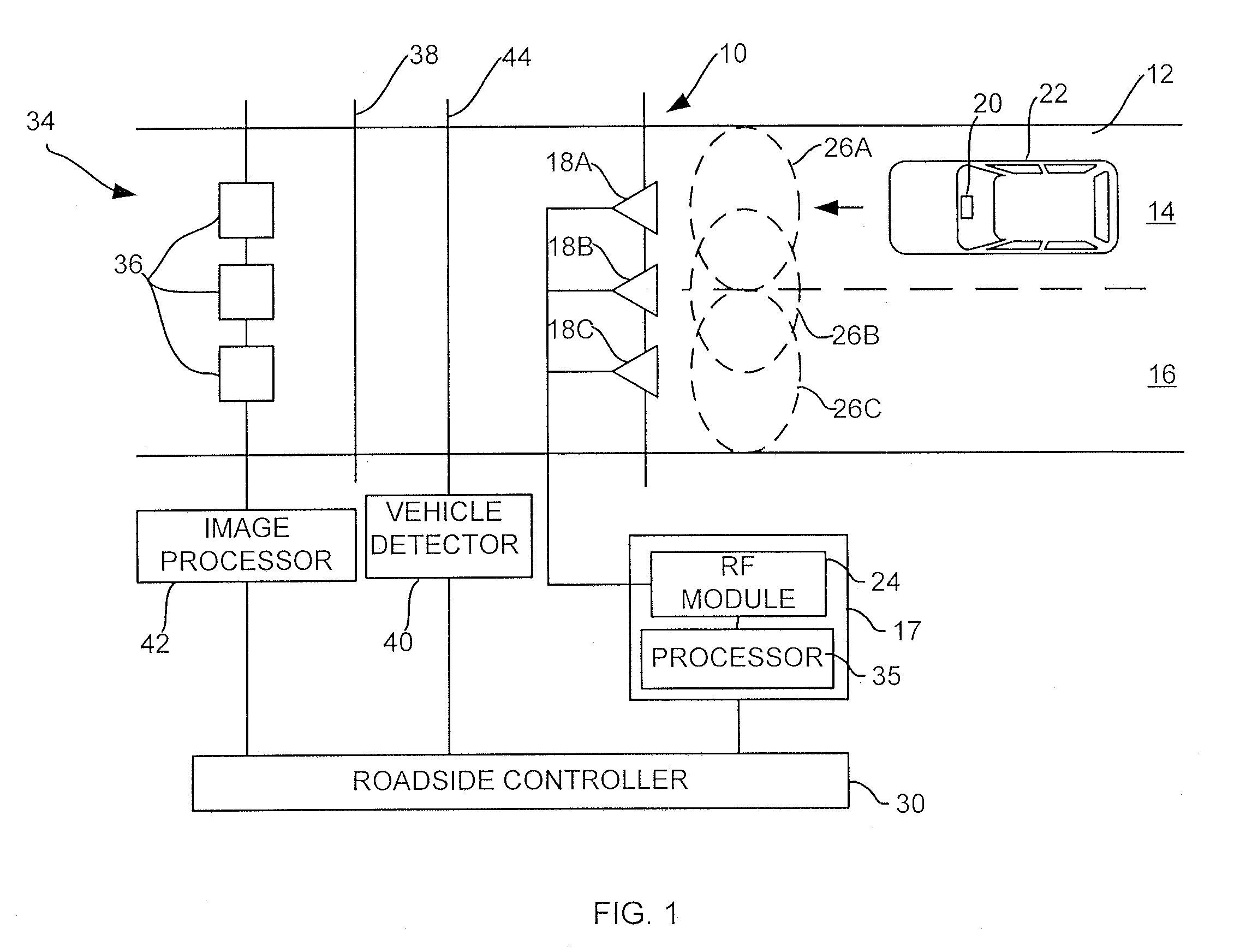
[0020]With reference to FIG. 1, there is shown an embodiment of a vehicle position determination system, illustrated generally by reference numeral 10. As shown in FIG. 1, the vehicle position determination system is applied to a roadway 12 having first and second adjacent lanes 14 and 16. The roadway 12 may be a two lane access roadway leading towards or away from a toll highway. The vehicle position determination system 10 includes three roadway antennas 18A, 18B and 18C, each of which is connected to signal processing means, namely an Automatic Vehicle Identification (“AVI”) reader 17. The AVI reader 17 processes signals that are sent and received by the roadway antennas 18A, 18B and 18C, and includes a processor 35 and a Radio Frequency (RF) module 24.
[0021]The RF module 24 is configured to modulate signals from the processor 35 for transmission as RF signals over the roadway antennas 18A, 18B and 18C, and to de-modulate RF signals received by the roadway antennas 18A, 18B and 1...
PUM
 Login to View More
 Abstract
Description
Claims
Application Information
 Login to View More