
Contact-free vehicle air vent
a technology of contact-free air vents and vehicles, which is applied in the direction of vessel parts, transportation and packaging, vessel construction, etc., can solve the problem of dangerous momentary re-focusing of the driver's attention away from the road
- Summary
- Abstract
- Description
- Claims
- Application Information
AI Technical Summary
Benefits of technology
Problems solved by technology
Method used
Image

Examples
second embodiment
[0068]Referring now to FIG. 12, a contact-free air vent 112 in accordance with a second embodiment will now be explained. In view of the similarity between the first and second embodiments, the parts of the second embodiment that are identical to the parts of the first embodiment will be given the same reference numerals as the parts of the first embodiment. Moreover, the descriptions of the parts of the second embodiment that are identical to the parts of the first embodiment may be omitted for the sake of brevity.
[0069]In the second embodiment, the contact-free air vent 112 has many of the same features as in the first embodiment, such as the outer housing 22, the plurality of vertically oriented air blades 24, the plurality of horizontally oriented air blades 26, the first servo device 28 and the second servo device 30. However, in the second embodiment the first pair of sensors 34 has been replaced with a sensor array 134, the second pair of sensors 36 has been replaced with a s...
third embodiment
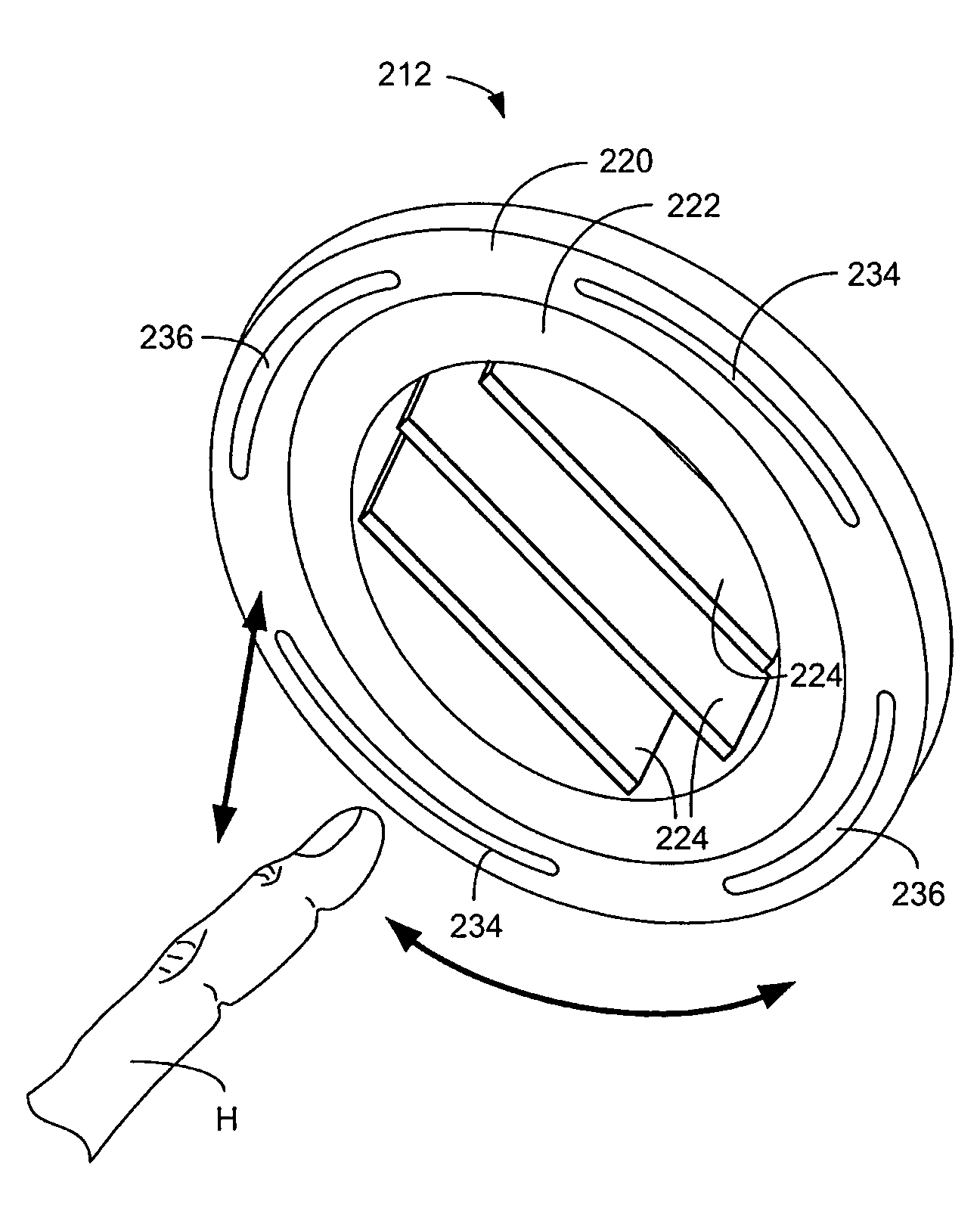
[0077]Referring now to FIG. 13-17, a contact-free air vent 212 in accordance with a third embodiment will now be explained. In view of the similarity between the first and third embodiments, the parts of the third embodiment that are identical to the parts of the first embodiment will be given the same reference numerals as the parts of the first embodiment. Moreover, the descriptions of the parts of the third embodiment that are identical to the parts of the first embodiment may be omitted for the sake of brevity.
[0078]In the third embodiment, the contact-free air vent 212 includes a fixed housing 220 and a rotatable housing 222 that supports a plurality of the flow control blades 224, a positioning mechanism that includes a first servo device 228 and a second servo device 230, a first pair of sensors 234, a second pair of sensors 236 and a controller 238 (a control unit).
[0079]The fixed housing 220 is attachable to the dashboard 14 in a manner similar to the attachment of the oute...
PUM
 Login to View More
 Abstract
Description
Claims
Application Information
 Login to View More