Check patentability & draft patents in minutes with Patsnap Eureka AI!

System and method for automatically generating test patterns for at-speed structural test of an integrated circuit device using an incremental approach to reduce test pattern count

Inactive Publication Date: 2010-09-16
IBM CORP
View PDF13 Cites 11 Cited by
  • Summary
  • Abstract
  • Description
  • Claims
  • Application Information

AI Technical Summary

Benefits of technology

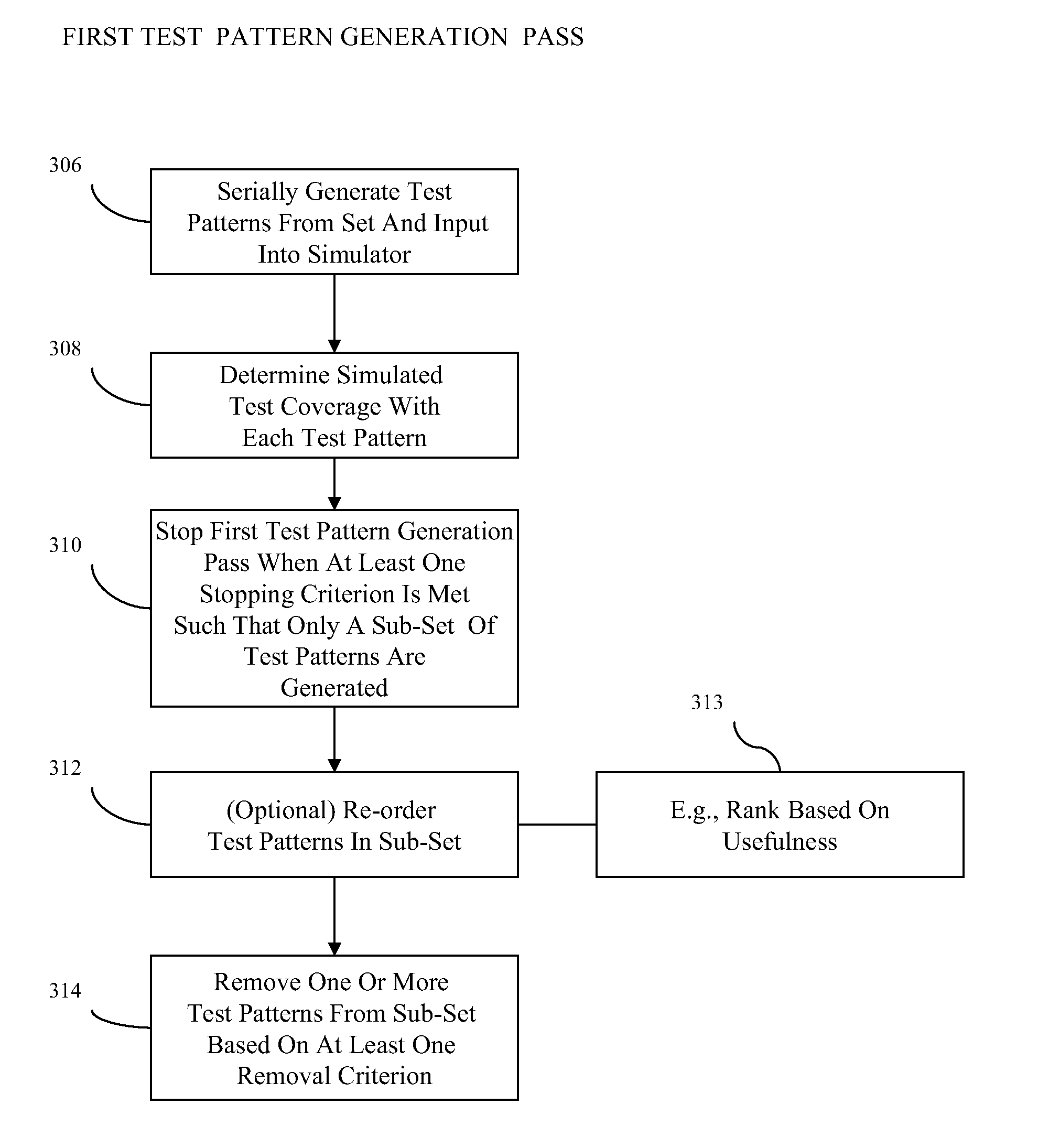
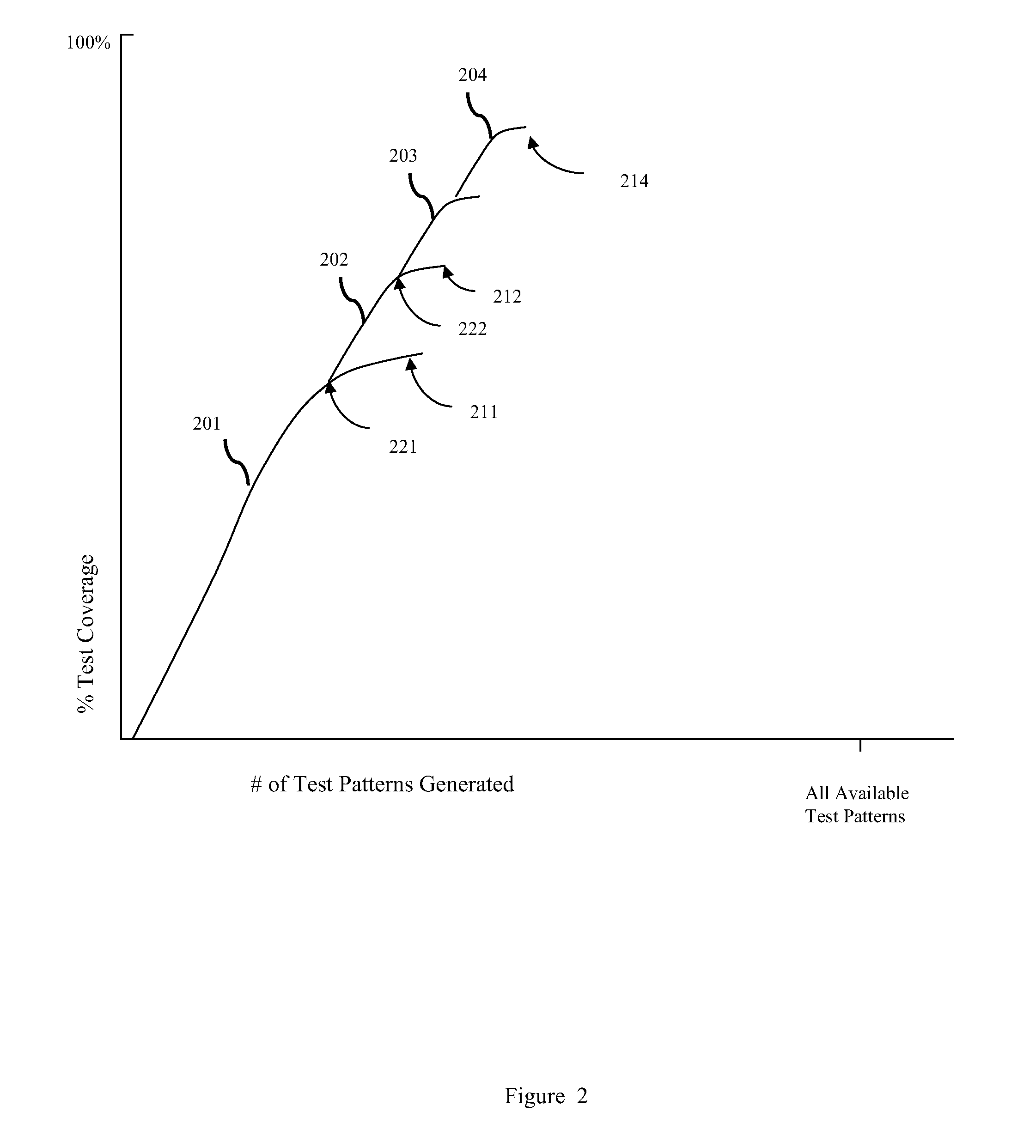
[0007]In view of the foregoing, disclosed herein are embodiments of a system and method for automatically selecting and generating test patterns for an at-speed structural test of an integrated circuit device. The embodiments use an incremental approach to test pattern selection and generation. Specifically, a test pattern generation pass is started and proceeds until the “knee” of the simulated test coverage curve is observed (i.e., until the percentage of simulated faults detected no longer increases or only minimally increases with each new test pattern generated). Next, the test patterns are optionally reordered and some are removed. Then, another test pattern generation pass is started. The process is repeated iteratively until some predetermined final stopping criterion is met. By performing multiple test pattern generation passes and reducing the number of available test patterns that can be generated with each pass, the method exploits the initial increase in the test coverage curve inherent in each pass and limits the overall test pattern count.
[0010]During this second test pattern generation pass, the ATPG can serially generate test patterns from the remaining test patterns in the sub-set and can again stop when at least one predetermined stopping criterion related to test coverage is met. The ATPG can perform additional test pattern generation passes in this same manner until at least one predetermined final stopping criterion is met. By performing multiple test pattern generation passes and reducing the number of available test patterns that can be generated with each pass, the system exploits the initial increase in the test coverage curve inherent in each pass and limits the overall test pattern count.
[0013]The second test pattern generation pass can comprise serially generating test patterns from the remaining test patterns in the sub-set and can be stopped when at least one predetermined criterion related to test coverage is met. Additional test pattern generation passes can be repeated in this same manner until at least one predetermined final stopping criterion is met. That is, the above-described test pattern generation, stopping, re-ordering and removing processes can be repeatedly performed until at least one predetermined final stopping criterion is met. By performing multiple test pattern generation passes and reducing the number of available test patterns that can be generated with each pass, the method exploits the initial increase in the test coverage curve inherent in each pass and limits the overall test pattern count.

Problems solved by technology

Unfortunately, during at-speed testing, misalignment of clock signals can occur as signals are exchanged between different circuit partitions, e.g., clock domains, power domains, etc.

Method used

the structure of the environmentally friendly knitted fabric provided by the present invention; figure 2 Flow chart of the yarn wrapping machine for environmentally friendly knitted fabrics and storage devices; image 3 Is the parameter map of the yarn covering machine
View more

Image

Smart Image Click on the blue labels to locate them in the text.
Viewing Examples
Smart Image
  • System and method for automatically generating test patterns for at-speed structural test of an integrated circuit device using an incremental approach to reduce test pattern count
  • System and method for automatically generating test patterns for at-speed structural test of an integrated circuit device using an incremental approach to reduce test pattern count
  • System and method for automatically generating test patterns for at-speed structural test of an integrated circuit device using an incremental approach to reduce test pattern count

Examples

Experimental program
Comparison scheme
Effect test

Embodiment Construction

[0023]The embodiments of the invention and the various features and advantageous details thereof are explained more fully with reference to the non-limiting embodiments that are illustrated in the accompanying drawings and detailed in the following description.

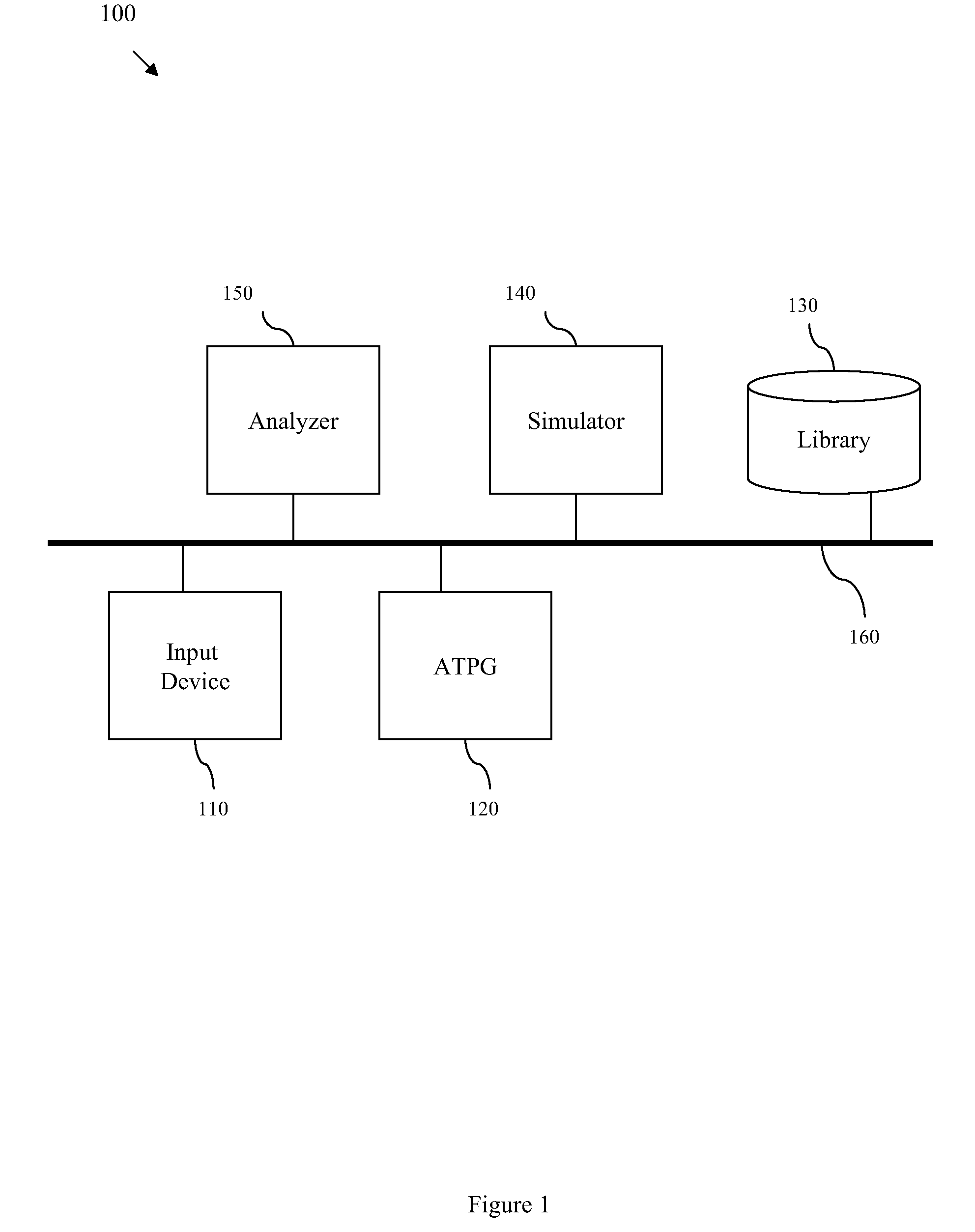
[0024]An automatic test pattern generator (ATPG) is a computer system that uses software tools to generate test patterns (i.e., input / test sequences) that, when applied to a level sensitive scan design (LSSD)), enable testers to distinguish between circuit behavior that is desirable and circuit behavior that is indicative of design or manufacturing defects. At-speed structural testing techniques use such ATPGs to select and generate test patterns when testing for defects, such as high impedance shorts, in-line resistance or cross-talk between signals, which are only apparent when the integrated circuit device is run at speed.

[0025]Those skilled in the art will recognize that large integrated circuit devices are often partition...

the structure of the environmentally friendly knitted fabric provided by the present invention; figure 2 Flow chart of the yarn wrapping machine for environmentally friendly knitted fabrics and storage devices; image 3 Is the parameter map of the yarn covering machine
Login to View More

PUM

No PUM Login to View More

Abstract

Disclosed are embodiments of a system and method for automatically selecting and generating test patterns for an at-speed structural test of an integrated circuit device. Specifically, a test pattern generation pass is started and proceeds until the “knee” of the simulated test coverage curve is observed. Next, the test patterns are optionally reordered and some are removed. Then, another test pattern generation pass is started. The process is repeated iteratively until some predetermined final stopping criterion is met. By performing multiple test pattern generation passes and reducing the number of available test patterns that can be generated with each pass, the method exploits the initial increase in the test coverage curve inherent in each pass and limits the overall test pattern count.

Description

[0001]Applicant claims the benefit of Provisional Application Ser. No. 61 / 159,166, System and Method for Automatically Generating Test Patterns for At-Speed Structural Test of an Integrated Circuit Device Using an Incremental Approach to Reduce Test Pattern Count, filed on Mar. 11, 2009.BACKGROUND[0002]1. Field of the Invention[0003]The embodiments of the invention generally relate to integrated circuit device at-speed structural testing techniques and, more specifically, to a system and method for automatically generating test patterns for an at-speed structural test of an integrated circuit device using an incremental approach to reduce test pattern count.[0004]2. Description of the Related Art[0005]An automatic test pattern generator (ATPG) is a computer system that uses software tools to generate test patterns (i.e., input / test sequences) that, when applied to a level sensitive scan design (LSSD)), enable testers to distinguish between circuit behavior that is desirable and circ...

Claims

the structure of the environmentally friendly knitted fabric provided by the present invention; figure 2 Flow chart of the yarn wrapping machine for environmentally friendly knitted fabrics and storage devices; image 3 Is the parameter map of the yarn covering machine
Login to View More

Application Information

Patent Timeline
no application Login to View More
IPC IPC(8): G06F19/00G01R31/00
CPCG01R31/31835
Inventor BASSETT, ROBERT W.FERKO, ANDREWIYENGAR, VIKRAM
Owner IBM CORP
Features
  • R&D
  • Intellectual Property
  • Life Sciences
  • Materials
  • Tech Scout
Why Patsnap Eureka
  • Unparalleled Data Quality
  • Higher Quality Content
  • 60% Fewer Hallucinations
Social media
Patsnap Eureka Blog
Learn More