Optical apparatus having optical Anti-shake function
- Summary
- Abstract
- Description
- Claims
- Application Information
AI Technical Summary
Benefits of technology
Problems solved by technology
Method used
Image



Examples
embodiment 1
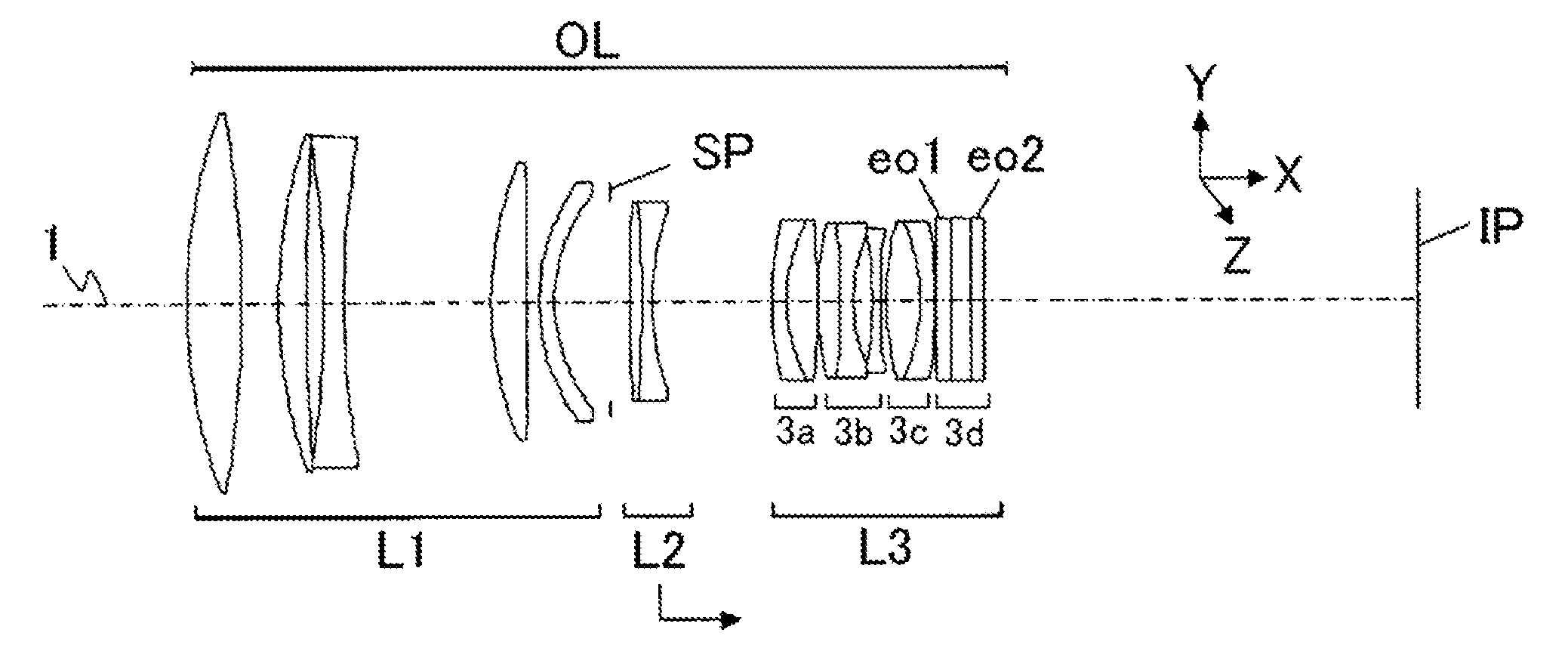
In Embodiment 1 described with reference to FIG. 2, an optical system OL is a telephoto lens having a focal length of 294 mm. In the optical system OL, a second lens unit L2 is a focus lens unit, which moves to an image side to perform a focus operation when an object distance decreases. A third lens unit L3 includes a first lens component 3a and a third lens component 3c which are fixed (do not move) in performing a focus operation and an anti-shake operation, and an anti-shake lens unit 3b which shifts in a direction orthogonal to an optical axis 1 in performing the anti-shake operation. The third lens unit L3 includes an anti-shake electro-optic element unit 3d which is constituted by electro-optic elements eo1 and eo2.
The anti-shake lens unit 3b is mainly used for reducing or correcting an image blur caused by a shake in a low-frequency range. The anti-shake electro-optic element unit 3d is mainly used for reducing an image blur caused by a shake in a high-frequency range. Thus,...
embodiment 2
In Embodiment 2 described with reference to FIG. 5, an optical system OL is a telephoto lens having a focal length of 294 mm. The optical system OL, basically, has the same configuration as that of the optical system of Embodiment 1. A third lens unit L3 includes an anti-shake electro-optic element unit 3d containing electro-optic elements eo1 and eo2.
FIG. 6A, as described above, illustrates a lateral aberration diagram of the optical system OL of the present embodiment in a reference state where there is no image blur. FIGS. 6B and 6C illustrate lateral aberration diagrams when the anti-shake operation is performed by the anti-shake electro-optic element unit 3d while a shake (a rotational shake of 0.03 degree) causing image blurs of y=−0.1 mm in a Y direction and z=−0.1 mm in a Z direction respectively is generated in the optical apparatus.
Also in the present embodiment, the KTN crystal is used as electro-optic elements eo1 and eo2 of the anti-shake electro-optic element unit 3d. ...
embodiment 3
In Embodiment 3 described with reference to FIG. 8, an optical system OL is a zoom lens having a focal length which changes between 6 mm and 96.5 mm. The optical system OL, in order from an object side, includes a first lens unit L1 having a positive refractive power, a second lens unit L2 having a negative refractive power, a third lens unit L3 having a positive refractive power, and a fourth lens unit L4 having a positive refractive power.
As indicated by arrows in FIG. 8, in a zoom operation from a wide-angle end to a telephoto end, the first lens unit L1 moves with a convex trajectory to an image side, and the second lens unit L2 moves to the image side. The third lens unit L3 moves to an object side, and the fourth lens unit L4 moves with a convex trajectory to the object side.
The fourth lens unit L4 is a focus lens unit, which moves to the object side for performing a focus operation when an object distance becomes short.
The third lens unit L3 includes an anti-shake lens unit 3...
PUM
 Login to View More
 Abstract
Description
Claims
Application Information
 Login to View More