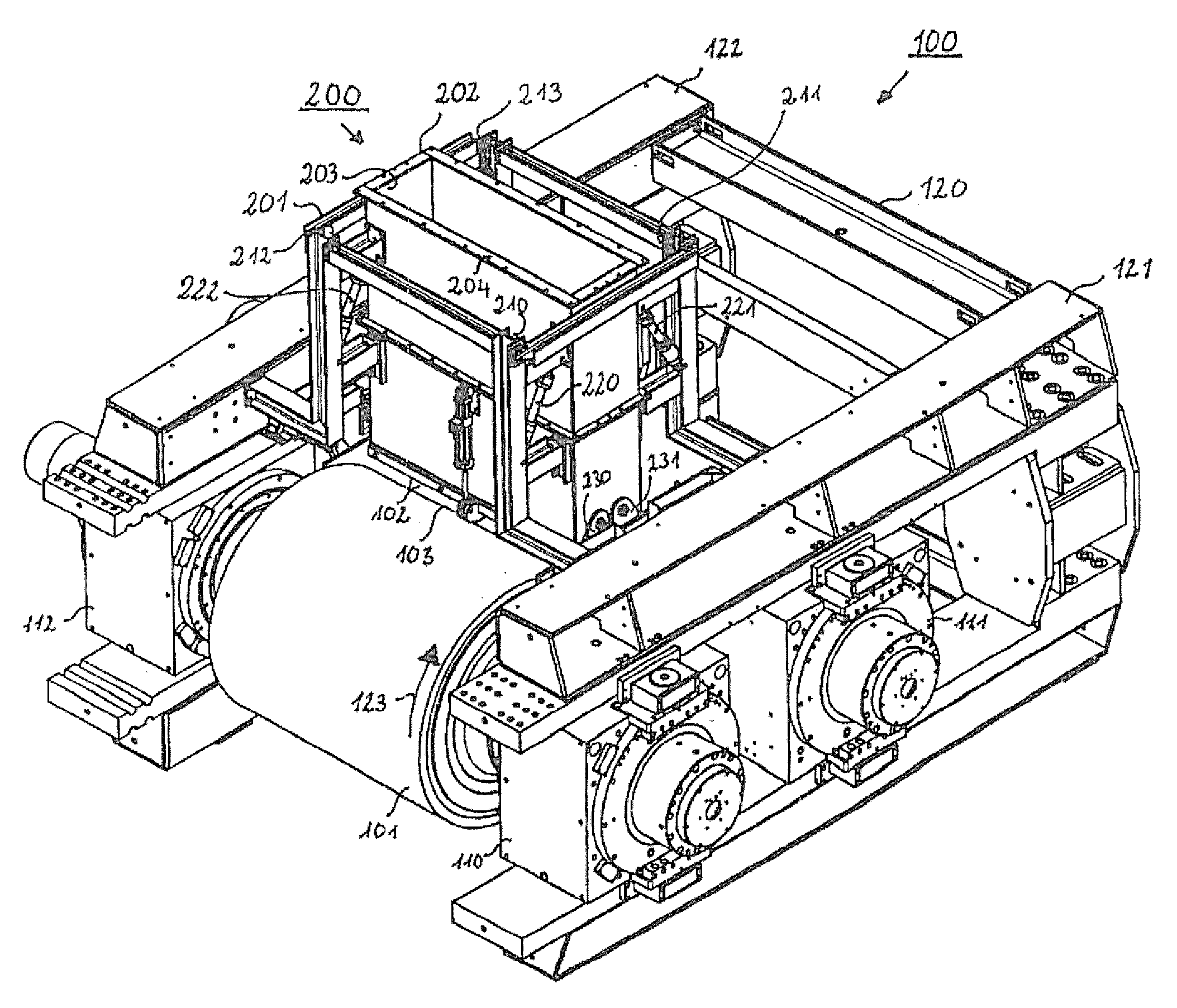
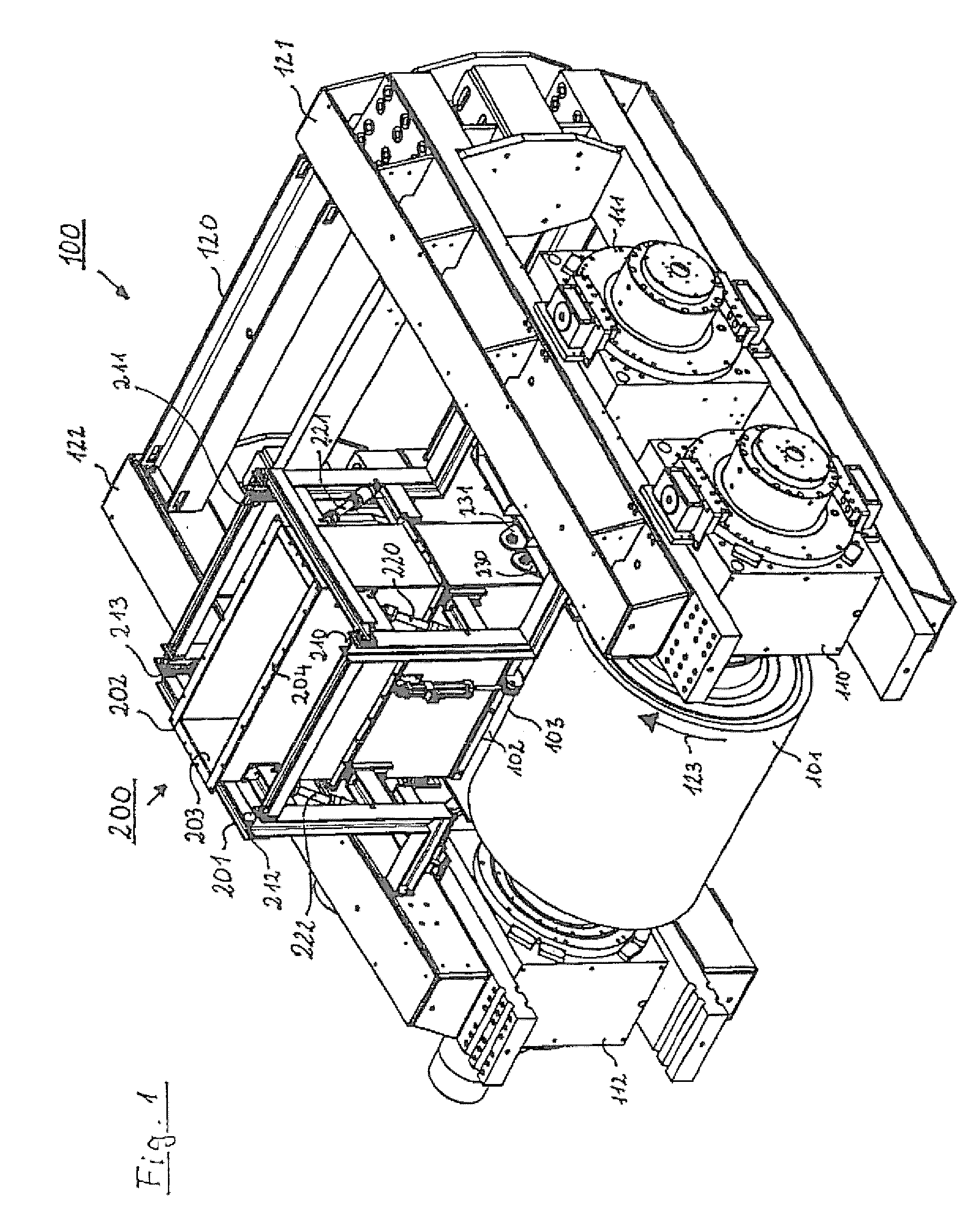
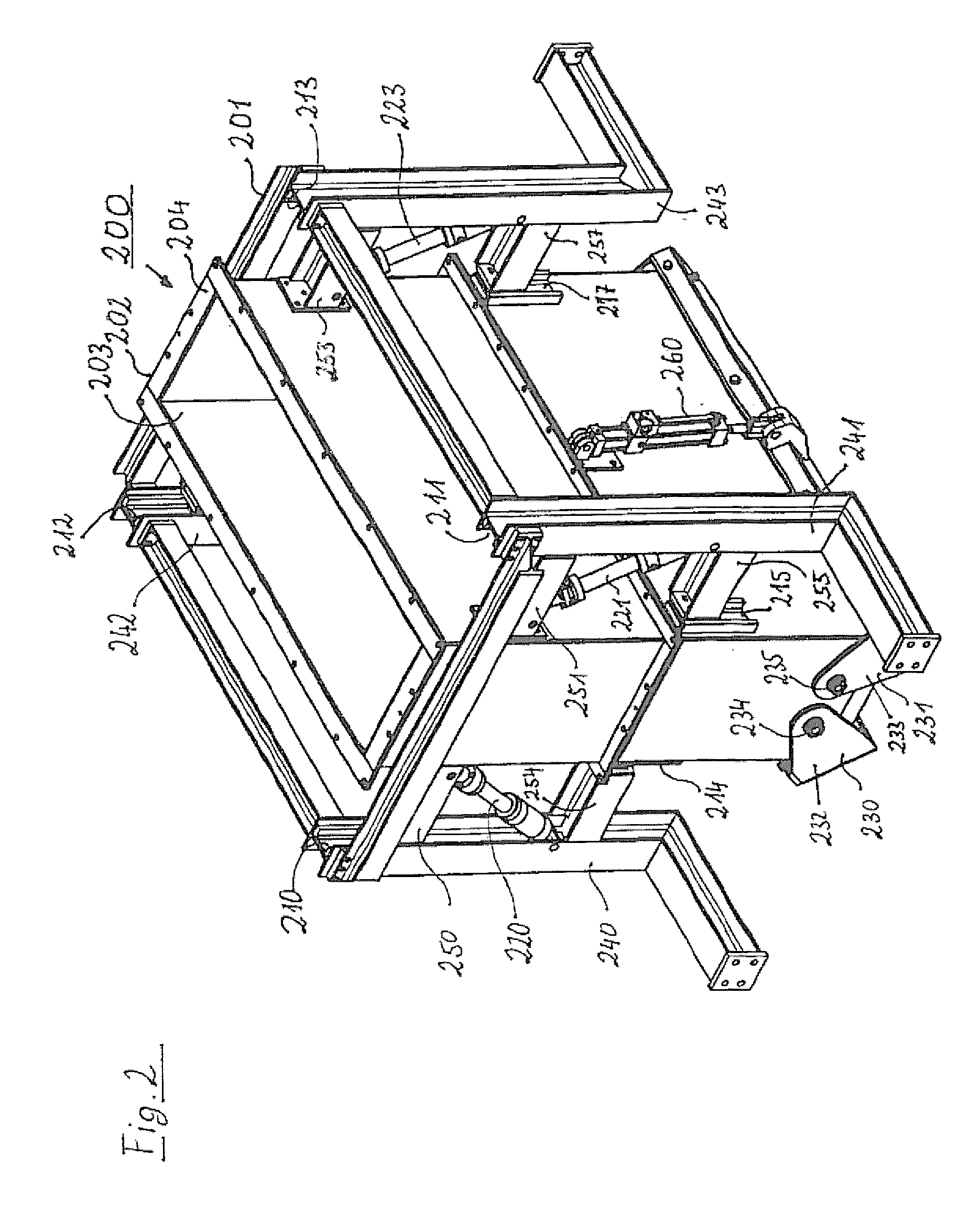
[0007]The object of the invention is to improve the function of the feed device in terms of the feed characteristics of the high-pressure roller press in its entirety and in terms of an even distribution of the drive power to different drive motors of the high-pressure roller press.
[0009]Through the presence of at least two rotary valves, the feed device according to the invention allows
adaptation to the varying requirements associated with the changing material properties of the feed material. It is thus possible to open and close the two rotary valves in symmetry in order thus to deliver a specific average total quantity per
unit of time to the high-pressure roller press. Apart from this pure metering function, as a result of uniform opening around the center point of the feed device centrally above the roller nip of the high-pressure roller press, it is also possible to set the two rotary valves such that the center of opening between the at least two rotary valves is not arranged over the center of the roller nip, but is laterally offset thereto. It is hereby possible to vary not only the feed quantity, but also the exact
delivery location. Specifically when the high-pressure roller press is started, this adjustment facility makes it easier to quickly reach the optimal operating state of the high-pressure roller press.
[0010]In one embodiment of the invention it is provided that the rotary valves are disposed on a shaft which is variable in height above the roller nip. The height-variability of the shaft, and hence also of the rotary valves, allows the bulk material cone leaving the feed device to be altered, within the limits of the natural bulk material cone that is predefined by the material properties of the feed material, on the one hand, by the mechanical movement of the bulk material cone from below and, on the other hand, by the rotating rollers of the high-pressure roller press. This variation facility, too, offers operating staff the opportunity to configure the optimal bulk material cone over the roller nip, so that a low-vibration operation with minimum possible
energy consumption is possible.
[0011]In order to protect the shaft from excessive abrasion by ores or by non-comminuted
cement clinker, in a further embodiment of the invention it is provided that the shaft is provided with an exchangeable inner lining as an abrasion protection. If the abrasion protection is eroded during operation, then the inner lining, which the lining and shaft lie one inside the other like two stacked together shafts, can be exchanged with comparatively little effort, and thus the shaft, which in addition to its shaft function must also deflect mechanical forces, can be protected from destruction.
[0012]According to the invention, the rotary valves are adjustable by means of a hydraulic
system. Although it is also possible to choose another type of drive, hydraulic operation has proved advantageous because it is robust enough to withstand the rough conditions associated with the grinding of brittle material. It is here provided that the hydraulic
system acts on one side upon the
rotary valve, and with the other side of the telescopic hydraulic
system upon the shaft, which shaft can be varied in height above the roller nip. Insofar as the supply lines for the hydraulic systems are long enough and flexible, it is possible to raise and lower the shaft which is variable in height above the roller nip, in which case the hydraulic systems for the opening and closure of the rotary valves travel along with the shaft.
[0016]Since the shaft is raised and relowered within the rack system by the hydraulic system, it is advantageous if the shaft is supported by a linear bearing within the rack system and, when raised and relowered, slides up and down within the linear bearing. The linear bearing consists in its simplest form of a U-profile, which is disposed on the shaft with its opening facing outward and in which a horizontal stay reaching from the rack system to the linear bearing engages; the stay is here fixedly connected to the rack system. The converse arrangement, too, is possible, in which the stay is fastened to the shaft and engages in a linear bearing on the rack system.