
Methods, systems and compositions involved in the synthesis of nonstable compounds
- Summary
- Abstract
- Description
- Claims
- Application Information
AI Technical Summary
Benefits of technology
Problems solved by technology
Method used
Image

Examples
example 1
Degradation of Ferrate
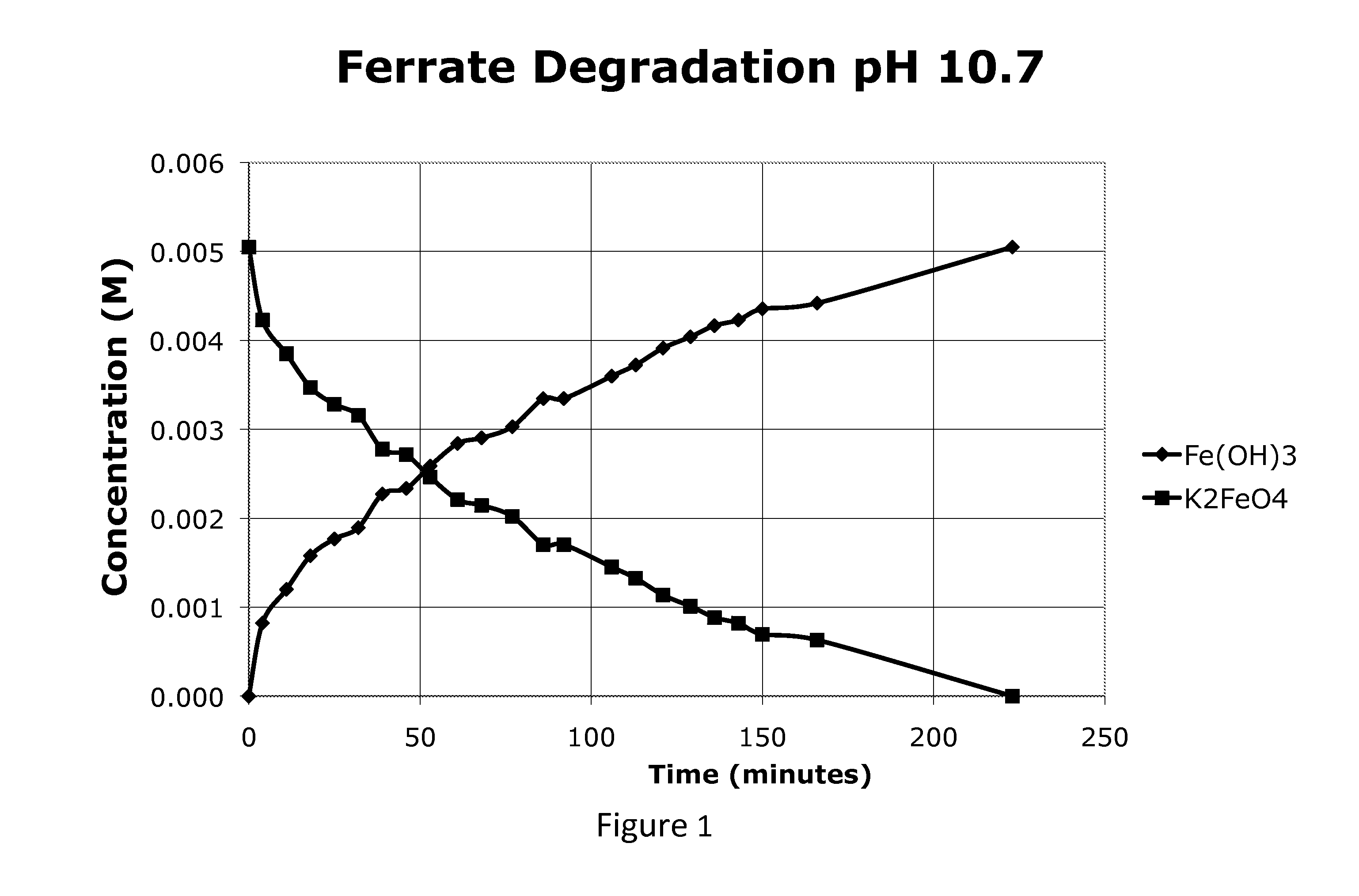
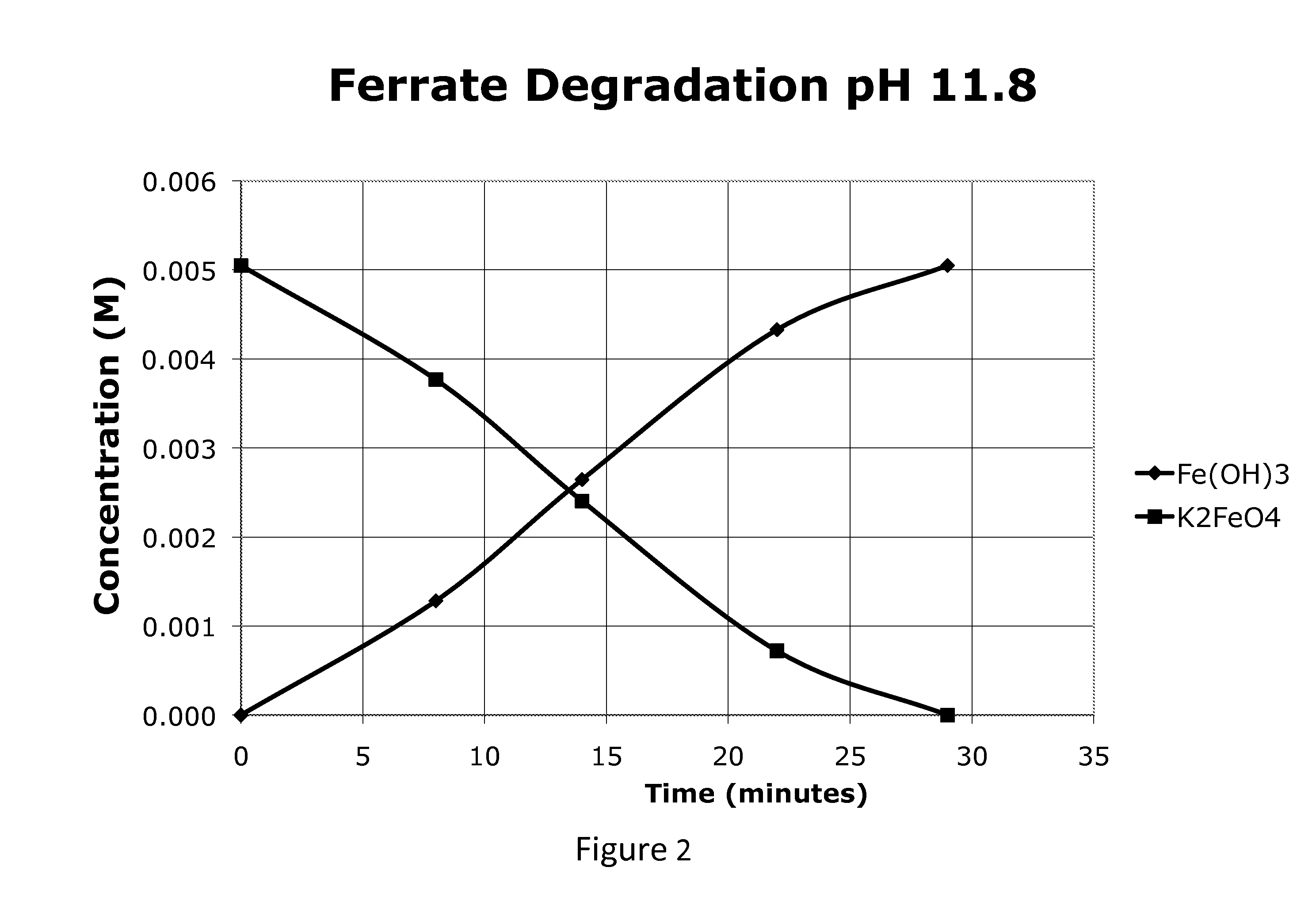
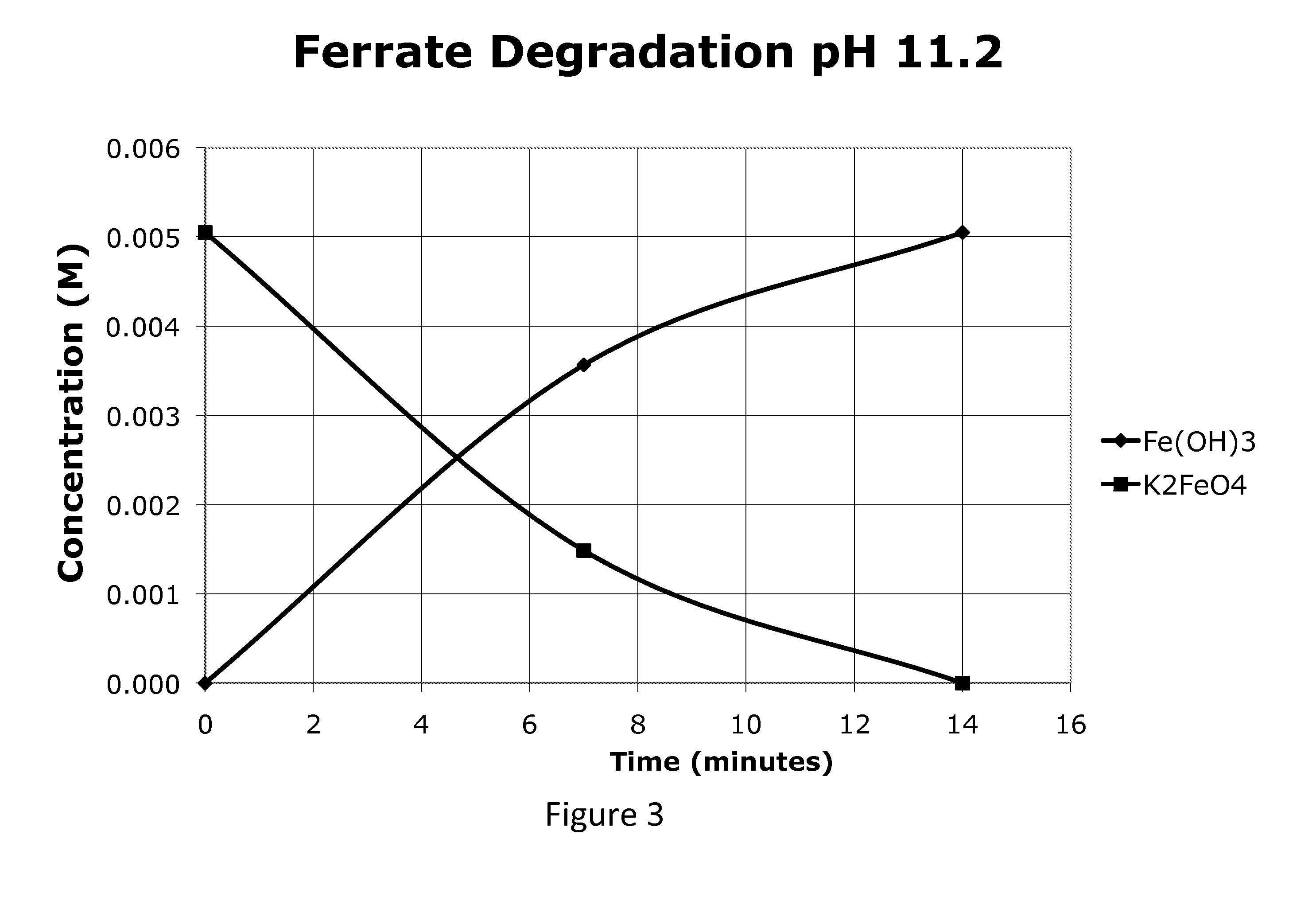
[0081]FIG. 1 is a profile of the ferrate concentration starting at 0.1% (5 mM) at the native pH of K2FeO4, about 10.7. As seen in FIG. 1 the ferrate was present in the solution for about 220 minutes. FIGS. 2 and 3 show the ferrate degrading faster at the higher pH's recommended by the Ciampi et al patent(s). Within about 21-46 minutes in the range of pH 11.2-11.8 the ferrate completely degraded. At this higher pH the Fe(OH)3 forms much faster and contributes to the acceleration in degradation.
[0082]FIG. 4 discloses a slightly lower pH of 10.4 which was buffered to approximately pH 9 with NaOH. Ferrate was detected in the solution for about four hours.
example 2
Preparation of Sodium Ferrate
[0083]Sodium ferrate was produced as follows:
[0084]A solution which contained 164 grams of a 12.5% solution of sodium hypochlorite was added to 530 grams of water. The sodium hypochlorite solution was mixed with the water followed by the addition of 240 grams of 50% sodium hydroxide solution at a rate to keep the temperature of the reaction below 30° C. After the addition of all the sodium hydroxide was completed, this mixture can be stored for later use or can be used for further reactions.
[0085]When further reactions were desired 66.7 grams of a 45% solution of ferric chloride was added to the hypochlorite—sodium hydroxide mixture in a reaction tank. The reaction was stirred and continuously monitored by UV-VIS for the production of ferrate and separately monitored to determine when there was no residual hypochlorite. The reaction took approximately 90 minutes with a yield of 25,000 ppm of ferrate measured as potassium ferrate. After the sodium ferrate...
example 3
Phosphate Stabilization
[0087]Addition of phosphate will stabilize the ferrate solution held in the storage tank to allow the solution to be held for extended holding periods. The addition of a 1:4 mixture of 0.05 M KH2PO4 to 0.05 M K2HPO4 was added to the diluted ferrate solution from Example 2. Stabilization was also obtained with a 1:19 mixture of the same components. The results indicated that with phosphate added the pH of the storage solution was no longer critical which gives more latitude for production and / or storage. For those cases where the pH of the system is required to be lower for a treatment application, phosphoric acid can be used to for stabilization and for addition to the treatment water.
PUM
 Login to View More
 Abstract
Description
Claims
Application Information
 Login to View More